
Water Blinks
Montia fontana
A cosmopolitan, amphibious annual or perennial herb that thrives in cool, non-calcareous freshwater springs and …
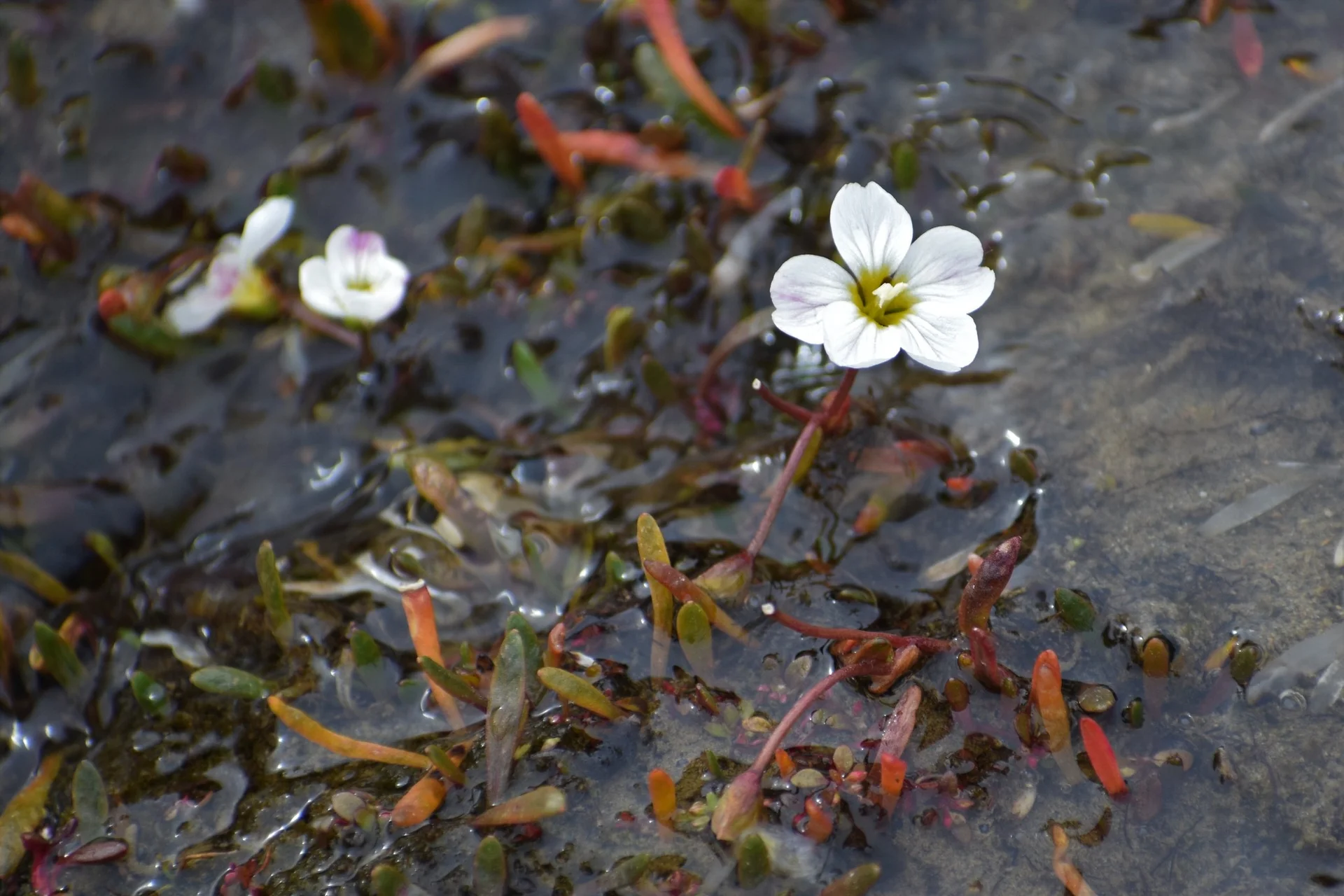
Montia bostockii is a low-growing perennial herb that forms loose mats along cold alpine streams and wet mossy depressions in northwestern North America. Its specific epithet honors Hugh Samuel Bostock, a Canadian geologist who collected the type specimen in the Yukon Territory while mapping remote mountain ranges.
First described in 1943 by botanist AE Porsild as Claytonia bostockii, the species was later transferred to the genus Montia by Stanley Larson Welsh in 1968. Noticeably distinct from many annual relatives, it persists through harsh subarctic winters via slender, creeping underground stems.
Unlike many ephemeral relatives in the genus Montia, this species is a true perennial that spreads through slender, branching rhizomes—horizontal underground stems that root at the nodes. The aerial flowering stems are weak, decumbent to ascending, and typically reach only 5 to 15 centimeters in height.
The leaves are somewhat succulent, glabrous (completely smooth), and arranged both in loose basal tufts and alternately along the lower stems. They have narrow, spatulate to oblanceolate blades that taper gradually into the petiole, measuring 1 to 4 centimeters long.
Summer (June to August during the brief subarctic and alpine melt season)
High-latitude alpine environments offer an extraordinarily brief summer window where cold, sleet, and sudden freezes can interrupt pollinator flights for days at a time. To survive where annual seed production is a gamble, Montia bostockii relies on a dual reproductive strategy built around its creeping rhizome network.
These delicate stolon-like runners weave directly through saturated mats of Sphagnum and brown mosses fed by melting permafrost and snowbeds. Because the moss layer insulates the soil against extreme thermal swings while providing constant cold moisture, each rooting node can establish an independent clone even in summers when not a single seed matures.
Taxon Synonyms: Montiastrum bostockii, Claytonia bostockii
Montia fontana
A cosmopolitan, amphibious annual or perennial herb that thrives in cool, non-calcareous freshwater springs and …

Montia parvifolia
A mat-forming, slightly succulent perennial herb native to moist cliffs and mossy streambanks of western …

Montia angustifolia
A low-growing, mat-forming perennial herb endemic to the damp montane and alpine habitats of New …

Montia howellii
A tiny, low-growing annual herb of the Pacific Northwest that completes its entire life cycle …