
Montia sessiliflora
Montia sessiliflora
A compact, cushion-forming alpine perennial endemic to New Zealand, named for its sessile flowers that …
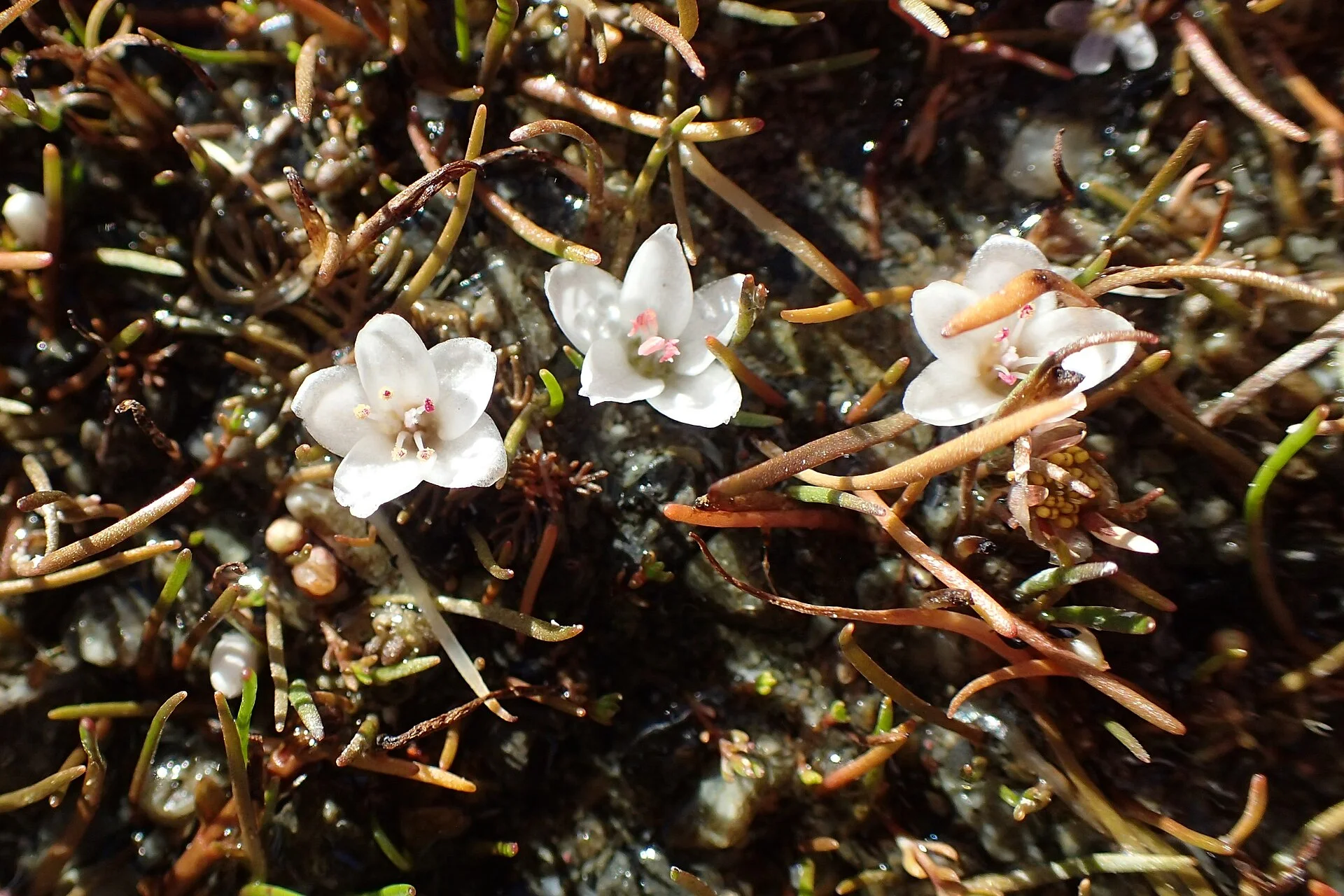
Montia angustifolia is a compact, mat-forming perennial herb native to the damp, frost-swept mountain valleys and lake margins of New Zealand's South Island. Its specific epithet angustifolia comes from the Latin words for "narrow" and "leaf", referring to the slender, fleshy, grass-like blades that weave into dense ground-hugging cushions.
This resilient alpine plant belongs to the family Montiaceae. Originally described by New Zealand botanist Peter B. Heenan in 1999 under the name Neopaxia linearifolia, it was transferred by Heenan to the genus Montia in 2007 under the replacement name Montia angustifolia because the combination Montia linearifolia was already occupied by another species.
The plant forms tight, prostrate mats or low cushions that spread across damp gravel, silt, and turf. Its slender, creeping stems root readily at the nodes (the points where leaves attach), anchoring the plant firmly against frost heave and mountain runoff.
Late spring to summer in the Southern Hemisphere (November to February)
Although not traded in mainstream commercial horticulture, Montia angustifolia is cultivated in specialized alpine plant houses and botanical garden rockeries, such as the collections documented in European and New Zealand botanical institutions.
In scientific collections, it serves as a living reference specimen for studying southern hemisphere island endemism and the evolutionary radiation of alpine cushion plants in the family Montiaceae.
Surviving along high-country tarns (mountain lakes) and seepage zones on New Zealand's South Island requires a delicate balance between water access and frost protection. The ground freezes and thaws repeatedly, creating mechanical movement in the soil that would tear apart ordinary root systems.
Taxon Synonyms: Neopaxia linearifolia
Montia sessiliflora
A compact, cushion-forming alpine perennial endemic to New Zealand, named for its sessile flowers that …

Montia racemosa
A fleshy, creeping perennial herb endemic to the South Island of New Zealand, notable for …

Montia campylostigma
A prostrate, mat-forming perennial herb endemic to the high-altitude habitats of New Zealand's South Island, …

Montia australasica
A creeping, mat-forming perennial herb native to southeastern Australia and Tasmania, bearing succulent linear leaves …