
Narrow-leaved montia
Montia angustifolia
A low-growing, mat-forming perennial herb endemic to the damp montane and alpine habitats of New …
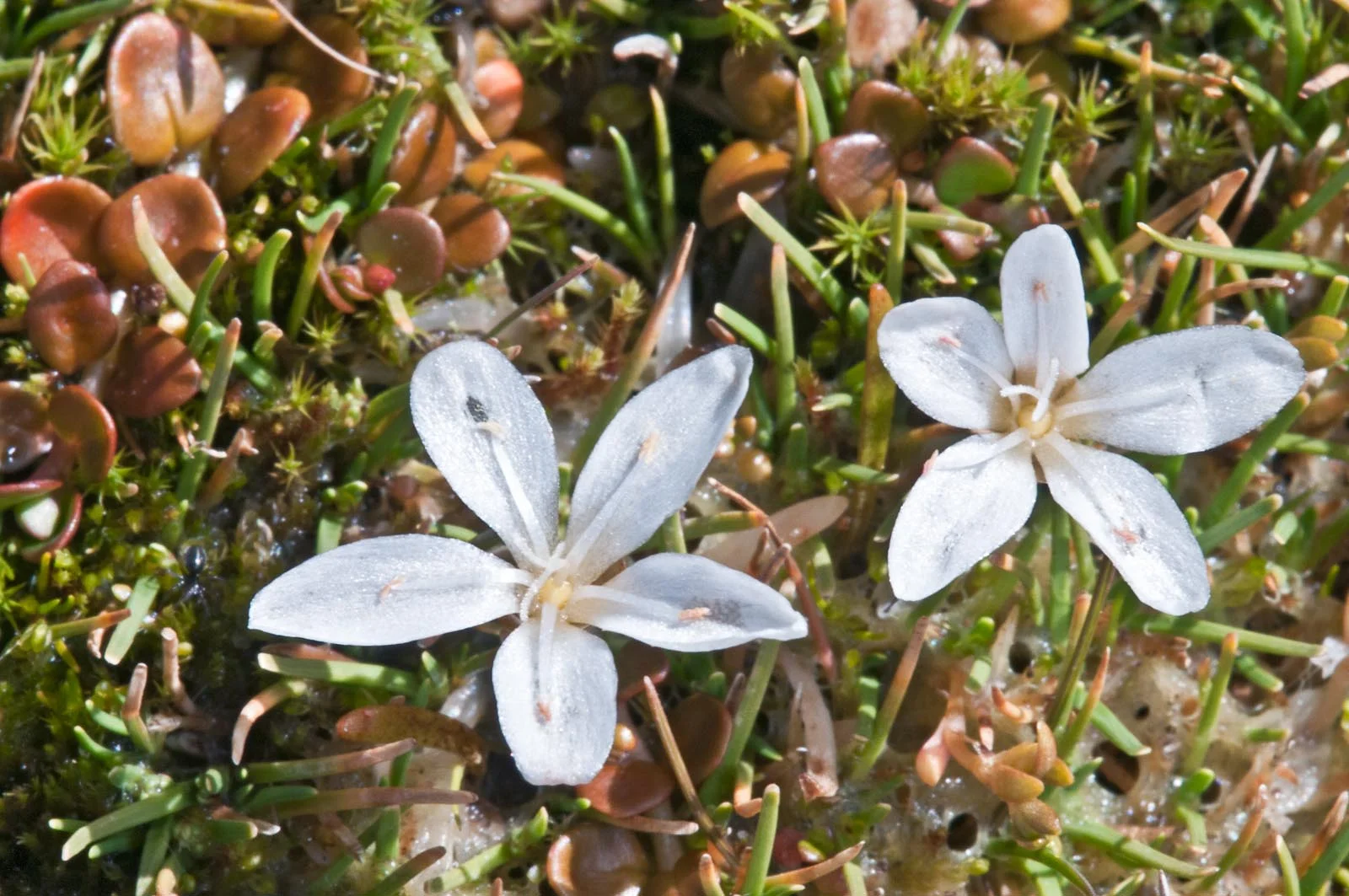
Montia campylostigma is a low-growing, mat-forming perennial herb native to the damp subalpine and alpine zones of New Zealand's South Island. Its specific epithet comes from the Greek words for 'curved' and 'stigma', highlighting the distinctively recurved, hook-like stigmatic branches that sit at the heart of its small white or pale pink flowers.
Belonging to the family Montiaceae, this species was originally described by New Zealand botanist Peter B. Heenan in 1999 under the name Neopaxia campylostigma. In 2007, following molecular and morphological revisions of the genus, Heenan transferred the species to Montia, establishing its currently accepted scientific name.
This herbaceous perennial develops creeping, slender stems that root readily at the nodes—the structural joints where leaves emerge—to weave dense, low-lying mats across moist ground. The prostrate shoots remain pressed against the substrate, helping the plant resist icy mountain winds and frost heave.
The leaves are narrow, linear to spathulate (spoon-shaped), and noticeably fleshy, storing water inside specialized internal parenchyma cells. Each leaf base widens into a thin, membranous sheath that clasps the stem and protects the developing axillary buds.
November to February (Austral late spring to summer)
In the exposed mountain flushes and snowbanks of the South Island, clear weather windows for insect activity are brief and unpredictable. The strongly curved stigmas referenced in the name Montia campylostigma are not an arbitrary shape, but a finely calibrated floral geometry.
Every proportion of the short style, stamen filament length, and stigma curvature operates in tight coordination, allowing this delicate herb to reproduce consistently in one of New Zealand's harshest mountain environments.
Taxon Synonyms: Neopaxia campylostigma
Montia angustifolia
A low-growing, mat-forming perennial herb endemic to the damp montane and alpine habitats of New …

Montia sessiliflora
A compact, cushion-forming alpine perennial endemic to New Zealand, named for its sessile flowers that …

Montia racemosa
A fleshy, creeping perennial herb endemic to the South Island of New Zealand, notable for …

Montia australasica
A creeping, mat-forming perennial herb native to southeastern Australia and Tasmania, bearing succulent linear leaves …