
Narrow-leaved montia
Montia angustifolia
A low-growing, mat-forming perennial herb endemic to the damp montane and alpine habitats of New …
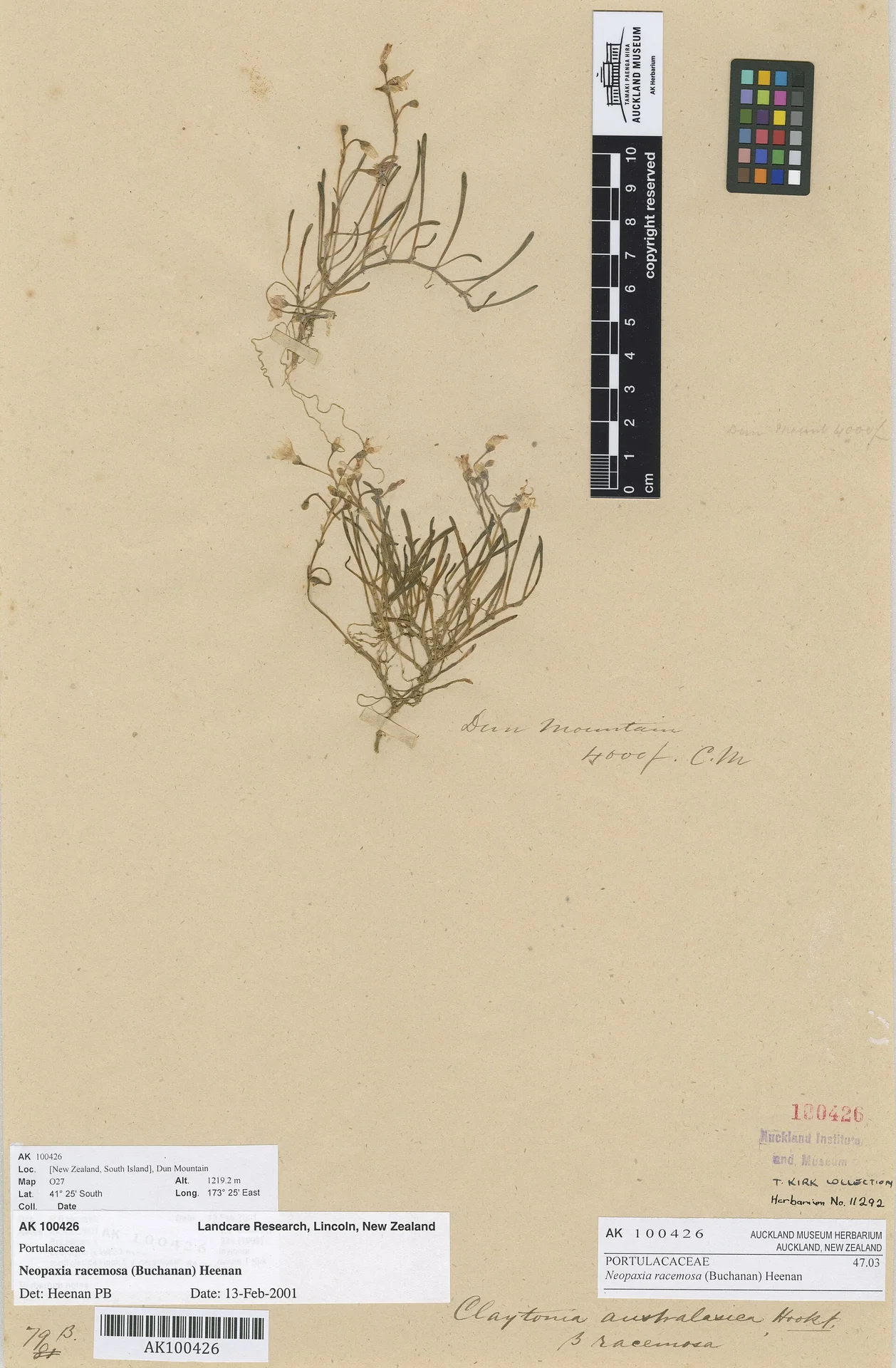
Montia racemosa is a creeping, succulent-leaved perennial herb endemic to the eastern and southern mountains of New Zealand's South Island. Its specific epithet racemosa refers to its elongated, raceme-like inflorescences—unbranched flower stalks where individual blossoms open sequentially along a central axis, setting it apart from solitary-flowered relatives.
A member of the family Montiaceae, the plant was first described in 1871 by Scottish-New Zealand botanist John Buchanan as a variety of Claytonia australasica. Peter B. Heenan elevated it to species rank within Neopaxia in 1999 before transferring it to Montia racemosa in 2007.
The plant spreads via glabrous (smooth and hairless) prostrate stems that root from the nodes to anchor firmly in shifting wet gravel and silt. These horizontal runners form loose to compact patches that hug the damp substrate.
Its alternate or tufted leaves are fleshy, narrow-linear to club-shaped, and tinted green to reddish-brown when exposed to intense mountain ultraviolet light. The succulent tissue acts as an internal water reservoir and buffer against sudden temperature drops.
November to February (Austral late spring to summer)
While most high-country species in the Claytonia australasica complex keep their solitary flowers tucked low among the leaves, Montia racemosa invests energy in building an elongated, multi-flowered stalk. This architectural shift is closely matched to the microclimates of damp tarn margins, seepages, and stony stream beds.
The combination of elevated, staggered flowering and mechanical seed ejection shows a finely balanced reproductive schedule tailored to dynamic alpine wetlands.
Taxon Synonyms: Neopaxia racemosa, Claytonia australasica var. racemosa
Montia angustifolia
A low-growing, mat-forming perennial herb endemic to the damp montane and alpine habitats of New …

Montia sessiliflora
A compact, cushion-forming alpine perennial endemic to New Zealand, named for its sessile flowers that …

Montia campylostigma
A prostrate, mat-forming perennial herb endemic to the high-altitude habitats of New Zealand's South Island, …

Montia australasica
A creeping, mat-forming perennial herb native to southeastern Australia and Tasmania, bearing succulent linear leaves …