
Narrow-leaved montia
Montia angustifolia
A low-growing, mat-forming perennial herb endemic to the damp montane and alpine habitats of New …
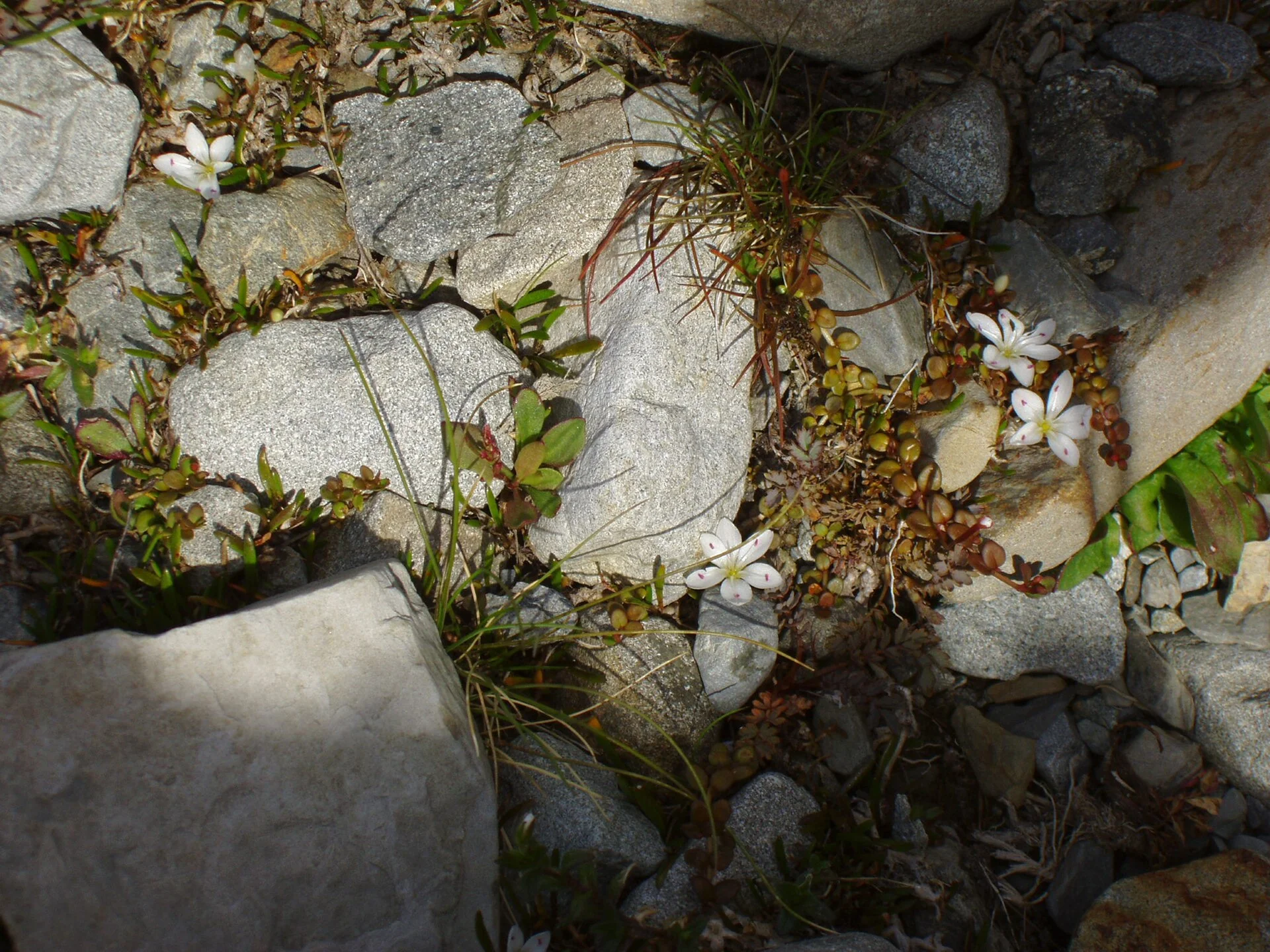
Montia sessiliflora is a compact, turf-forming perennial herb native to the high-altitude wetlands, tarn edges, and snowbank hollows of New Zealand's South Island. Its Latin epithet sessiliflora means 'sessile-flowered', referring to the way its solitary blossoms sit directly among the leaves on virtually non-existent stalks.
Classified in the family Montiaceae, the plant was first formally described in 1952 by New Zealand botanist George Simpson as Claytonia australasica var. sessiliflora. Peter B. Heenan raised it to full species status in 1999 as Neopaxia sessiliflora and subsequently placed it into the genus Montia in 2007.
This species grows as a tightly woven, low-profile mat with short internodes—the stem segments between leaves—creating a dense carpet over saturated alpine soils. Slender adventitious roots emerge along the buried stems to lock the cushion into wet turf and gravel.
The leaves are short, thick, and fleshy, ranging from olive-green to deep bronze or reddish-purple due to protective anthocyanin pigments—natural cellular sunscreens that shield chlorophyll from intense alpine glare. Wide basal sheaths overlap tightly around the stems.
December to March (Austral summer to early autumn)
Where Montia racemosa raises its blossoms on elongated stalks, Montia sessiliflora takes the exact opposite approach by eliminating the flower stalk almost entirely. In the gale-swept alpine basins and late-melting snow hollows of the South Island, this structural reduction serves as a precise thermal adaptation.
This seamless integration of abbreviated flower stalks, heat-absorbing leaf pigments, and compact mat geometry allows the plant to bloom and set seed right at the edge of receding mountain snowfields.
Taxon Synonyms: Neopaxia sessiliflora, Claytonia australasica var. sessiliflora
Montia angustifolia
A low-growing, mat-forming perennial herb endemic to the damp montane and alpine habitats of New …

Montia racemosa
A fleshy, creeping perennial herb endemic to the South Island of New Zealand, notable for …

Montia campylostigma
A prostrate, mat-forming perennial herb endemic to the high-altitude habitats of New Zealand's South Island, …

Montia australasica
A creeping, mat-forming perennial herb native to southeastern Australia and Tasmania, bearing succulent linear leaves …