
Water Blinks
Montia fontana
A cosmopolitan, amphibious annual or perennial herb that thrives in cool, non-calcareous freshwater springs and …
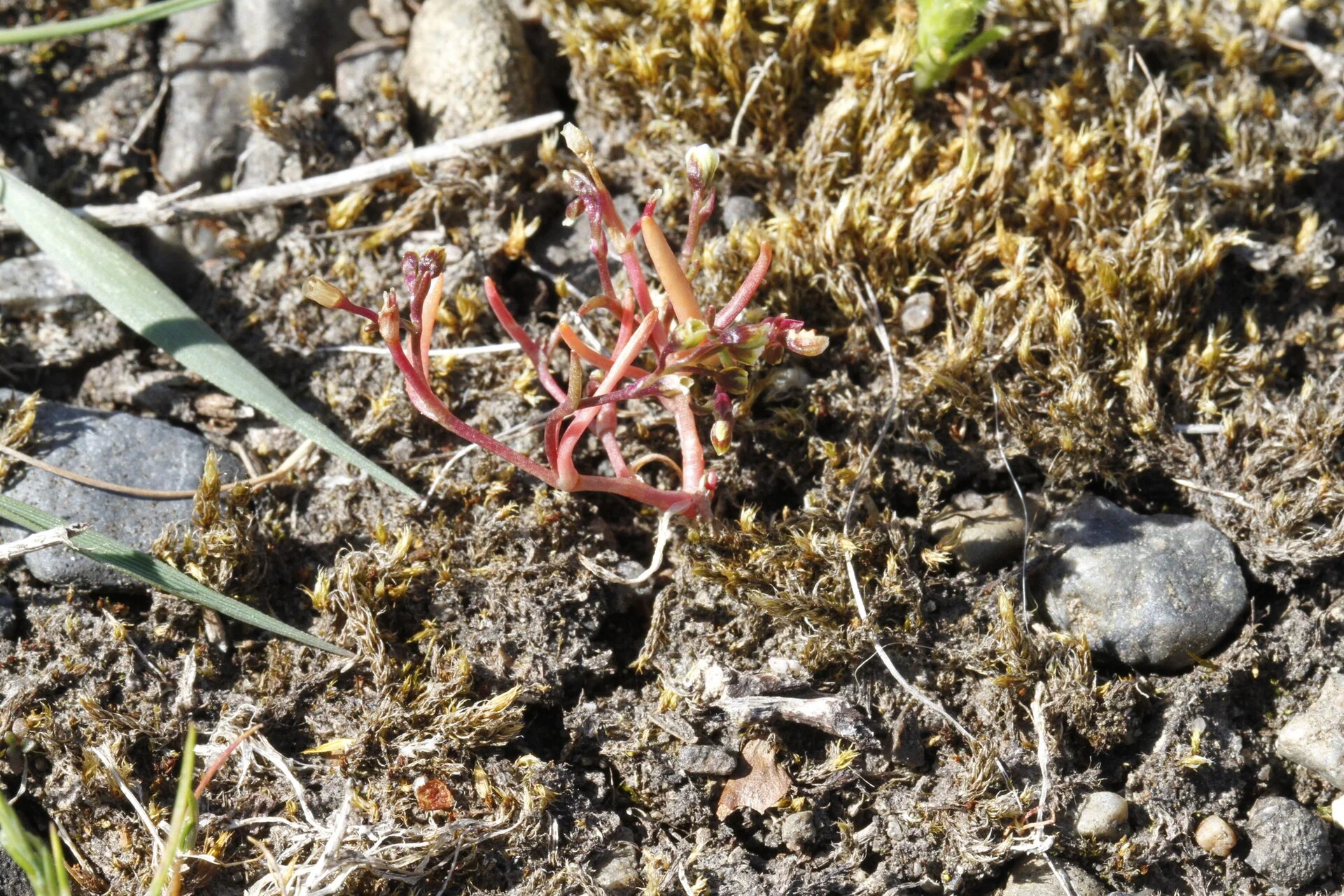
Montia dichotoma is a miniature, slightly succulent annual herb native to vernal pools, damp meadows, and mossy rock outcrops across western North America. Its specific epithet dichotoma comes from the Greek for 'divided in two,' referring to the neat, repeated Y-shaped forking of its slender stems.
First described in 1833 as Claytonia dichotoma by Thomas Nuttall and later transferred to the genus Montia by Thomas Jefferson Howell in 1893, this diminutive species is recognized as an accepted taxon in modern botanical databases.
Rarely exceeding two toeight centimeters in height, this tiny annual often grows in dense, reddish-green tufts that easily blend into damp moss. Its compact architecture is built for rapid growth in seasonally wet soils.
March to June
Because Montia dichotoma inhabits shallow vernal pools and winter-wet seepage slopes that bake bone-dry by early summer, every aspect of its miniature body works like a precision timepiece.
The combination of low-friction seed coats and inward-snapping capsule valves works like a miniature mechanical spring, ensuring seeds land in fresh micro-depressions before summer drought arrives.
Taxon Synonyms: Claytonia linearis var. dichotoma, Montiastrum dichotomum, Claytonia dichotoma
Montia fontana
A cosmopolitan, amphibious annual or perennial herb that thrives in cool, non-calcareous freshwater springs and …

Montia parvifolia
A mat-forming, slightly succulent perennial herb native to moist cliffs and mossy streambanks of western …

Montia angustifolia
A low-growing, mat-forming perennial herb endemic to the damp montane and alpine habitats of New …

Montia howellii
A tiny, low-growing annual herb of the Pacific Northwest that completes its entire life cycle …