
Water Blinks
Montia fontana
A cosmopolitan, amphibious annual or perennial herb that thrives in cool, non-calcareous freshwater springs and …
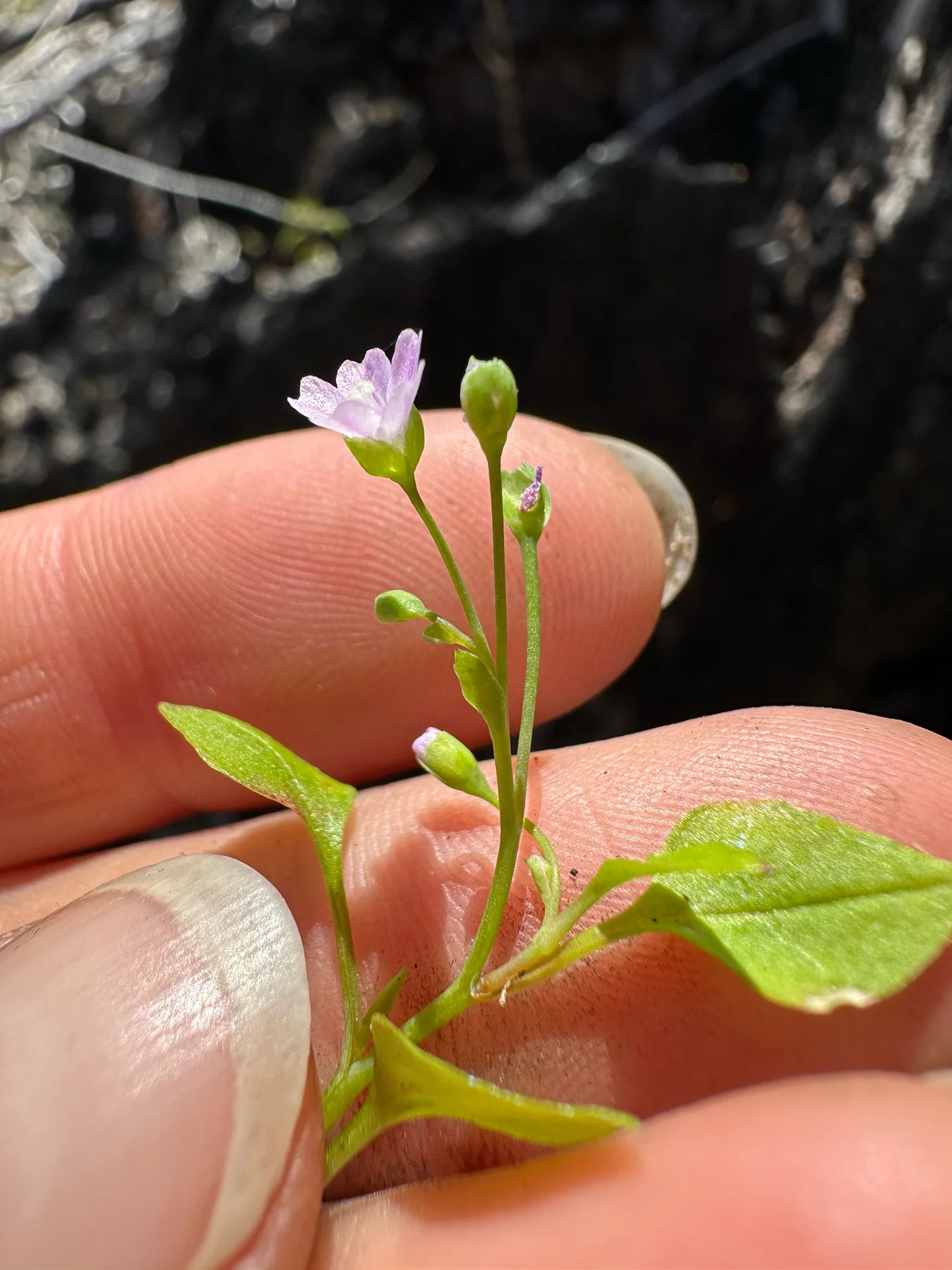
Montia diffusa, known as branching montia, is a graceful, loosely spreading annual herb native to moist coniferous forests across western North America. Its specific epithet, diffusa, comes from the Latin for "spread out" or "widely branching," capturing the airy, forked architecture of its stems as they weave across damp forest litter.
Originally collected along the lower Columbia River by David Douglas and described by Thomas Nuttall in 1838 as Claytonia diffusa, the species was transferred to the genus Montia by Edward Lee Greene in 1891, where it remains distinct for its broad, alternate stem leaves.
Unlike relatives whose stem leaves fuse into a single saucer-like disk around the stalk, Montia diffusa bears several distinctly alternate leaves all along its branching, 5- to 25-centimeter stems. The lower leaves have long petioles and deltoid-ovate to spoon-shaped blades up to 3 centimeters wide, often tinged with bronze or reddish tones in bright light.
Slender, leafy-bracted racemes arise from both the stem tips and upper leaf axils, carrying 3 to 12 small flowers on arching pedicels. The five white or pale pink petals measure 3 to 5 millimeters long and surround a capsule whose black seeds are covered with a fine, woven pattern of flattened cells.
Spring to early summer (April to July)
In mature, deeply shaded Douglas-fir and redwood forests, Montia diffusa can seem entirely absent for decades at a time, yet thousands of its tiny black seeds lie dormant beneath the duff. Laboratory and field studies of Pacific Northwest forest soils have revealed that these buried seeds remain viable for fifty years or more while waiting for a canopy opening.
When a forest fire or windthrow clears the overhead shade and gently warms the upper mineral soil, the thermal pulse breaks the dormancy of the seed coat. Within a single spring season, barren ash beds and sunny forest openings flush with branching mats of Montia diffusa, which rapidly flower, replenish the underground seed vault with fresh capsules, and peacefully retreat into dormancy as shrubs and young trees reclaim the canopy.
Montia fontana
A cosmopolitan, amphibious annual or perennial herb that thrives in cool, non-calcareous freshwater springs and …

Montia parvifolia
A mat-forming, slightly succulent perennial herb native to moist cliffs and mossy streambanks of western …

Montia angustifolia
A low-growing, mat-forming perennial herb endemic to the damp montane and alpine habitats of New …

Montia howellii
A tiny, low-growing annual herb of the Pacific Northwest that completes its entire life cycle …