
Water Blinks
Montia fontana
A cosmopolitan, amphibious annual or perennial herb that thrives in cool, non-calcareous freshwater springs and …
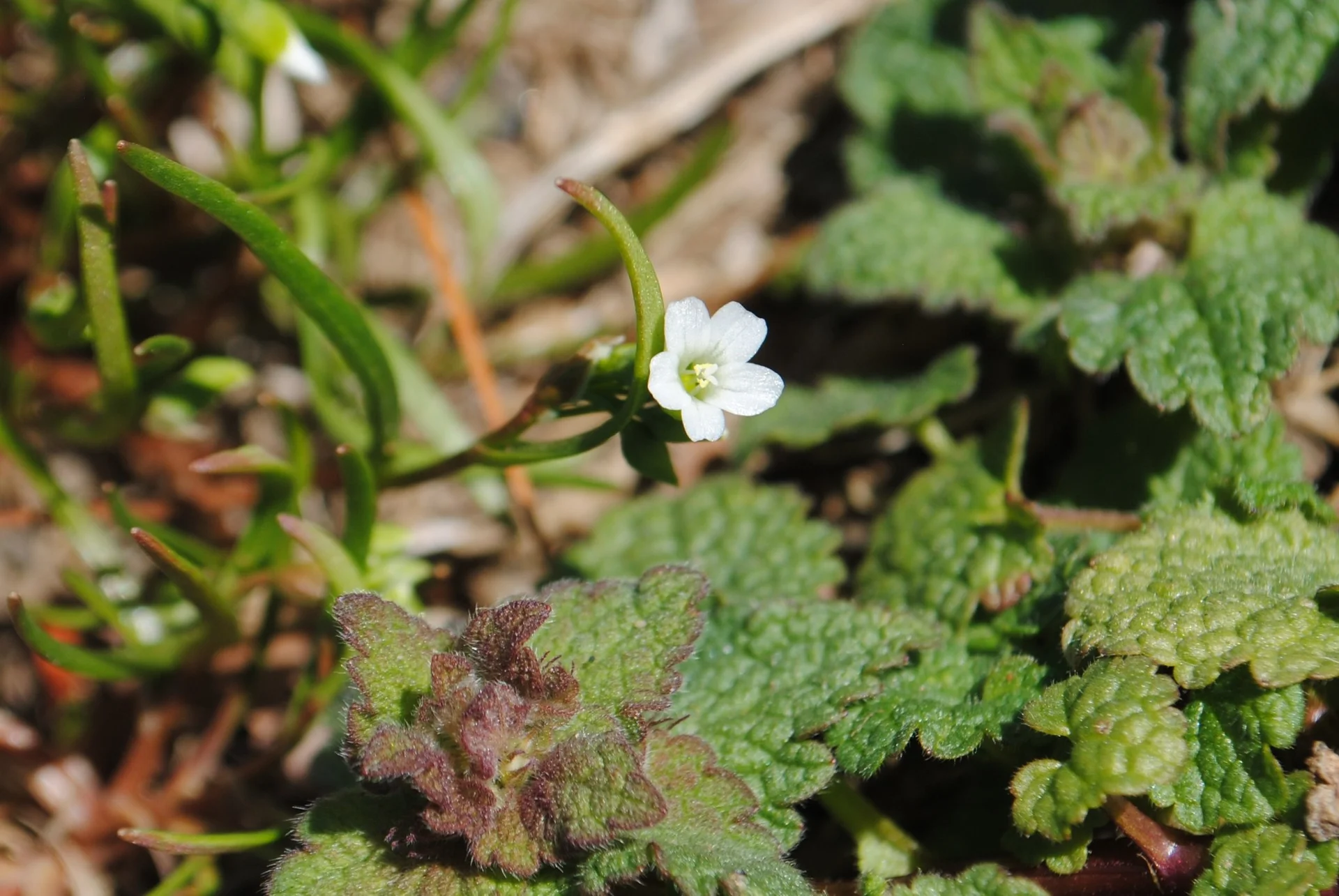
Montia linearis is a delicate, upright to sprawling annual herb native to vernally moist meadows, streambanks, and open slopes across western North America. Its specific epithet linearis is Latin for "linear," pointing directly to its narrow, grass-like leaves that easily distinguish it from broad-leaved relatives.
Originally described by David Douglas and William Jackson Hooker in 1832 under the name Claytonia linearis, this species was moved to the genus Montia by Edward Lee Greene in 1891. Throughout its wide range from British Columbia to California and the Rocky Mountains, it thrives in seasonal pools and damp sandy soils that dry out by summer.
Growing from a slender, fibrous taproot, Montia linearis produces one to several simple or branched stems that stand 5 to 30 centimeters tall. The stems are smooth, slightly succulent, and often tinged with reddish or pinkish pigment near the base when exposed to bright sunlight.
The leaves are arranged alternately along the stem, measuring 1.5 to 10 centimeters in length but rarely exceeding 1 to 2 millimeters in width. Each narrow, thread-like blade has a broadened, membranous base that clasps the stem slightly without forming a fused cup.
Spring to early summer (March to July, depending on elevation and latitude)
Although less bulky than its close garden relative Claytonia perfoliata, the tender young shoots and succulent linear leaves of Montia linearis are edible raw or lightly steamed as a mild spring green. In ecological restoration and native wildflower gardening across the Pacific Northwest, its seeds are occasionally included in vernal pool and wet meadow seed mixes to support early native pollinators and stabilize seasonal washes.
To escape strong competition in drying spring meadows, Montia linearis does not simply drop its seeds next to the parent plant. Instead, its fruit acts as a miniature mechanical catapult that launches mature seeds up to two meters away.
As the three-valved capsule dries under the late-spring sun, its papery walls contract inward and squeeze tightly against the smooth, lens-shaped black seeds. Once internal tension peaks, the valves split suddenly along their seams, and the slick, convex sides of the seed slip out under high pressure like a wet watermelon seed pinched between two fingers.
Taxon Synonyms: Claytonia linearis, Montiastrum lineare
Montia fontana
A cosmopolitan, amphibious annual or perennial herb that thrives in cool, non-calcareous freshwater springs and …

Montia parvifolia
A mat-forming, slightly succulent perennial herb native to moist cliffs and mossy streambanks of western …

Montia angustifolia
A low-growing, mat-forming perennial herb endemic to the damp montane and alpine habitats of New …

Montia howellii
A tiny, low-growing annual herb of the Pacific Northwest that completes its entire life cycle …