
Mexican Purslane
Portulaca mexicana
Portulaca mexicana is a low-growing succulent plant native to numerous states across Mexico. First described …
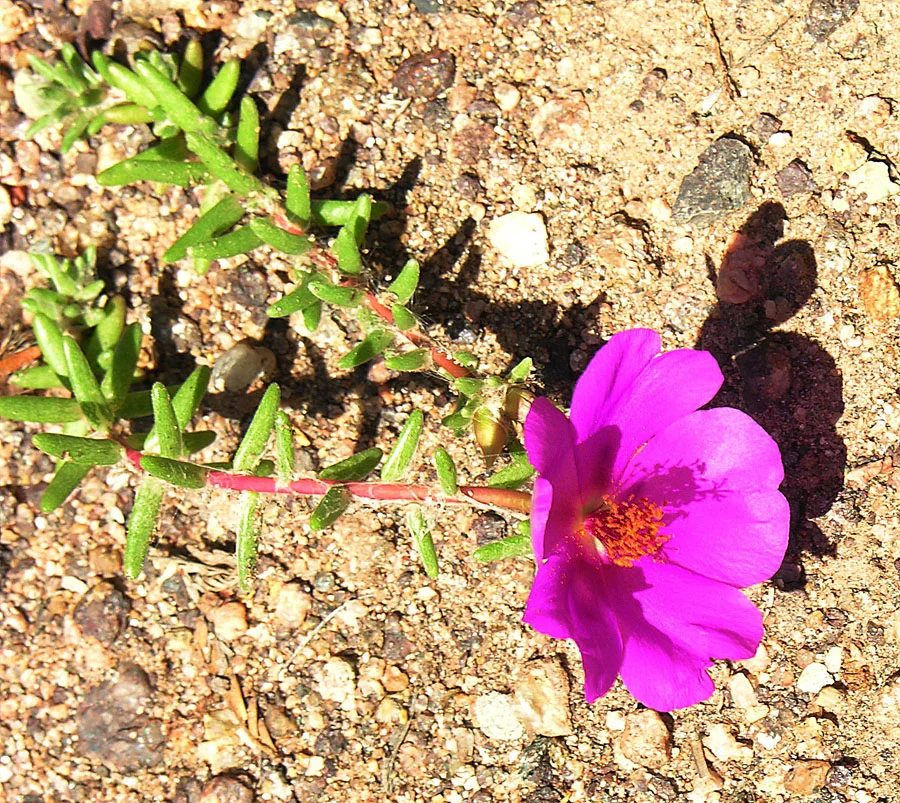
Originating from South America, Portulaca gilliesii has established itself as a resilient and adaptable succulent annual. It thrives in undisturbed sites such as roadsides and railway tracks, showing remarkable drought tolerance across various environments. The species has naturalized globally and is frequently encountered as a robust weed in agricultural settings.
In modern agriculture, this plant poses a significant challenge due to its adaptation to zero-tillage farming practices. It exhibits exceptional resistance to common systemic herbicides, forcing agronomists to develop specialized management strategies for crop protection.
Portulaca gilliesii develops smooth, fleshy, and predominantly prostrate reddish stems that can reach up to 30 centimeters in length. The stems feature distinctive axillary hairs and small branching structures. Its leaves are arranged alternately, densely clustering along the stem and at the growing apex.
The plant produces solitary, sessile flowers with a striking red-purple hue, measuring approximately 6 millimeters across. These flowers possess five regular parts with round petals that are characteristically notched at the tips. Following the flowering period, it yields subglobose capsules containing tiny yellowish-brown seeds.
Late spring to mid-autumn
Agricultural studies reveal that standard doses of glyphosate control only about 30% of the Portulaca gilliesii population. Achieving near-total control requires exceptionally high herbicide concentrations that are rarely used in standard farming.
Paleobotanical evidence indicates its surprisingly early arrival in North America. Sediment records suggest the species lived in the Crawford Lake region of Ontario between 1430 and 1489, establishing its presence long before European colonization.
Portulaca mexicana
Portulaca mexicana is a low-growing succulent plant native to numerous states across Mexico. First described …

Portulaca rubricaulis
An annual succulent herb characterized by distinctive reddish stems and solitary yellow flowers, found across …

Portulaca hirsutissima
A succulent plant endemic to Brazil, characterized by its prominent hairy morphological traits and described …

Portulaca giuliettiae
A rare succulent plant species in the purslane family, naturally endemic to the Bahia region …