Portulaca (purslane): botany, morphology, uses, and cultivation
Portulaca is a widespread genus of sun-loving, mostly low-growing succulent herbs that thrive across tropical, subtropical, and warm temperate regions worldwide. Known commonly as purslanes or moss roses, these resilient plants form fleshy, water-storing mats adorned with jewel-toned flowers, and their generic name comes from the Latin portula ('little door'), referring to the tiny hinged lid on their seed capsules that pops open when ripe.
Formally established by Carl Linnaeus in 1753 in his foundational work Species Plantarum, Portulaca serves as the type and sole genus of the family Portulacaceae within the order Caryophyllales. Modern molecular phylogenetics revealed that dozens of genera formerly grouped into this family belonged elsewhere, leaving over 100 species of true purslanes as a distinct, cohesive lineage closely related to cacti.
Plants in the genus Portulaca are annual, biennial, or perennial herbs designed to conserve moisture in baked, fast-draining soils. Most species grow as prostrate or ascending mats between 10 and 30 centimeters tall, anchored by fleshy taproots or fibrous, sometimes tuberous root systems.
Stems and foliage
The branched stems are cylindrical, succulent, and frequently flushed with reddish or bronze pigments that act as a natural sunscreen. While the smooth internodes are hairless, the stem nodes often bear tufts of pale, silvery axillary hairs — modified stipules that trap dew and shade the growing buds.
Leaf arrangement: The simple leaves sit alternately or nearly opposite along the stems on very short stalks, often clustering densely at the branch tips like miniature rosettes.
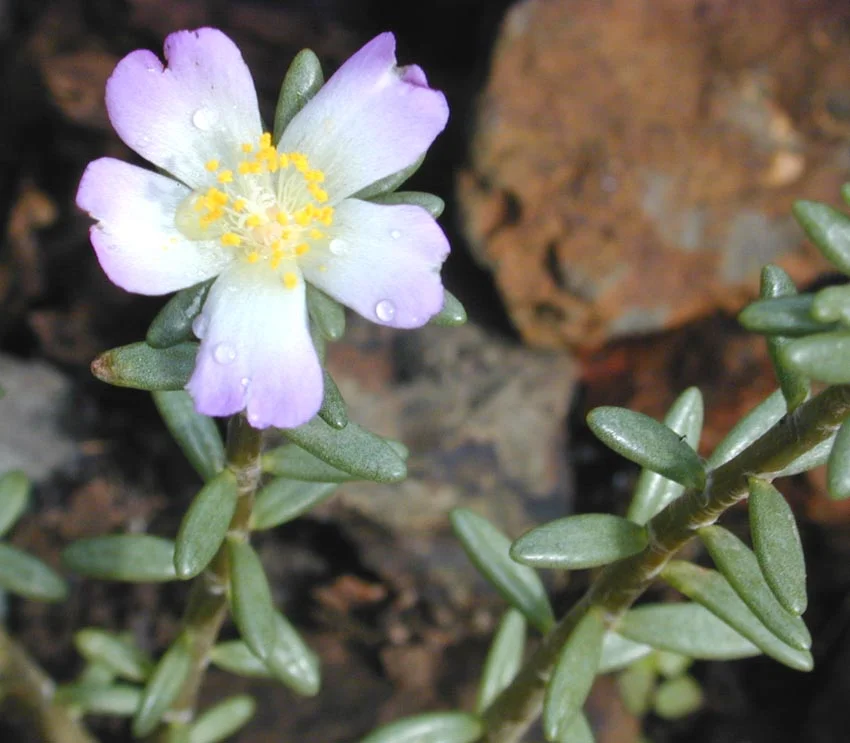
Blade structure: Depending on the species, the fleshy, smooth-edged leaf blades range from flat and spoon-shaped (spatulate, as in Portulaca oleracea) to cylindrical and needle-like (terete, as in Portulaca grandiflora).
Flowers and fruits
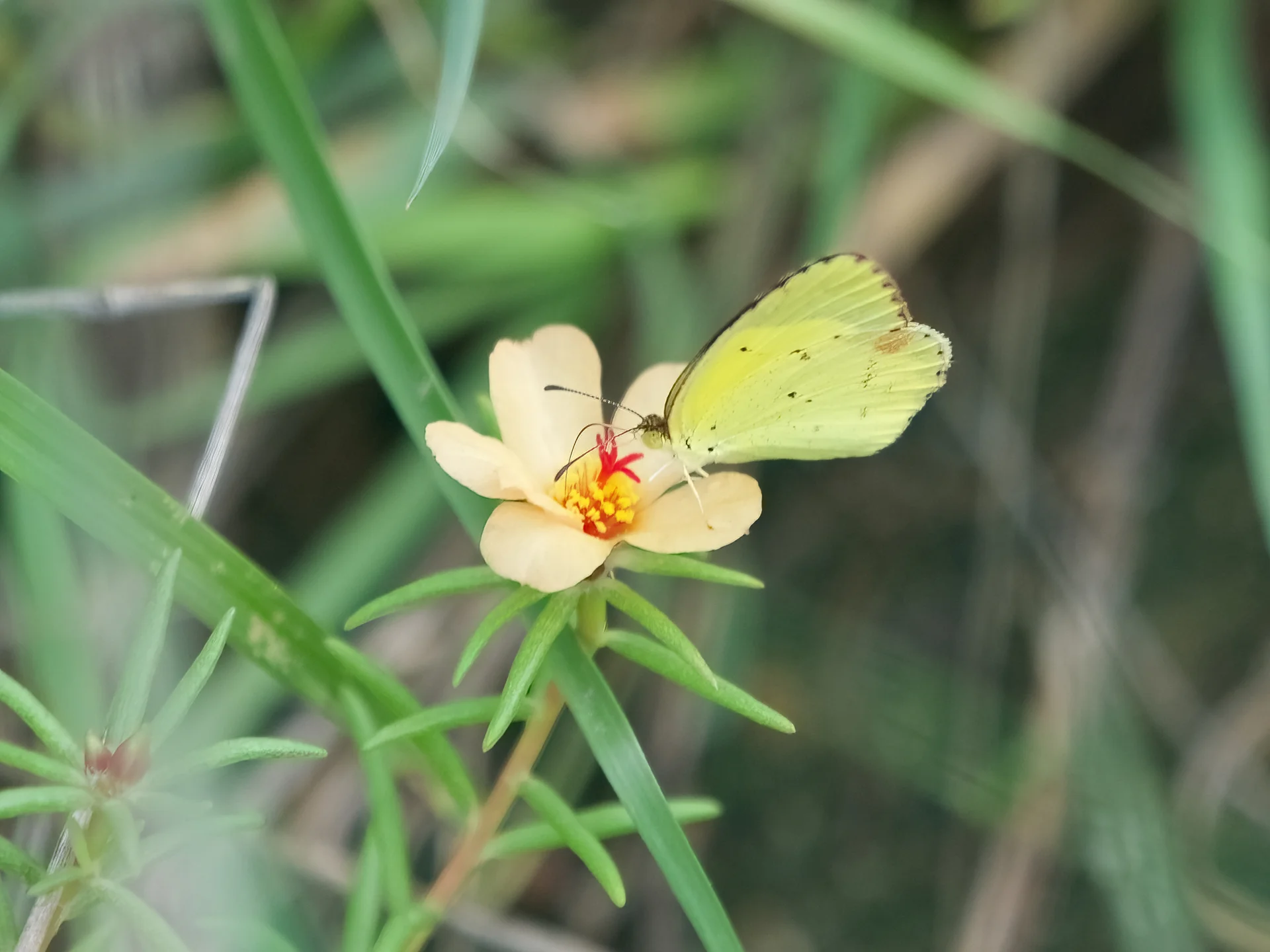
The flowers are bisexual, radially symmetrical (actinomorphic), and sit singly or in small terminal clusters cradled by leaf-like bracts. In terms of floral anatomy, the two green outer flaps are actually modified bracts (involucral leaves), while the four to seven silky, brightly colored 'petals' are botanically modified sepals (petaloid sepals) surrounding a dense ring of 4 to 100 sensitive stamens.
Solar-timed blooming: The ephemeral corollas open only under bright sunshine for a few hours from mid-morning to early afternoon, and many species can produce self-pollinating, unopened (cleistogamous) flowers during cloudy or cold spells.
Circumscissile capsules: The fruit is a papery, globe-shaped capsule called a pyxidium that splits cleanly around its equator, lifting off like a pot lid to release dozens of tiny, kidney-shaped seeds sculpted with microscopic tubercles or metallic sheen.
Flowering season
Blooms continuously from late spring through early autumn (June to September in temperate zones, and year-round in frost-free tropical climates), with individual flowers opening only during sunny midday hours.
Jan
Feb
Mar
Apr
May
Jun
Jul
Aug
Sep
Oct
Name
Dec
Care parameters
Light
Full, direct sunlight for at least 6 to 8 hours daily; flowers remain tightly closed in shade or overcast weather.
Watering
Low water needs; drench sparingly and allow the soil to dry out completely between waterings to prevent root and stem rot.
Temperature
Thrives in warm conditions between 20 °C and 35 °C; sensitive to frost and grown as an annual in temperate climates (USDA zones 2–11).
Humidity
Prefers low to moderate ambient humidity (30–50%) with good air circulation; requires no misting.
Toxicity
While common purslane (Portulaca oleracea) is edible for humans in moderation, ornamental species like Portulaca grandiflora and high-oxalate foliage can be toxic to cats, dogs, and grazing livestock if ingested in large quantities.
Applications
Across human history, the genus Portulaca has played a dual role as both a prized ornamental bedding plant and a nutrient-dense culinary green. Its extreme drought tolerance makes it a staple for low-water landscaping, while its biochemical richness places it among the most valued wild and cultivated potherbs.
Ornamental gardening: South American species such as Portulaca grandiflora (moss rose) and Portulaca umbraticola (wingpod purslane) are cultivated worldwide in rock gardens, drystone walls, sunny borders, and hanging baskets, where they carpet scorching pavement edges with neon-bright blooms.
Culinary traditions: Common purslane (Portulaca oleracea) offers crisp, mucilaginous stems and leaves with a lemony, slightly salty tang caused by malic acid; it is eaten raw in Middle Eastern fattoush and Greek salads, simmered with yogurt in Turkish cuisine, pickled in the Caucasus, or stir-fried and braised across East Asia and Mexico.
Nutritional and folk medicine uses: Purslane foliage is one of the richest terrestrial plant sources of alpha-linolenic acid (an omega-3 fatty acid), alongside glutathione, melatonin, beta-carotene, and vitamins C and E, earning it a longstanding place in traditional Mediterranean, Iranian, and Chinese herbal remedies for soothing skin inflammation and digestive ailments.
Interesting facts
Beneath the unassuming appearance of a roadside weed or garden border flower, Portulaca operates one of the most sophisticated metabolic and mechanical survival systems in the plant kingdom. Every anatomical and biochemical detail is calibrated to turn blistering heat and erratic rainfall into an evolutionary advantage.
Dual-mode photosynthesis: the C4 and CAM switch
Unlike almost all other land plants that are locked into a single carbon-fixation pathway, several species of Portulaca (most notably Portulaca oleracea, Portulaca grandiflora, and Portulaca cryptopetala) are facultative C4-CAM plants. They possess the biochemical machinery to run two distinct photosynthetic engines within the exact same leaf depending on soil moisture.
High-speed C4 mode: When water is available, the leaves arrange their cells into specialized Kranz anatomy (concentric rings of mesophyll and bundle-sheath cells) to pump carbon dioxide directly to the RuBisCO enzyme, allowing rapid growth under intense sunlight without wasting energy on photorespiration.
Drought-saving CAM mode: As soon as drought strikes, the plant reconfigures its enzymatic cycle to Crassulacean Acid Metabolism (CAM), sealing its microscopic leaf pores (stomata) tight during the scorching day and opening them only in the cool of night to capture carbon dioxide as malic acid, which gives morning-picked purslane leaves their signature tart, lemony crunch.
Micro-hydraulics of the seed capsule and stamens
The reproductive organs of Portulaca show a similarly tight coordination between structure and environment. The flowers of Portulaca grandiflora feature dozens of stamens wired with thigmonastic (touch-sensitive) filaments: when a foraging bee brushes against them, cellular turgor pressure shifts within milliseconds, causing the stamens to bend inward and dust the insect with pollen.
The 'little door' capsule: Once fertilized, the ovary matures into a circumscissile pyxidium — a spherical pod engineered with a pre-formed horizontal fracture line of thin-walled cells that dries and shrinks at a precise rate, popping the top dome off like a tiny hatch so wind and raindrops can scatter the seeds.
Multi-year seed dormancy: The microscopic seeds are encased in a hard, tuberculate seed coat (testa) that resists digestive acids and extreme desiccation, allowing them to remain viable in dry soil for up to 40 years until a sudden summer downpour triggers germination within 24 hours.
Varieties and cultivars
Breeding work in Portulaca has focused on two main directions: ornamental hybrids of Portulaca grandiflora and Portulaca umbraticola bred for double flowers that stay open longer on cloudy days, and culinary selections of Portulaca oleracea bred for upright stems and broad, tender leaves.
'Sundial' Series (Portulaca grandiflora): A compact, early-blooming cultivar group renowned for extra-large, semi-double to double flowers in shades of fuchsia, tangerine, scarlet, and Peppermint-striped bicolors that open earlier in the morning than wild types.
'Happy Hour' Series (Portulaca grandiflora): Genetically mounded, uniform plants bred to flower reliably under shorter day lengths, producing dense, rose-like double blossoms that resist closing during brief afternoon cloud cover.
'Mojo' and 'Cupcake' Series (Portulaca umbraticola): Vigorous, trailing wingpod purslane cultivars prized for hanging baskets, featuring flat, spoon-shaped leaves and vivid single flowers with contrasting central eyes and picotee petal margins.
'Golden Purslane' / 'Sativa' (Portulaca oleracea var. sativa): Upright culinary selections with thick, pale green to golden-yellow leaves that grow up to twice the size of wild purslane, offering a milder, less mucilaginous texture for fresh salads.