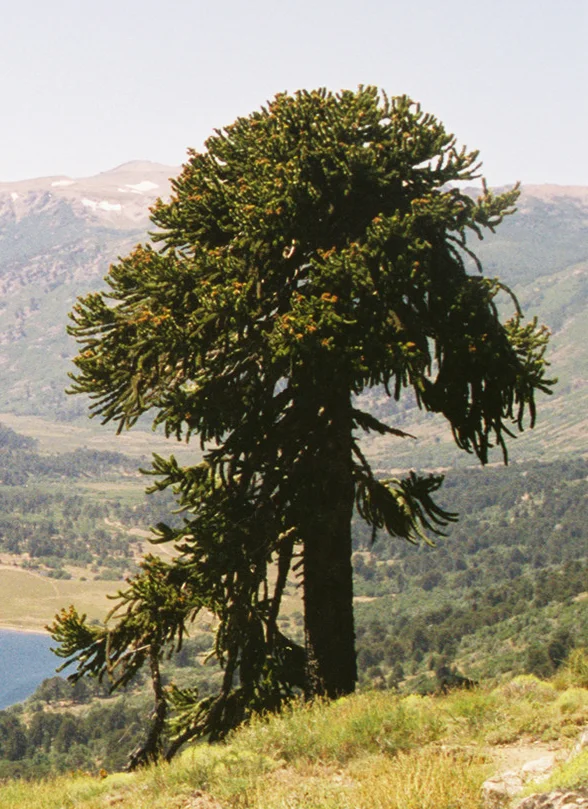
Araucaria
Monkey puzzle tree group
Broad-leaved Araucaria
#282611
#B4A880
#6C674A
#E6E7ED
#988D54
Plant palette
Araucaria sect. Araucaria: Taxonomy, Species & Traits
Ancient silhouettes rising against the dramatic backdrop of the Andes mountains define the majestic presence of the species within Araucaria sect. Araucaria. This botanical section belongs to the ancient coniferous genus Araucaria, encompassing some of the most iconic and recognizable trees of South America. It notably includes the renowned Monkey puzzle tree (Araucaria araucana) and the Paraná pine (Araucaria angustifolia).
Trees in this section are celebrated for their distinctive, prehistoric appearance and architectural growth habits. They have survived for millions of years, acting as living links to the flora of the Mesozoic era. Their highly symmetrical branches and uniquely armored foliage make them truly striking elements of their native landscapes.
Taxonomy
∟царствоPlantae
∟divisionTracheophytes(Vascular Plants)
∟subdivisionSpermatophytes(Seed plants)
∟superclassGymnospermae(Gymnosperms)
∟divisionPinophyta(Conifers)
∟subclassCupressidae
∟orderAraucariales(Southern pines and monkey-puzzles)
Trees of Araucaria sect. Araucaria are typically large, evergreen conifers with a highly symmetrical, whorled branching pattern. As the trees mature, they often shed their lower branches naturally, developing a characteristic and striking umbrella-like crown that dominates the forest canopy.
The foliage is particularly distinctive, consisting of broad, tough, and leathery leaves. These leaves are densely overlapping, spirally arranged along the thick branches, and usually armed with a sharply pointed apex that provides a formidable defense against herbivores.
Being gymnosperms, they reproduce via cones rather than true flowers. They produce large, heavy, and spherical female seed cones that can take up to two years to fully mature. The male pollen cones are elongated, cylindrical, and usually borne in clusters on the lower branches.
Applications
Species within Araucaria sect. Araucaria have significant economic and cultural value in their native South American ranges. The large, edible seeds, often referred to as piñones, are a traditional and highly nutritious carbohydrate source for indigenous communities, such as the Mapuche people.
Historically, these majestic trees were heavily harvested for their high-quality, straight-grained timber, which was highly prized in construction, carpentry, and shipbuilding. Today, due to severe conservation concerns, logging is strictly regulated, and the trees are primarily valued for their ecological importance and as striking ornamental specimens in botanical gardens worldwide.
Interesting facts
The section is remarkably small today, containing only two extant species: Araucaria araucana from Chile and Argentina, and Araucaria angustifolia from Brazil and Argentina.
These ancient trees are often described as 'living fossils', with evolutionary origins tracing back to a time when dinosaurs roamed the Earth.
The sharp, armor-like leaves characteristic of Araucaria sect. Araucaria are theorized by paleobotanists to have evolved as a robust defense mechanism against the grazing of large herbivorous dinosaurs.
The common name 'Monkey puzzle' for A. araucana was coined in the 19th century by an English observer who remarked that climbing its spiky branches would puzzle even a monkey.
A towering evergreen conifer native to New Guinea, widely recognized in historical forestry literature and closely associated with Araucaria hunsteinii.