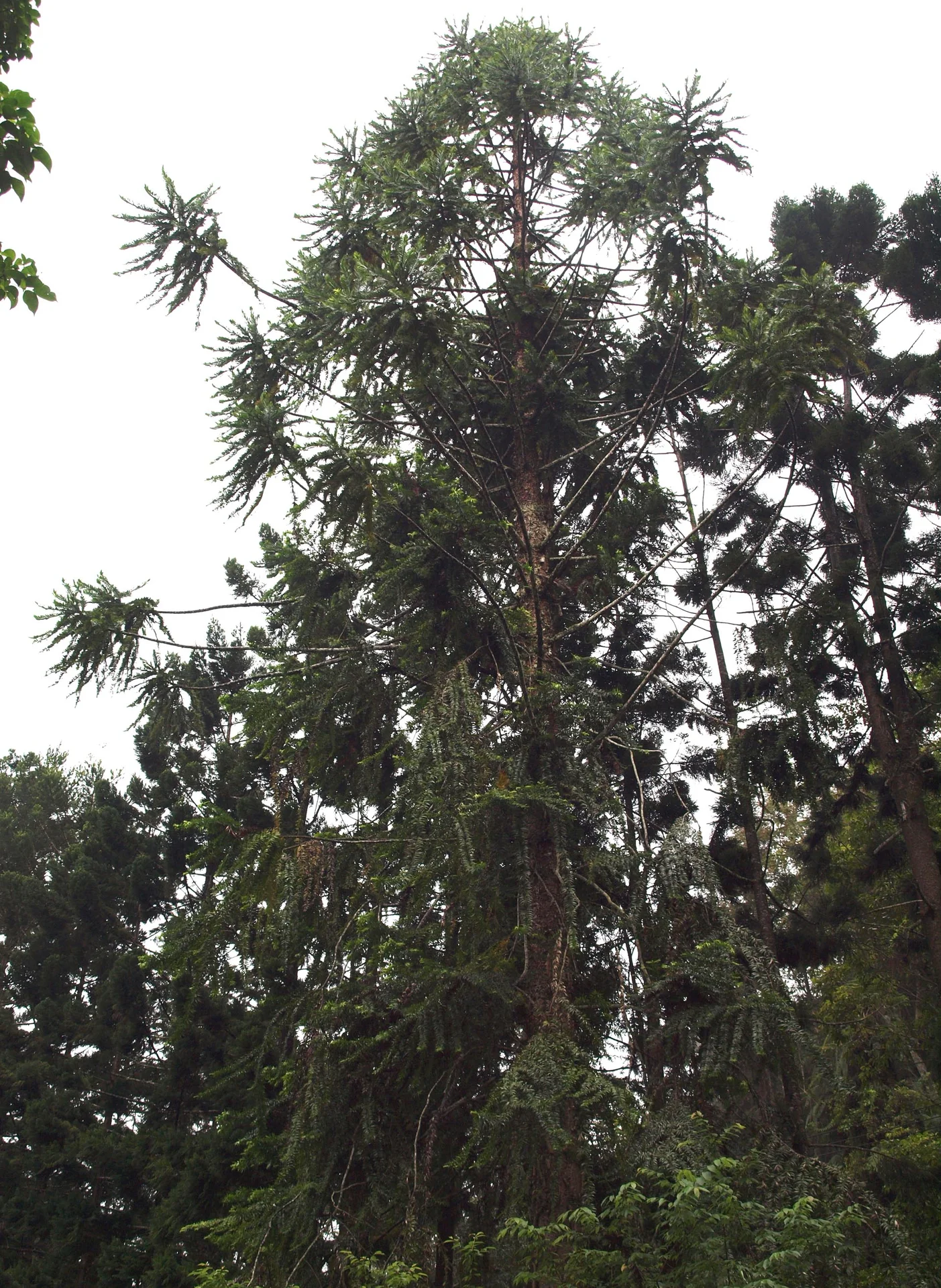
Araucaria hunsteinii: The Tallest Tree of New Guinea
Towering majestically above the dense canopies of Papua New Guinea's mountainous rainforests, Araucaria hunsteinii holds the undisputed title of the tallest tree in the region. This colossal evergreen conifer, often referred to as the Klinki pine, is a true giant of the forest, reaching breathtaking heights that can exceptionally approach 90 meters. Its straight, formidable trunk and distinctively flat-topped crown make it a prominent feature of the highland landscapes where it has thrived for millennia.
As the largest member of the ancient Araucariaceae family, Araucaria hunsteinii represents an extraordinary botanical lineage. Found exclusively at elevations between 600 and 2000 meters, it grows in scattered stands, often sharing the ecosystem with various broad-leaved trees. The tree is not only an ecological marvel but also deeply intertwined with the natural heritage of the island, despite facing significant modern environmental pressures.
Taxonomy
∟царствоPlantae
∟divisionTracheophytes(Vascular Plants)
∟subdivisionSpermatophytes(Seed plants)
∟superclassGymnospermae(Gymnosperms)
∟divisionPinophyta(Conifers)
∟subclassCupressidae
∟orderAraucariales(Southern pines and monkey-puzzles)
The sheer scale of Araucaria hunsteinii is its most defining characteristic, with mature specimens typically reaching 50 to 80 meters in height and developing a straight trunk up to 3 meters in diameter. The bark is dark brown, highly resinous, and rough, shedding in large, corky horizontal plates or flakes. The branches are horizontal and arranged in precise whorls of five or six, initially giving the tree a pyramidal shape that gradually flattens and spreads out as it ages.
This species exhibits pronounced heterophylly, meaning its leaves change shape as the tree matures. Young saplings bear short, awl-like foliage, while mature trees display flattened, lance-shaped, and sharply pointed leaves that grow 6 to 15 centimeters long and 1.5 to 2 centimeters wide. These stiff leaves are spirally arranged and densely clustered toward the ends of the branches, creating a distinctive structural appearance.
Araucaria hunsteinii is typically monoecious, bearing both male and female cones on the same tree. The reproductive structures include:
Male pollen cones: Cylindrical, long, and slender, growing up to 20 centimeters in length and 1.8 to 2.5 centimeters in width.
Female seed cones: Large, oval or egg-shaped structures that can measure 15 to 25 centimeters long and up to 16 centimeters wide.
Seeds: Triangular, nut-like seeds about 3 to 4 centimeters long, bordered by narrow papery wings, which are released when the mature female cone disintegrates on the tree.
Applications
Historically, the timber of Araucaria hunsteinii has been highly prized for its exceptional quality and strength. Known commercially as Klinki pine, the wood was extensively harvested for a variety of construction purposes, including the manufacturing of airplane frames in the past. Its straight grain and durability made it a sought-after material in both local and international markets.
Today, due to heavy exploitation of accessible natural stands, the use of wild timber is strictly regulated, and the export of Araucaria wood is banned in Papua New Guinea. However, the species has been successfully cultivated in timber plantations since the mid-20th century. It is grown as a fast-growing forestry crop not only in its native range but also experimentally in tropical highland regions of Malaysia, Fiji, and Puerto Rico.
Interesting facts
The discovery and naming of Araucaria hunsteinii carry a rich historical legacy. The specific epithet honors Carl Hunstein, a German ornithologist and plant collector who extensively explored the rugged terrains of New Guinea between 1878 and 1888. The species was formally described by botanist Karl Moritz Schumann in 1889.
Some fascinating aspects of this giant conifer include:
Record Heights: The tallest reliably measured specimen, recorded in 1941, reached an astounding 88.9 meters, cementing its status as the tallest tree in Oceania.
Avian Pests: In plantation settings, the seeds of the tree are heavily predated by the Sulphur-crested cockatoo (Cacatua galerita), which can destroy up to half of the seed crop by attacking unripe cones.
Climate Mitigation: In Puerto Rico, the tree was introduced as part of the KLINKIFIX project, an initiative aimed at carbon sequestration to offset greenhouse gas emissions.
Fire Vulnerability: Natural stands are highly susceptible to forest fires, particularly during severe drought periods driven by El Niño events. A massive fire in 1997 devastated significant populations within the McAdam National Park.