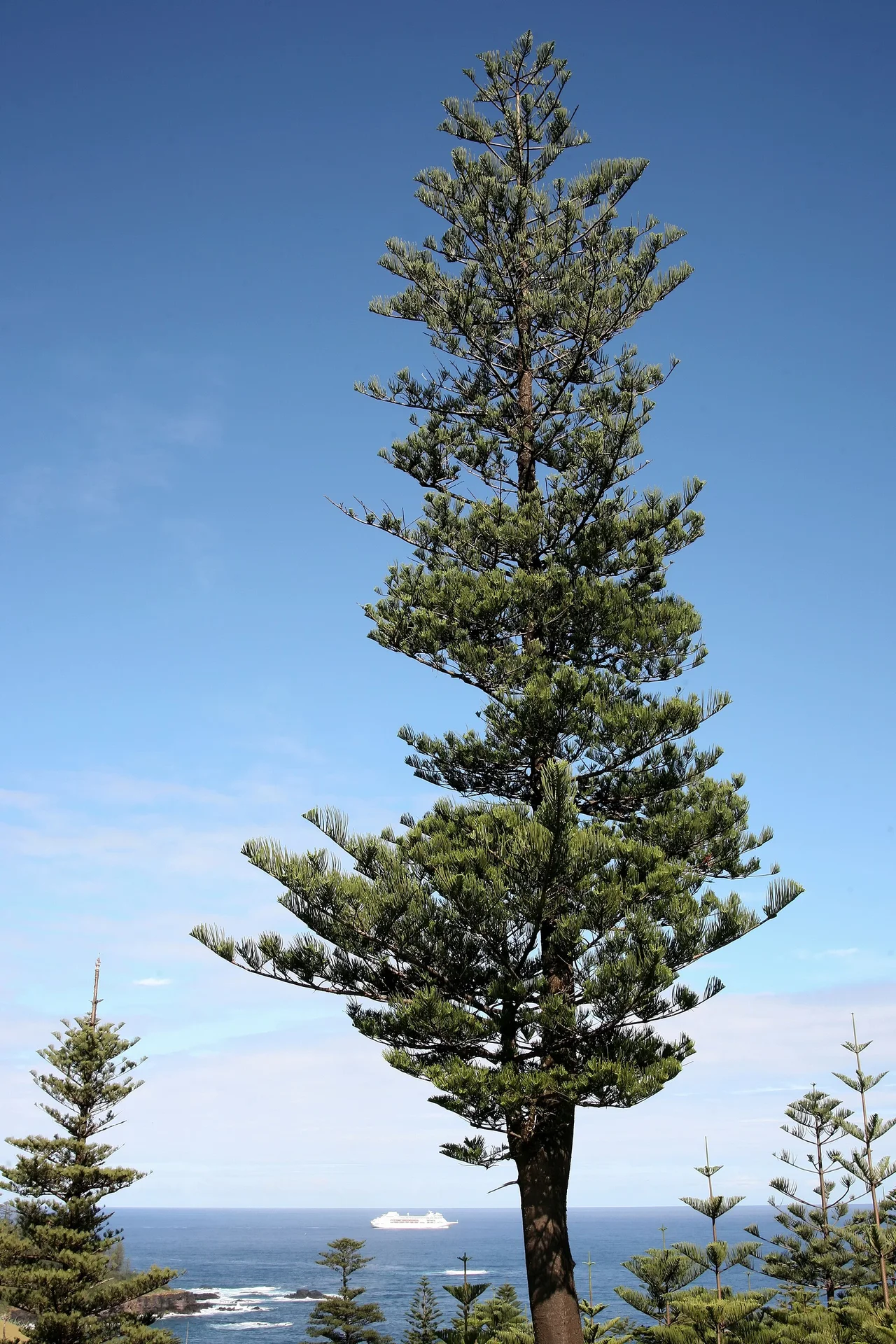
Norfolk pine
star pine
Polynesian pine
triangle tree
living Christmas tree
IUCN: Vulnerable
#79A0CA
#49668E
#C7DEF6
#5B5D49
#2B2C1D
Plant palette
Araucaria heterophylla (Norfolk Island Pine) Guide
Swept by incessant oceanic winds on a small, isolated landmass in the Pacific, a towering conifer stands resolute, its perfectly symmetrical, tiered branches defining the skyline. Araucaria heterophylla, widely cherished as the Norfolk Island pine, evokes a sense of prehistoric majesty and resilience. Although it resembles a true pine with its needle-like foliage, this architectural marvel belongs to the ancient Araucariaceae family, a completely different lineage of vascular plants.
In its natural habitat, the tree can reach breathtaking heights, forming a straight, vertical trunk that serves as a living monument. Its unique aesthetic, characterized by widely spaced, horizontal branches forming precise pentagonal layers, has captivated botanists and plant enthusiasts since the late 18th century. Today, its exotic appearance has earned it a prominent place in ornamental horticulture across the globe, bringing a touch of the South Pacific to subtropical gardens and bright living spaces alike.
Taxonomy
∟царствоPlantae
∟divisionTracheophytes(Vascular Plants)
∟subdivisionSpermatophytes(Seed plants)
∟superclassGymnospermae(Gymnosperms)
∟divisionPinophyta(Conifers)
∟subclassCupressidae
∟orderAraucariales(Southern pines and monkey-puzzles)
The physical structure of Araucaria heterophylla is characterized by a slow growth rate and an impressive potential height of 50 to 65 meters in its native environment. The trunk is notably straight and vertical, covered in grey-brown bark that exfoliates in fine, shedding scales. The tree's branching habit is exceptionally regular, emitting four to seven almost horizontal or slightly oblique branches per tier, creating the appearance of floors shaped as perfect pentagons.
The foliage exhibits distinct dimorphism, changing significantly in appearance as the tree matures. Young plants and lower branches feature soft, awl-shaped leaves that are incurved, measuring about 1 to 1.5 centimeters in length. As the tree ages, the leaves on the upper reproductive branches become thicker, scale-like, and more tightly overlapping, taking on a broadly ovate shape with a spiny tip.
Reproduction in this species occurs via cones, with the tree typically being dioecious. The male cones are elongated and yellowish-brown, clustered together, while the female cones are large, squat, and globose, reaching up to 14 centimeters in diameter. It takes approximately 18 months for female cones to fully mature, eventually disintegrating to release large, edible seeds equipped with broad wings for wind dispersal.
Care parameters
Light
Requires bright, indirect sunlight; can tolerate moderate shade indoors but should be protected from harsh, scorching rays.
Watering
Maintain consistently moist but well-drained soil during the growing season, reducing watering frequency slightly in the winter months.
Temperature
Thrives in cool to moderate indoor temperatures between 17°C and 22°C (63°F–72°F). It is highly sensitive to frost and prolonged cold.
Humidity
Prefers moderate to high humidity levels above 60%. Extremely sensitive to dry, central-heated air which can cause needle drop.
Toxicity
Generally considered non-toxic to humans and pets, though ingestion of the tough needles may cause mild gastrointestinal irritation.
Applications
Beyond its primary role in ornamental horticulture, Araucaria heterophylla holds both cultural and practical value. In regions with suitable climates, such as coastal Southern California and the Mediterranean, it is extensively planted as a majestic landscape specimen for avenues and parks. Young, symmetrical specimens are cultivated globally as potted indoor plants and are frequently utilized as living Christmas trees.
Historically, the impressive straight trunks of these trees caught the attention of early European explorers like Captain James Cook, who believed the timber would be ideal for ship masts. Although the wood ultimately proved insufficiently resilient for heavy marine applications, it possesses an appealing white color and hardness that makes it highly suitable for woodturning. Today, the timber is primarily reserved for local use, where artisans on Norfolk Island and Hawaii craft it into intricate wooden bowls and decorative items.
Interesting facts
Araucaria heterophylla has a fascinating history and cultural presence, particularly tied to its native origins.
Endemic Symbol: The tree is an iconic symbol of its homeland and is prominently featured on the official flag and coat of arms of Norfolk Island.
Mistaken Identity: Many of the "Norfolk Island pines" grown in Hawaii and sold as potted plants in the United States are actually Cook pines (Araucaria columnaris). The two species were confused during their early introduction.
Living Fossil: The genus Araucaria is ancient, dating back to the Mesozoic era, making this tree a true living fossil that survived from the time of the dinosaurs.
Ecological Importance: The large, nut-like seeds produced by the female cones are edible and serve as a crucial food source for the endangered Norfolk Island green parrot.
Varieties and cultivars
Although the wild-type form is the most commonly encountered, several recognized cultivars of Araucaria heterophylla have been developed for ornamental use. These variations typically offer unique foliage colors or growth habits.
'Albospica': Features striking foliage with whitish or silvery tips.
'Aurea Variegata': Known for its golden-variegated needles that add a bright contrast to landscapes.
'Compacta': A smaller, denser form that is particularly well-suited for indoor container cultivation.
'Glauca': Valued for its distinctly blue-green or glaucous foliage.
'Gracilis': Characterized by a more slender, graceful branching pattern.