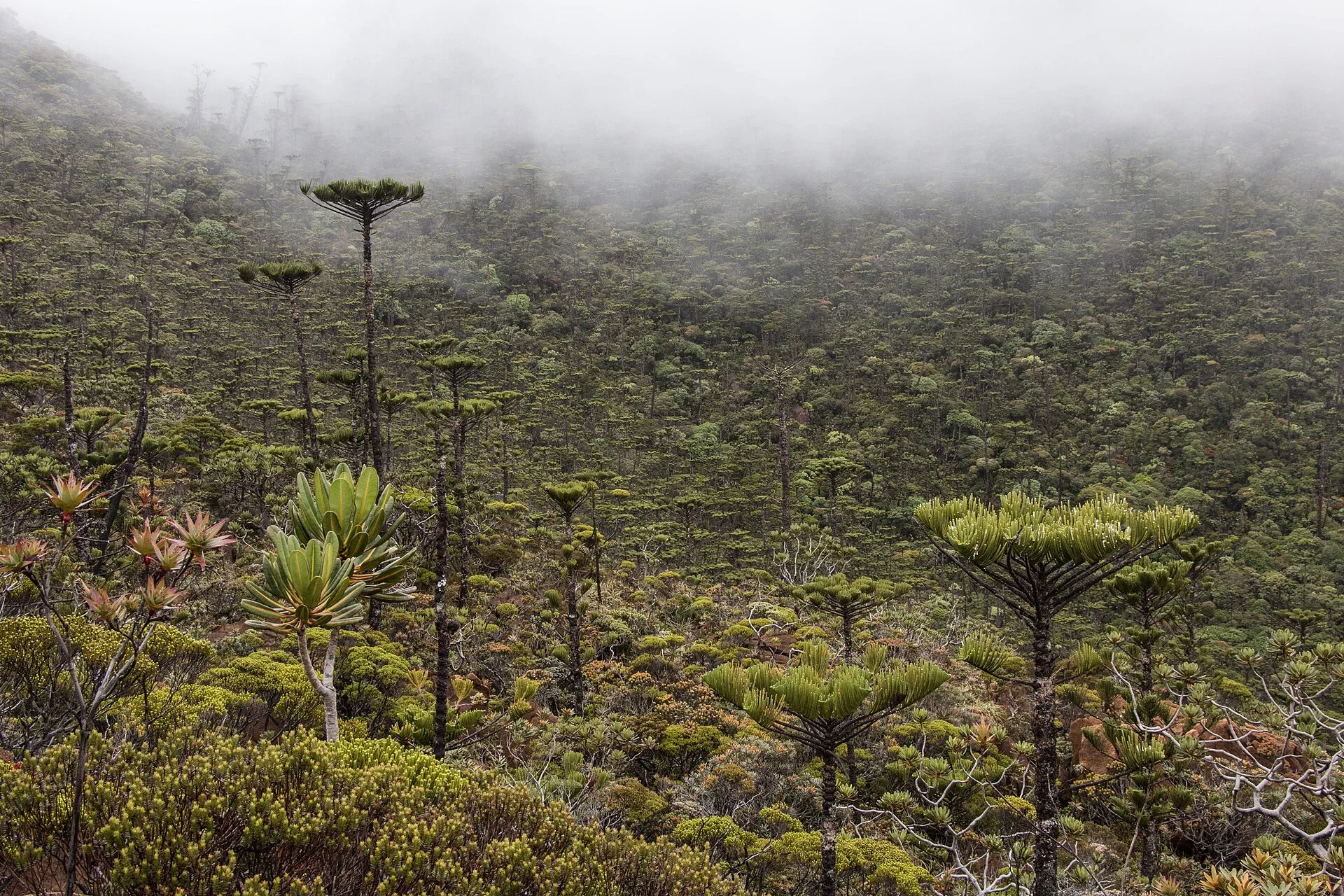
Thriving in the extreme, high-altitude environments of New Caledonia, Araucaria humboldtensis develops into a morphologically distinct and relatively compact conifer belonging to the ancient Araucariaceae family. It is strictly endemic to the main island of Grande Terre, where it has highly specialized ecological adaptations to survive on isolated mountain ridges.
Frequently dominating the botanical landscape near the summit of Mont Humboldt, this species grows exclusively on soils derived from ultramafic rocks. Despite its isolation in high-altitude refuges, the species faces intense environmental pressures, rendering its long-term survival prospects increasingly fragile.
Taxonomy
∟царствоPlantae
∟divisionTracheophytes(Vascular Plants)
∟subdivisionSpermatophytes(Seed plants)
∟superclassGymnospermae(Gymnosperms)
∟divisionPinophyta(Conifers)
∟subclassCupressidae
∟orderAraucariales(Southern pines and monkey-puzzles)
Compared to other towering members of its genus, this species is noticeably diminutive, typically achieving a maximum height of only 6 to 15 meters. Mature specimens invariably develop a characteristic flattened, candelabra-like crown, with lateral branches radiating horizontally in a distinct V-shaped architectural pattern.
The tree's bark initially appears glossy and light brown before weathering to a muted gray, continuously exfoliating in quadrangular scales or thin, papery strips. Its foliage consists of densely packed, scale-like leaves featuring a prominent midrib and a sharply curved apex, while reproduction relies on thick, twisted cylindrical male cones and heavily scaled, subglobose female cones.
Interesting facts
The tree maintains an extraordinary and highly specialized ecological relationship with endemic insects and fungi. Specific weevils bore into the wood, triggering massive defensive resin flows that subsequently provide the exclusive microhabitat for a unique, substrate-specific ascomycete fungus known as Resinogalea humboldtensis.
Wildfires currently represent one of the most critical and immediate threats to the remaining wild subpopulations. Because these ancient trees are biologically restricted to a very narrow altitudinal band near isolated mountain peaks, they are exceptionally vulnerable to anthropogenic climate change, lacking higher-elevation refuges to migrate toward as global temperatures increase.