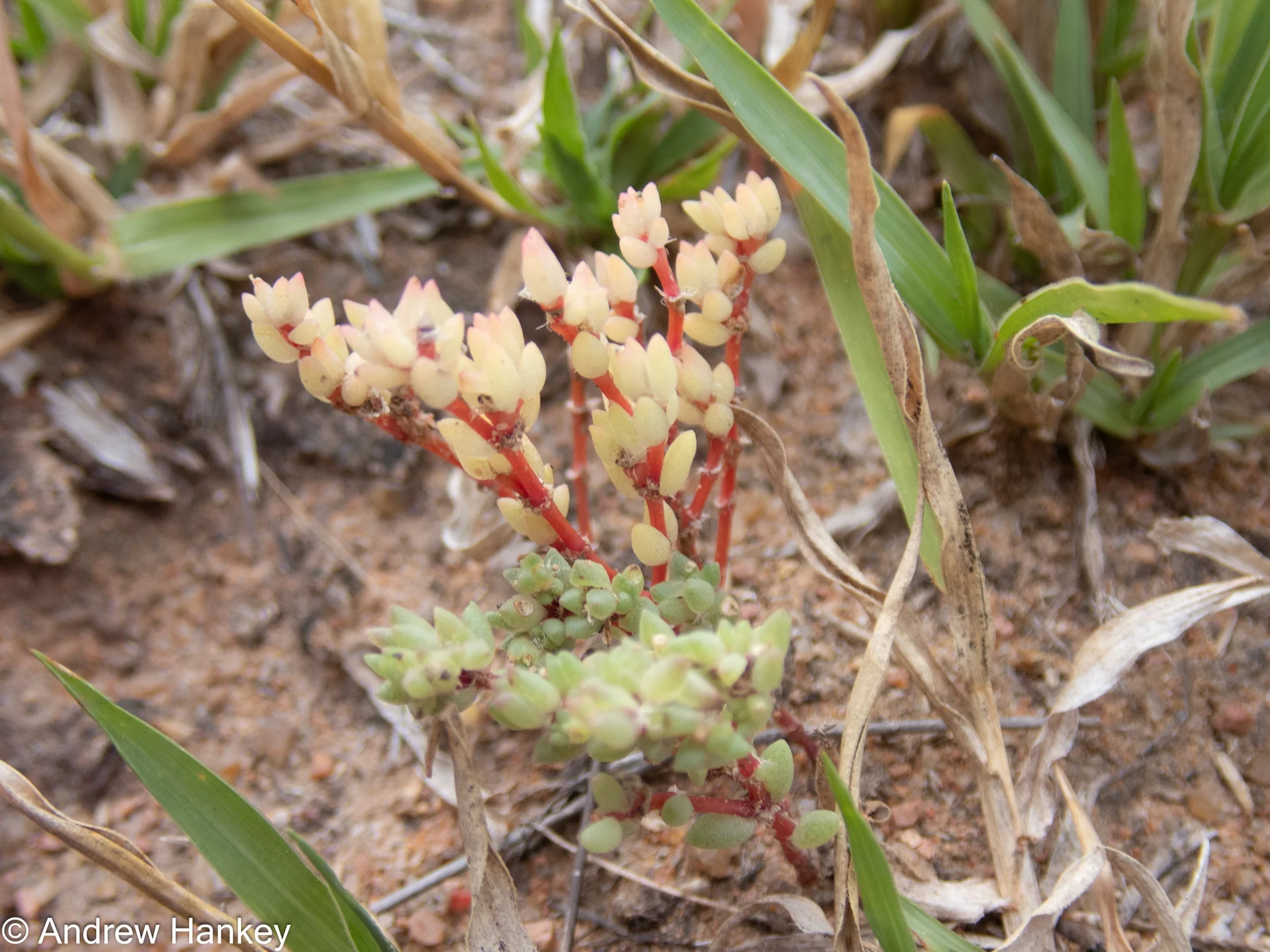
Portulaca hereroensis: succulent purslane of southern Africa
Portulaca hereroensis is a compact, fleshy-leaved herb native to the sun-drenched plains, rocky outcrops, and sandy savannas of southern and south-central Africa. Its specific epithet, hereroensis, honors Hereroland in Namibia, the arid region where the plant was first scientifically collected.
Placed within the purslane family, Portulacaceae, this species was formally described by the Swiss botanist Hans Schinz in 1897. In botanical literature and herbarium records, it has also been treated under historical synonyms including Sedopsis hereroensis and Sedopsis carrissoana, though Portulaca hereroensis stands as its accepted name.
Growing as a small annual or short-lived perennial herb, Portulaca hereroensis forms prostrate to ascending, branched stems that stay close to the warm substrate. Its diminutive, opposite or subopposite leaves are fleshy and cylindrical to lance-shaped, functioning as miniature water-storage tanks during prolonged dry spells.
At the nodes where leaves meet the stem, the plant bears clusters of fine, pale axillary hairs—silky trichomes that trap microscopic droplets of morning dew and shield the tender growing tips from intense solar radiation.
Flowers and capsules
The small, radially symmetrical flowers sit nestled in terminal clusters surrounded by a ring of involucral leaves and tufts of hair. They open briefly during peak midday heat and sunlight.
Perianth and stamens: Delicate, thin-textured petals surround a cluster of sensitive stamens that dust visiting insects with pollen upon contact.
Pyxidium fruit: After fertilization, the ovary ripens into a specialized dry fruit called a pyxidium (or circumscissile capsule), which splits cleanly around its middle like a tiny lidded box to scatter numerous microscopic seeds.
Interesting facts
Micro-engineering for the Namibian sun
Surviving in the skeletal soils and erratic rainfall zones of Namibia, Botswana, and the Northern Cape requires an economy of water where not a single drop is wasted. Portulaca hereroensis combines structural micro-architecture with flexible biochemistry to thrive where leafy herbs quickly wither.
Dew-combing nodal hairs: The dense tufts of pale hairs in the leaf axils act simultaneously as high-albedo parasols that reflect scorching ultraviolet light away from the stem buds and as hydrophilic sponges that condense night fog and morning dew.
Switchable photosynthesis: Like specialized arid-zone members of its genus, the plant can shift between rapid C4 carbon fixation when moisture is available and CAM-cycling (Crassulacean Acid Metabolism) during drought, keeping its microscopic leaf pores sealed throughout the blistering day while recycling internal respiratory carbon.
Pop-top seed dispersal: Its circumscissile capsule stays tightly sealed until dry winds or passing raindrops knock off the upper cap, releasing tiny, sculpted seeds right when seasonal surface runoff can wash them into protective rock crevices.