Variety
Okinawa purslane (Portulaca okinawensis)
Okinawa moss rose
IUCN: Vulnerable
Portulaca okinawensis: Morphology, Habitat & Conservation
Clinging tenaciously to the harsh, sun-baked limestone cliffs of the Ryukyu Islands, Portulaca okinawensis paints a vibrant picture of resilience. This diminutive succulent thrives where few other plants can survive, anchoring itself firmly into the rocky coastal crevices of Japan's southern archipelago. Its delicate, fleeting blossoms offer a stunning contrast to the rugged terrain it calls home.
As a highly specialized coastal species, this plant forms low, dense mats that perfectly adapt to the salty winds and intense sunlight of its native habitat. Portulaca okinawensis is deeply intertwined with the unique ecological fabric of the Nansei Islands, representing a fascinating example of evolutionary adaptation to extreme island environments. Unnoticed by many, it quietly endures the challenging coastal conditions.
Taxonomy
- ∟ царство Plantae
- ∟ division Tracheophytes (Vascular Plants)
- ∟ subdivision Spermatophytes (Seed plants)
- ∟ Angiosperms
- ∟ mesangiosperms (Core angiosperms)
- ∟ eudicots
- ∟ core eudicots
- ∟ Superasterids
- ∟ order Caryophyllales
- ∟ подотряд / подпорядок Portulacineae
- ∟ family Portulacaceae (Purslane family)
- ∟ genus Portulaca (Purslane genus)
- ∟ species Portulaca okinawensis (Okinawa purslane)
Morphology
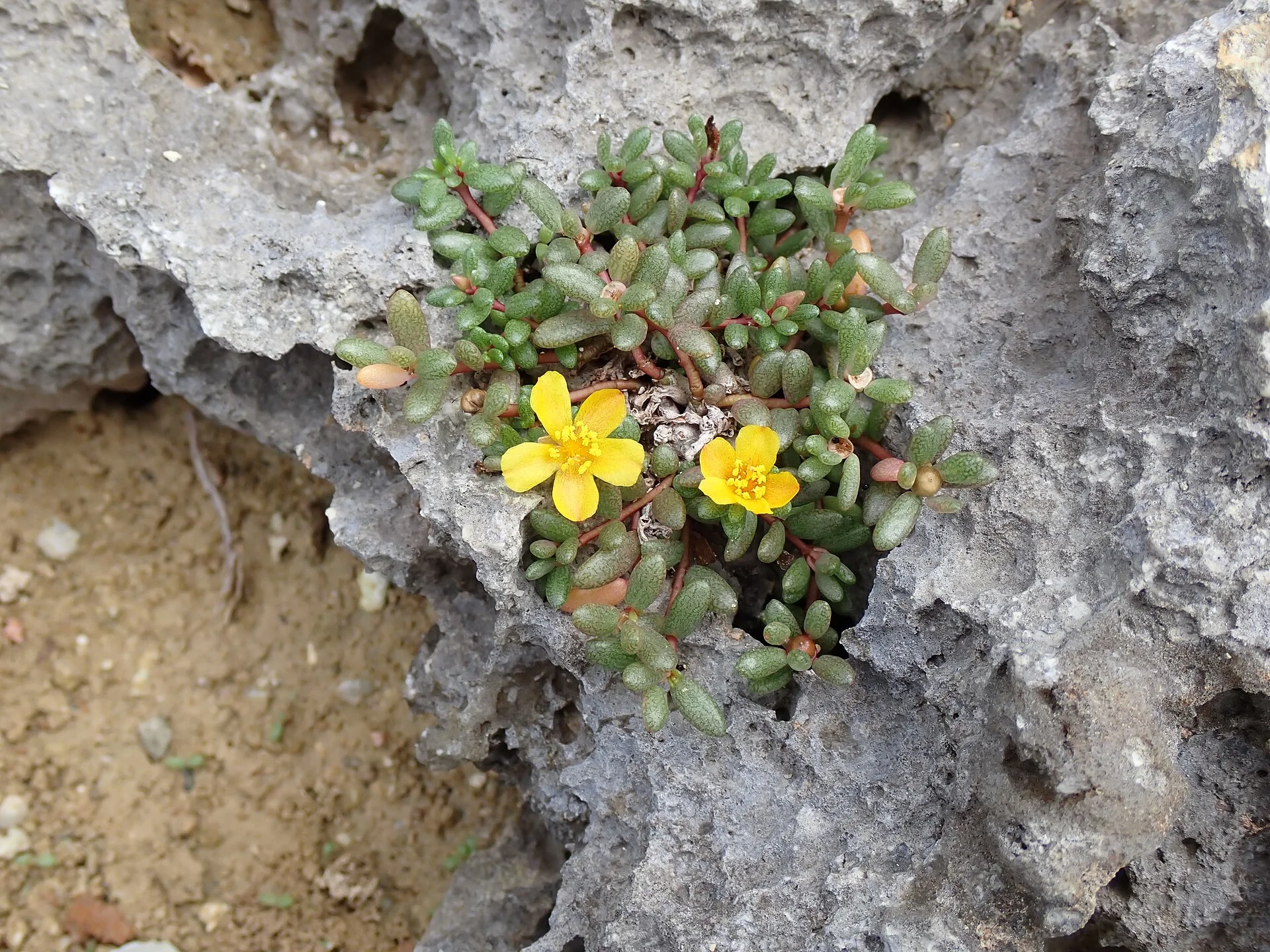
Portulaca okinawensis is a small, perennial succulent herb that typically reaches a height of 5 to 10 centimeters. It develops a sturdy, thick rhizome that allows its roots to adhere securely directly onto limestone bedrock. From this base, multiple reddish stems grow in a clustered formation.
The fleshy leaves are arranged alternately along the stem and are incredibly small, measuring only 3 to 5 millimeters in length. These leaves feature a narrowly elliptical to oblong-elliptical shape with a bluntly pointed tip. During the blooming period, solitary flowers emerge at the apex of the stems.
Each flower measures approximately 1 centimeter in diameter and consists of five petals that range in color from bright yellow to vibrant orange-yellow. Following pollination, the plant produces small, spherical capsule fruits that are about 1.7 millimeters long. By late autumn, the upper parts of the stems usually wither, leaving only the underground root system and the thickest parts of the basal stems to survive the winter.
Flowering season
Blooms irregularly from late spring through late summer.
Jan
Feb
Mar
Apr
May
Jun
Jul
Aug
Sep
Oct
Name
Dec
Interesting facts
Despite its charming appearance, Portulaca okinawensis remains largely invisible to the untrained eye. Its exceptionally small flowers only open for a few brief hours on bright, sunny days, making them a rare sight even in their native habitat. In some popular scenic coastal areas of Okinawa, tourists frequently walk right past—and occasionally step on—these resilient little plants without ever noticing them.
There is a distinct geographical variation found within the Amami Islands, recognized as Portulaca okinawensis var. amamiensis. This specific variety differs from the main population by producing pale lemon-yellow flowers and having fewer stamens, alongside stems that lack the typical reddish hue.
The species faces significant ecological pressure and is strictly protected in several municipalities. Due to its fleeting blooms and specific habitat requirements, it holds almost no value in the commercial horticultural trade, yet it remains a botanical treasure for conservationists.
Geography of distribution
- Japan
Natural varieties
Sources
- Plants of the World Online (POWO)
- Global Biodiversity Information Facility (GBIF)
- Ministry of the Environment, Japan (Red List Data)
See also

Mexican Purslane
Portulaca mexicana
Portulaca mexicana is a low-growing succulent plant native to numerous states across Mexico. First described …

Red-Stemmed Purslane
Portulaca rubricaulis
An annual succulent herb characterized by distinctive reddish stems and solitary yellow flowers, found across …

Round-Leaved Purslane
Portulaca rotundifolia
An annual succulent plant species of the Portulacaceae family, native to South America.

Hairy Hawaiian Purslane
Portulaca villosa
Portulaca villosa, commonly known as hairy purslane or 'ihi, is a rare, prostrate succulent endemic …