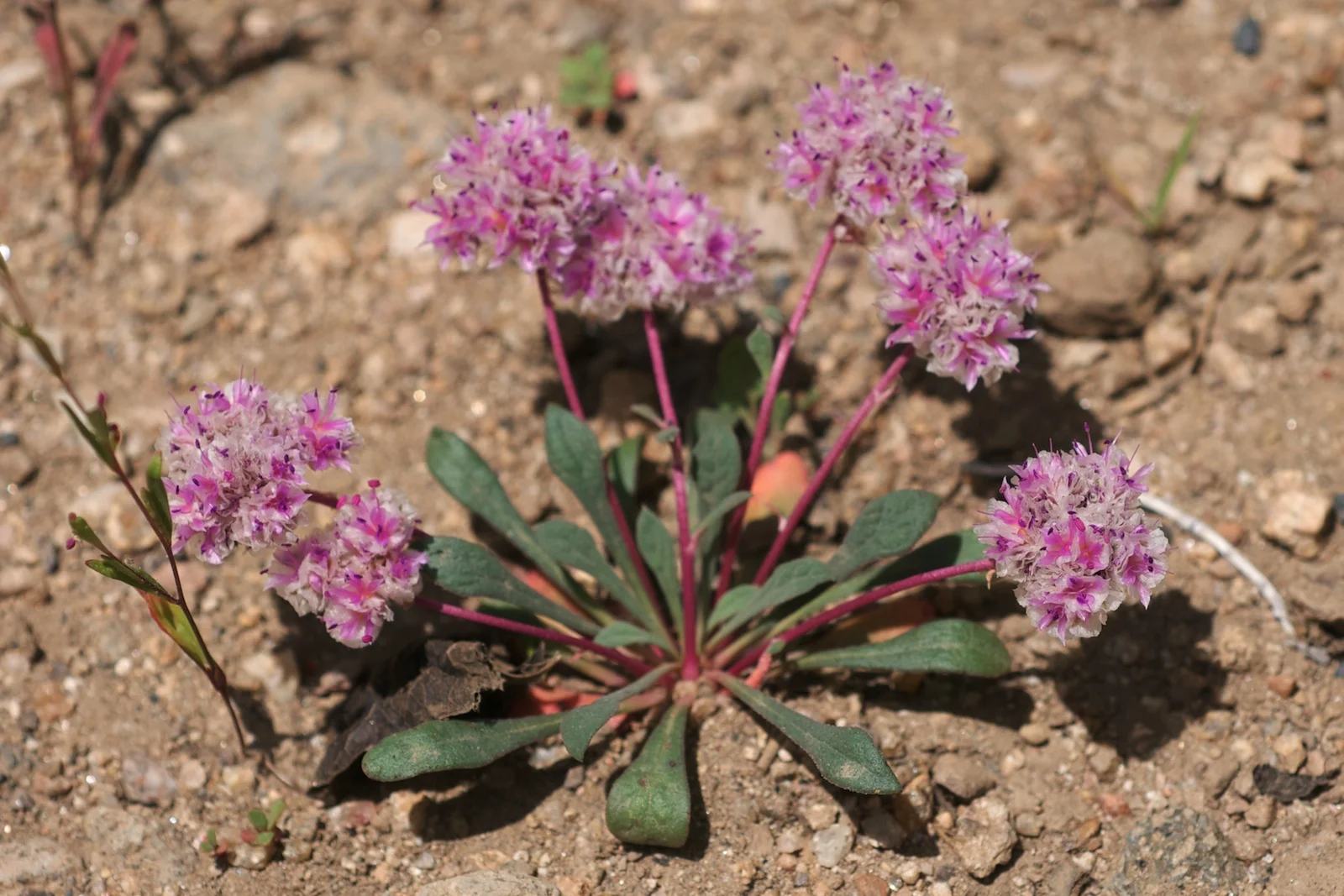
Known commonly as one-seeded pussypaws, Calyptridium monospermum stands out in its native habitats across western North America. This resilient perennial herb populates diverse environments ranging from Oregon down to Baja California, adapting well to forest floors and open woodlands.
Historically placed in the purslane family (Portulacaceae), modern taxonomy classifies this species within the miner's lettuce family (Montiaceae). It is valued by botanists for its distinct rosette structure and delicate flowering heads.
This perennial species arises from a substantial taproot and a thick, woody caudex. It exhibits a somewhat upright growth habit, with flowering stems reaching up to 50 centimeters in length.
A prominent feature is the basal rosette composed of thick, spoon-shaped leaves that grow up to 6 centimeters long. Several smaller, reduced leaves occur along the upright stems, adding to its structural complexity.
Unlike its close relative Calyptridium umbellatum, this taxon usually supports multiple inflorescences per rosette. The inflorescence forms an erect umbel up to 10 centimeters across, featuring flowers with four white-to-pink petals surrounded by paper-like, frilly sepals. The resulting fruit is a small, rounded capsule containing a single seed.
Flowering season
April to September
Jan
Feb
Mar
Apr
May
Jun
Jul
Aug
Sep
Oct
Name
Dec
Applications
In native plant restoration and ecological conservation, Calyptridium monospermum plays an important role. Its deep taproot helps stabilize loose, sandy, or gravelly soils in fire-prone or disturbed montane habitats.
Additionally, the nectar-rich blossoms offer sustenance to local bees and other small insect pollinators during the spring and summer months.
Interesting facts
The common name pussypaws refers to the soft, rounded appearance of the inflorescences, which resemble the paws of a cat. Another intriguing aspect is its taxonomic history, as it was previously known under the synonym Cistanthe monosperma.