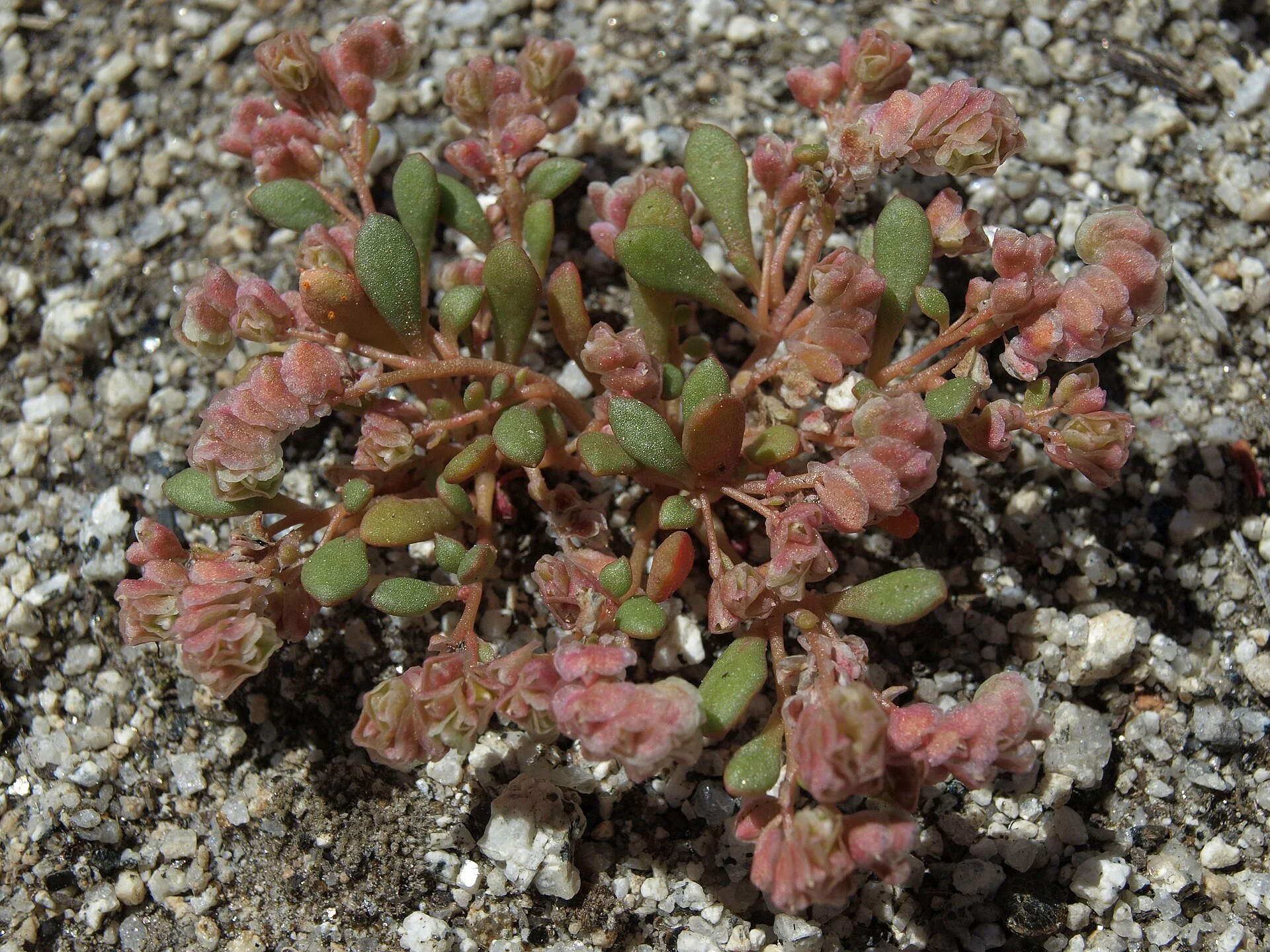
Spreading across the arid sandy soils of western North America, this delicate annual wildflower brings a touch of pink to sagebrush deserts. Calyptridium roseum is commonly found in gravelly flats, pinyon-juniinter woodlands, and dry scrublands. Its low-growing habit and specialized reproductive biology make it well-suited to regions with low annual rainfall.
The plant is highly valued by native plant enthusiasts for its subtle beauty and ecological role in desert ground cover. It typically emerges rapidly in late spring, completing its life cycle before the peak heat of summer arrives.
The growth form of this annual herb is distinctly prostrate, with multiple stems radiating from a central point. Its leaves are spatulate, succulent, and light green, measuring up to 5 centimeters in length. The vegetative parts are designed to store water during brief wet periods.
Distinctive floral structures include:
Sepals: Two large, rounded, kidney-shaped sepals that display prominent white or rose-pink membranous margins.
Petals: Usually only two small, white petals, which is an unusual reduction compared to other members of the genus.
Stamen: A single stamen per flower, adapting the species for efficient self-pollination.
Fruit: A small, two-valved capsule containing smooth, black, shiny seeds.
Flowering season
Late Spring to Mid-Summer (May to July)
Jan
Feb
Mar
Apr
May
Jun
Jul
Aug
Sep
Oct
Name
Dec
Interesting facts
The reduction of floral organs in this species is a fascinating example of evolutionary adaptation. Having only two petals and a single stamen allows the flower to self-pollinate quickly and reliably without relying on scarce desert insect pollinators. Furthermore, the sepals remain colorful and expand after fertilization, protecting the maturing seeds from solar radiation and assisting in wind dispersal.
Geography of distribution
California
Nevada
Oregon
Utah
Idaho
Wyoming
Colorado
Sources
POWO: Accepted name record for Calyptridium roseum.
GBIF: Distribution maps and specimen collections in the Great Basin region.
WFO: Detailed botanical description and taxonomic reference data.