
Oriental Charcoal Tree
Trema orientale
Trema orientale, widely known as the charcoal tree or pigeon wood, is a fast-growing evergreen …
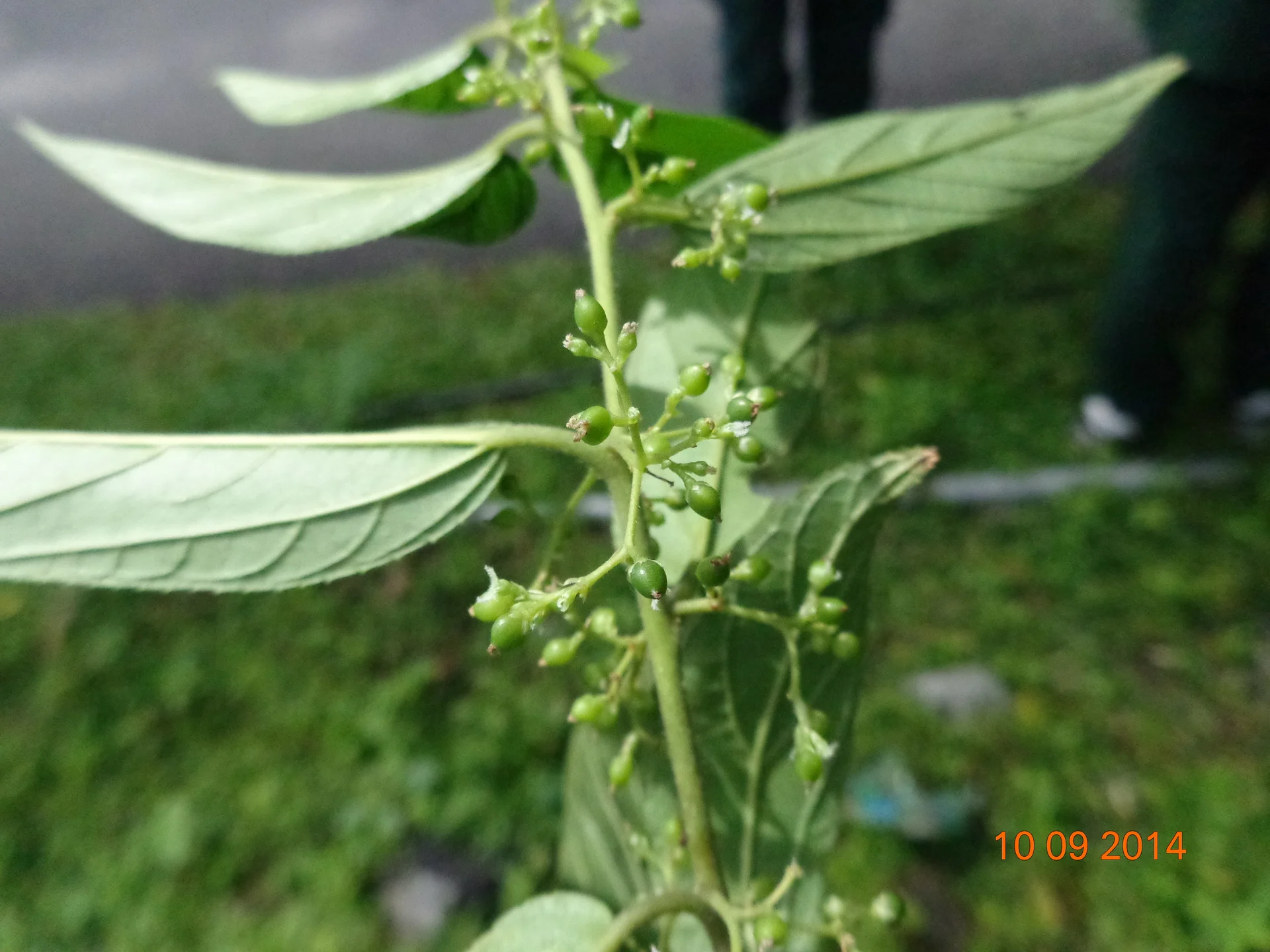
Trema politoria is a rugged, sun-loving shrub or small tree native to the foothills of the Himalayas, the Indian subcontinent, and mainland Southeast Asia, where it colonizes rocky riverbanks and gravelly landslips. Its stiff, oblong-lanceolate leaves feel remarkably like fine-grit sandpaper to the touch—a characteristic directly reflected in the specific epithet politoria, derived from the Latin word for "polishing" or "smoothing".
Classified within the family Cannabaceae, this species was first formally described as Celtis politoria in 1848 by Jules Émile Planchon, building on earlier manuscript notes compiled by Nathaniel Wallich from a 1821 collection. In 1856, the German-Dutch botanist Carl Ludwig Blume transferred the taxon to the genus Trema, establishing the accepted name Trema politoria.
Growing as an erect shrub or modest tree between 2 and 10 meters tall, Trema politoria develops tough, terete (cylindrical) branches covered in short, stiff, bristly hairs. The young twigs are pale brown and scabrous, hardening quickly to withstand dry seasonal winds and shifting stony substrates.
The leaves are stiff and coriaceous (leathery), measuring 5 to 12 centimeters long, with a rounded or slightly heart-shaped base and sharply toothed edges. Three prominent primary veins branch from the base of the blade—a pattern known as trinerved venation—while both surfaces are densely studded with microscopic, mineralized bristles.
Flowers primarily from April to June at the onset of the warm season, with fruits maturing from July through autumn.
True to its Latin name, the dried foliage of Trema politoria has long been used by craftspeople across northern India and Nepal as a botanical sandpaper. Carvers rub the stiff, silica-rich leaves over seasoned timber, horn, and bone to buff away fine tool marks without scratching the underlying grain.
The sandpaper texture that gives Trema politoria its name is not merely stiff plant fiber, but a miniature array of mineralized structures called cystoliths and silicified trichomes (hairs). As the leaf matures, epidermal cells deposit calcium carbonate and amorphous silica into rigid, conical bristles angled across the upper and lower surfaces.
Taxon Synonyms: Sponia politoria, Celtis politoria
Trema orientale
Trema orientale, widely known as the charcoal tree or pigeon wood, is a fast-growing evergreen …

Trema micranthum
A fast-growing evergreen pioneer tree native to the tropical Americas, bearing rough two-ranked leaves and …

Picrasma
A genus of deciduous trees and shrubs known for their extremely bitter bark and medicinal …

Araucaria humboldtensis
A small, critically endangered coniferous tree native strictly to the high-altitude mountain peaks of southern …