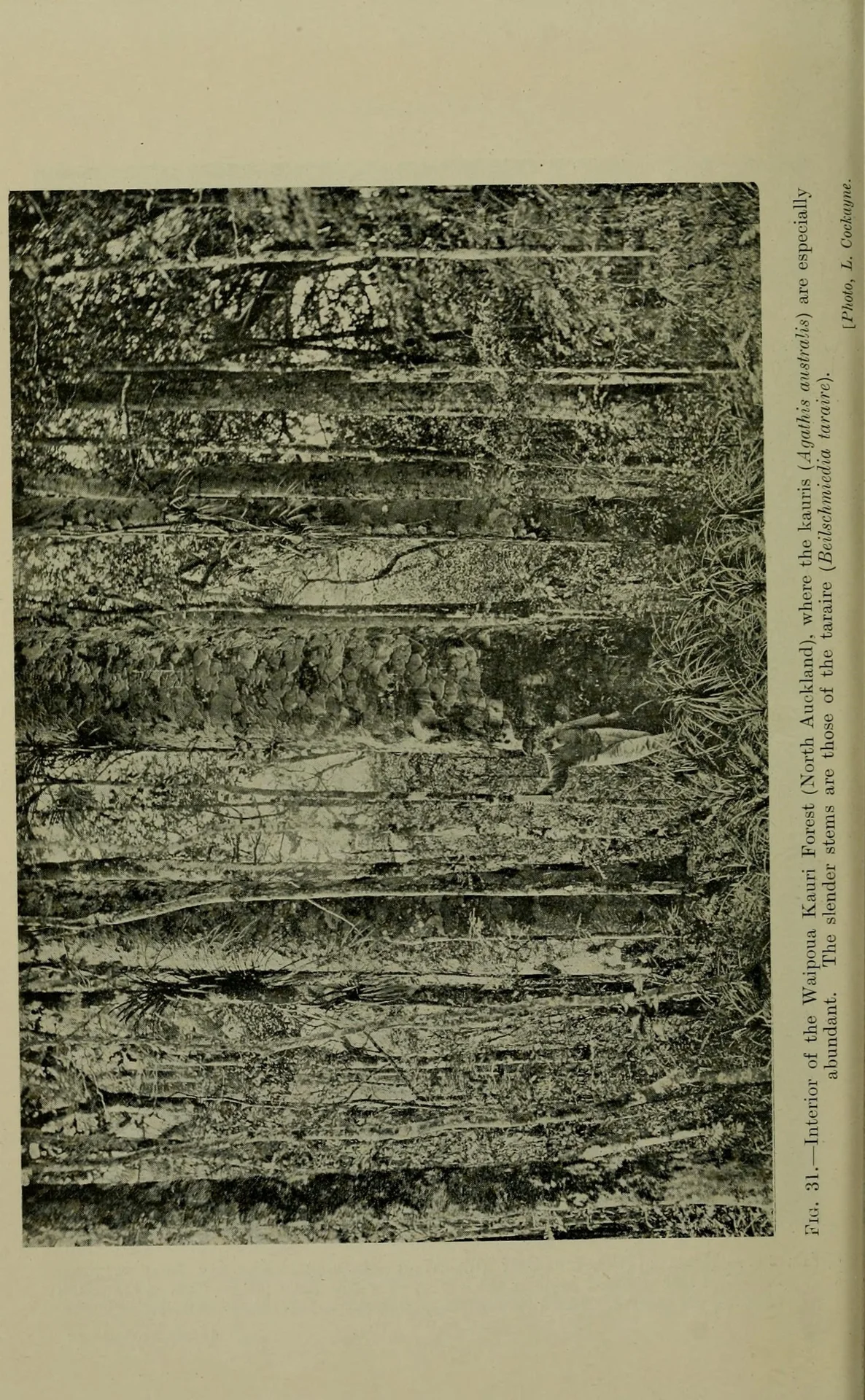
Deep within the mist-shrouded forests of New Zealand's North Island stands a living monument that has witnessed millennia of earthly history. Agathis australis, widely known by its Maori name Kauri, is an awe-inspiring coniferous giant that forms the backbone of a unique ecosystem and dominates the forest canopy.
Tracing its lineage back to the Jurassic period, this remarkable species is a true living fossil that survived the age of dinosaurs. Although not the tallest tree in New Zealand, it holds the record for the greatest volume, actively altering the soil chemistry beneath its canopy to ensure its survival.
Taxonomy
∟царствоPlantae
∟divisionTracheophytes(Vascular Plants)
∟subdivisionSpermatophytes(Seed plants)
∟superclassGymnospermae(Gymnosperms)
∟divisionPinophyta(Conifers)
∟subclassCupressidae
∟orderAraucariales(Southern pines and monkey-puzzles)
In its youth, Agathis australis exhibits a narrow, conical shape with branches extending down the length of its trunk. As the tree matures, it sheds its lower branches—a process that prevents parasitic vines from climbing—and eventually develops a massive, spreading crown that towers over the native forest. The trunk is remarkably cylindrical with little taper, cloaked in smooth, ash-gray or mottled-purple bark that flakes off in thick scales.
Unlike the needle-like leaves typical of many conifers, the foliage consists of tough, leathery, and narrow leaves that are 3 to 7 centimeters long without a prominent midrib. It is a monoecious species, bearing both stout, cylindrical male pollen cones and nearly spherical, bluish-green female seed cones on the same tree.
Flowering season
Pollination typically occurs in October, with seed cones taking up to 20 months to reach full maturity.
Jan
Feb
Mar
Apr
May
Jun
Jul
Aug
Sep
Oct
Name
Dec
Applications
Historically, the timber of Agathis australis was highly prized for its exceptional qualities, being straight-grained, remarkably strong, and lightweight. It was an outstanding material for shipbuilding, particularly for crafting the masts of sailing vessels, as well as for housing construction and high-quality furniture.
Beyond its timber, the tree is famous for producing copious amounts of resin, known as Kauri copal or gum, which was once a major export utilized in premium varnishes and linoleum. Today, due to extensive historical logging and the vulnerability of remaining populations, the commercial harvesting of live trees is strictly prohibited, and the species is fiercely protected.
Interesting facts
The largest known living specimen of Agathis australis is famously named Tāne Mahuta, which translates to 'Lord of the Forest' in Maori mythology, standing over 51 meters tall with an estimated age of up to 2,500 years. Another colossal specimen, Te Matua Ngahere or 'Father of the Forest', boasts the greatest girth of any living Kauri, measuring over 16 meters in circumference.
Ancient forests have left behind an incredible legacy known as swamp Kauri, prehistoric trees buried in peat swamps that have been preserved for up to 50,000 years. Modern populations now face a severe threat from Kauri dieback, a fatal disease caused by the soil-borne pathogen Phytophthora agathidicida, prompting strict conservation measures.