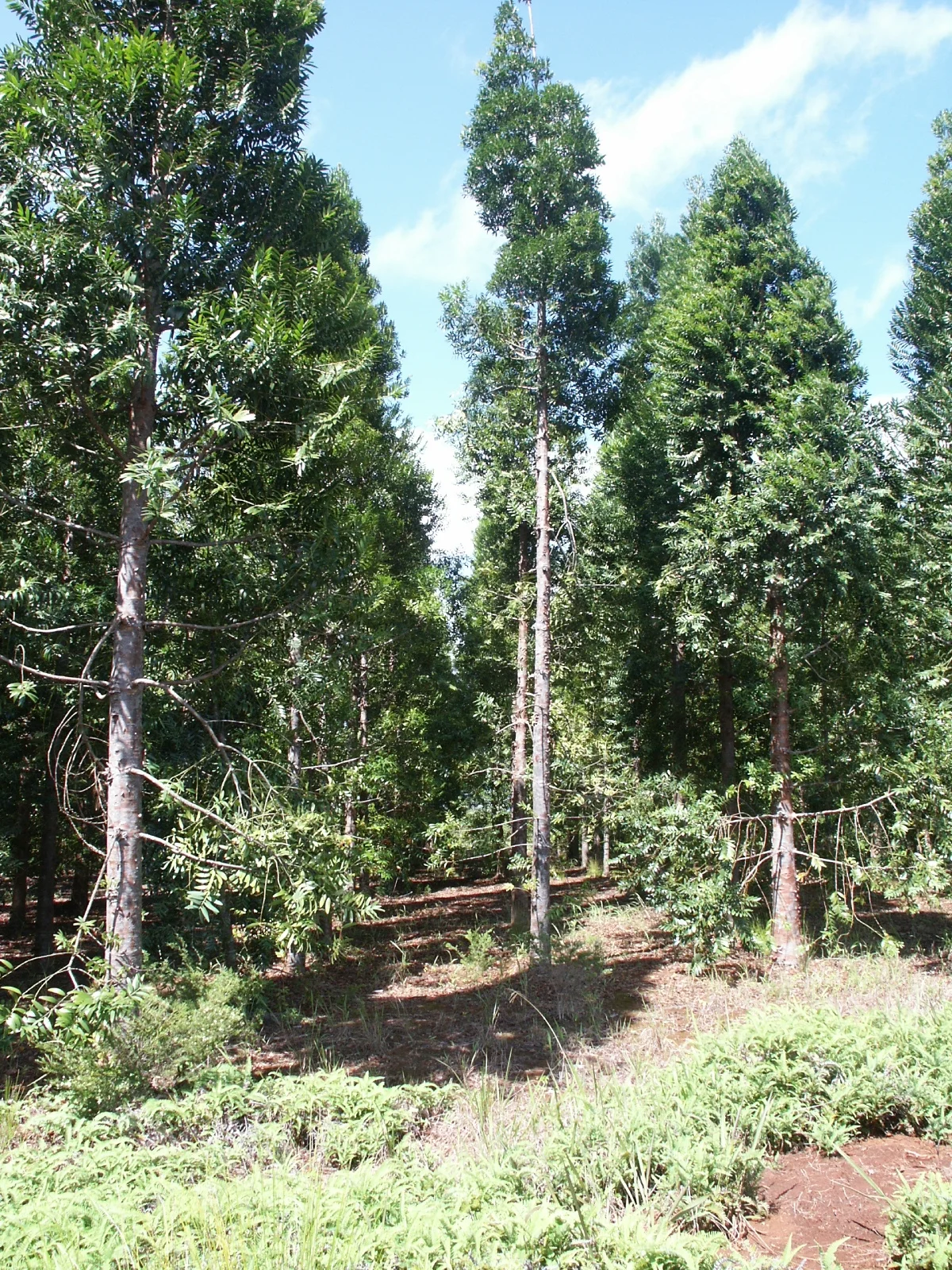
Agathis lanceolata (Koghis Kauri): Morphology, Ecology, and Uses
Deep within the dense, humid rainforests of New Caledonia stands Agathis lanceolata, a towering giant of the Araucariaceae family. This magnificent conifer is completely endemic to the region, predominantly restricted to the southern half of Grande Terre with scattered populations in the Northern Province. Thriving on ultramafic substrates at altitudes ranging from 200 to 1,100 meters, it is a prominent feature of the island's unique ecosystem.
Reaching heights of up to 40 meters, this tree commands attention with its massive, cylindrical trunk and dense, irregularly shaped crown. Some exceptional ancient specimens, such as the famous 'Grand Kaori' in the Rivière Bleue Provincial Park, have survived for over a millennium, bearing witness to the deep botanical history of the archipelago.
Taxonomy
∟царствоPlantae
∟divisionTracheophytes(Vascular Plants)
∟subdivisionSpermatophytes(Seed plants)
∟superclassGymnospermae(Gymnosperms)
∟divisionPinophyta(Conifers)
∟subclassCupressidae
∟orderAraucariales(Southern pines and monkey-puzzles)
The physical presence of Agathis lanceolata is defined by its long, clear trunk that can remain unbranched for up to 15 meters. Its bark transitions from smooth and light grey, shedding in thin plates, to a rough, reddish-brown texture with irregular scales and numerous brown lenticels. When injured, the trunk exudes a distinctive yellowish resin.
The foliage features dark green leaves that are lanceolate to elliptical in shape, typically measuring 6 to 8 centimeters in length and up to 2 centimeters in width. Adult leaves are characterized by acute apices and slightly recurved margins.
The species produces solitary male pollen cones and robust, globose-to-elliptical female seed cones that measure approximately 12 centimeters in length. The seeds themselves are ovoid and equipped with broad wings to facilitate wind dispersal.
Applications
Since the 19th century, the high-quality wood of Agathis lanceolata has been extensively exploited for various construction and crafting purposes. Its straight, regular grain makes it exceptionally valuable across multiple industries.
The primary historical and modern uses of the timber include:
Heavy construction and structural framework.
Boat building and maritime carpentry.
Fine woodworking and cabinet making.
In recent decades, dedicated plantation programs have been established for silviculture and reforestation. Although the trees require 50 to 60 years of growth before harvesting, these efforts support long-term sustainable forestry.
Interesting facts
The historical overexploitation of its timber has led to a dramatic reduction in the natural range of Agathis lanceolata, resulting in its classification as a Vulnerable species by the IUCN. Today, the global population is estimated to contain fewer than 10,000 mature individuals, with no single subpopulation exceeding 1,000 adult trees.
A significant challenge to modern plantation efforts is the proliferation of the introduced Rusa deer (Cervus timorensis). The browsing damage caused by these animals has restricted viable new plantations primarily to the extreme south of Grande Terre and the Isle of Pines.