Amboina pine
East Indian kauri
Amboina pitch tree
crystal tree
IUCN: Vulnerable
#FAFCF2
#607923
#3F6108
#7B9B2F
#123204
Plant palette
Agathis dammara (Dammar Pine): Morphology, Uses & Distribution
In the dense tropical rainforests of Southeast Asia, moonlight catching the translucent resin of Agathis dammara creates an illusion of a shimmering "crystal tree." This towering evergreen conifer, a living relic with a lineage stretching back to the Mesozoic era, forms a majestic emergent canopy in its native habitats. The species is primarily distributed across the Maluku Islands, Sulawesi, and the Philippines.
Often referred to as the dammar pine or Amboina pine, the tree is highly valued for both its ecological role and economic contributions. It belongs to the ancient Araucariaceae family, standing as a testament to the prehistoric flora that once dominated the globe.
Taxonomy
∟царствоPlantae
∟divisionTracheophytes(Vascular Plants)
∟subdivisionSpermatophytes(Seed plants)
∟superclassGymnospermae(Gymnosperms)
∟divisionPinophyta(Conifers)
∟subclassCupressidae
∟orderAraucariales(Southern pines and monkey-puzzles)
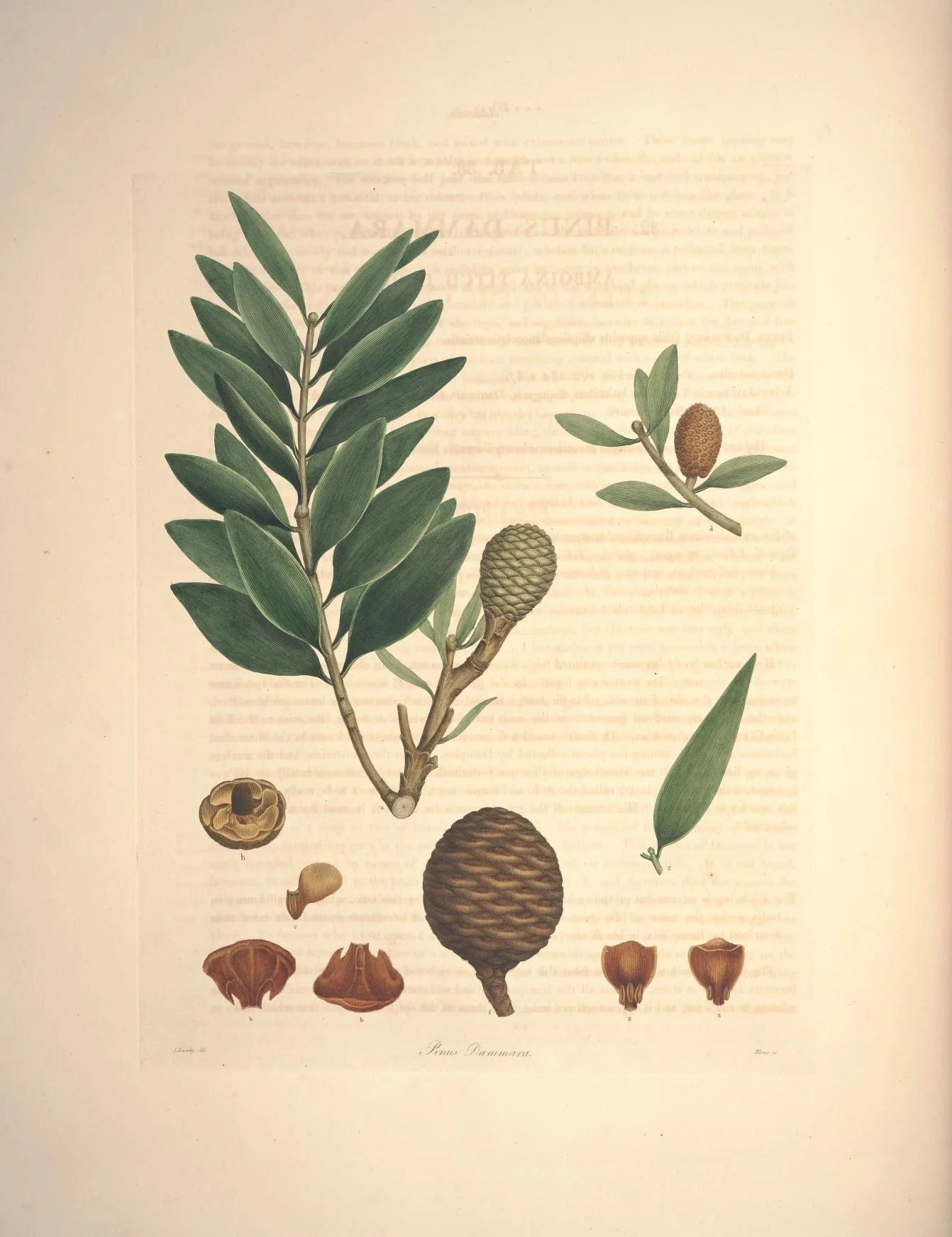
Botanical illustration
Фото: BioDivLibrary / Лицензия: Public Domain Mark
Morphology
Agathis dammara is a monumental evergreen that can reach heights of up to 60 meters, featuring a massive, straight trunk measuring up to 1.8 meters in diameter. The thick bark varies in color from reddish-gray to dark brown or black. It is often heavily textured with fine scales, dimples, and numerous blisters containing resin.
The leathery, dark green leaves are remarkably variable depending on the tree's developmental stage. Juvenile leaves are typically lanceolate with an acute apex, while mature leaves are smaller, ovate to oblong-elliptical, and rounded at the tip. The tree produces solitary, cylindrical male pollen cones and larger, spherical to ovoid female seed cones.
Upon maturity, the female cones release obovoid seeds equipped with distinctively asymmetrical membranous wings. This unique wing structure allows the seeds to be efficiently dispersed by the wind across the forest floor.
Applications
The most significant economic product of Agathis dammara is its prolific resin, historically known as Manila copal or dammar gum. This valuable exudate is harvested commercially by tapping the bark and serves as a crucial ingredient in the manufacture of varnishes, lacquers, paints, and traditional incense.
Additionally, the tree yields high-quality, straight-grained, and knot-free timber. Its strong and light-colored wood is highly sought after for construction, boat building, and delicate carpentry work. Due to its economic importance, it has been extensively cultivated in forest plantations outside its natural range, particularly in Java.
Interesting facts
This ancient conifer holds a fascinating place in both natural history and local folklore.
The Crystal Tree: In some cultures, it is affectionately dubbed the "crystal tree" because its clear, light brown resin beautifully reflects moonlight during a full moon night.
Prehistoric Connections: The ancient lineage of this tree is so profound that the extinct Mesozoic genus Protodammara was named in its honor, reflecting an evolutionary history of over 200 million years.
Taxonomic Journey: When first discovered, European botanists mistakenly classified it under the genus Pinus (pines) and later Abies (firs), before finally establishing its place in the distinct genus Agathis.