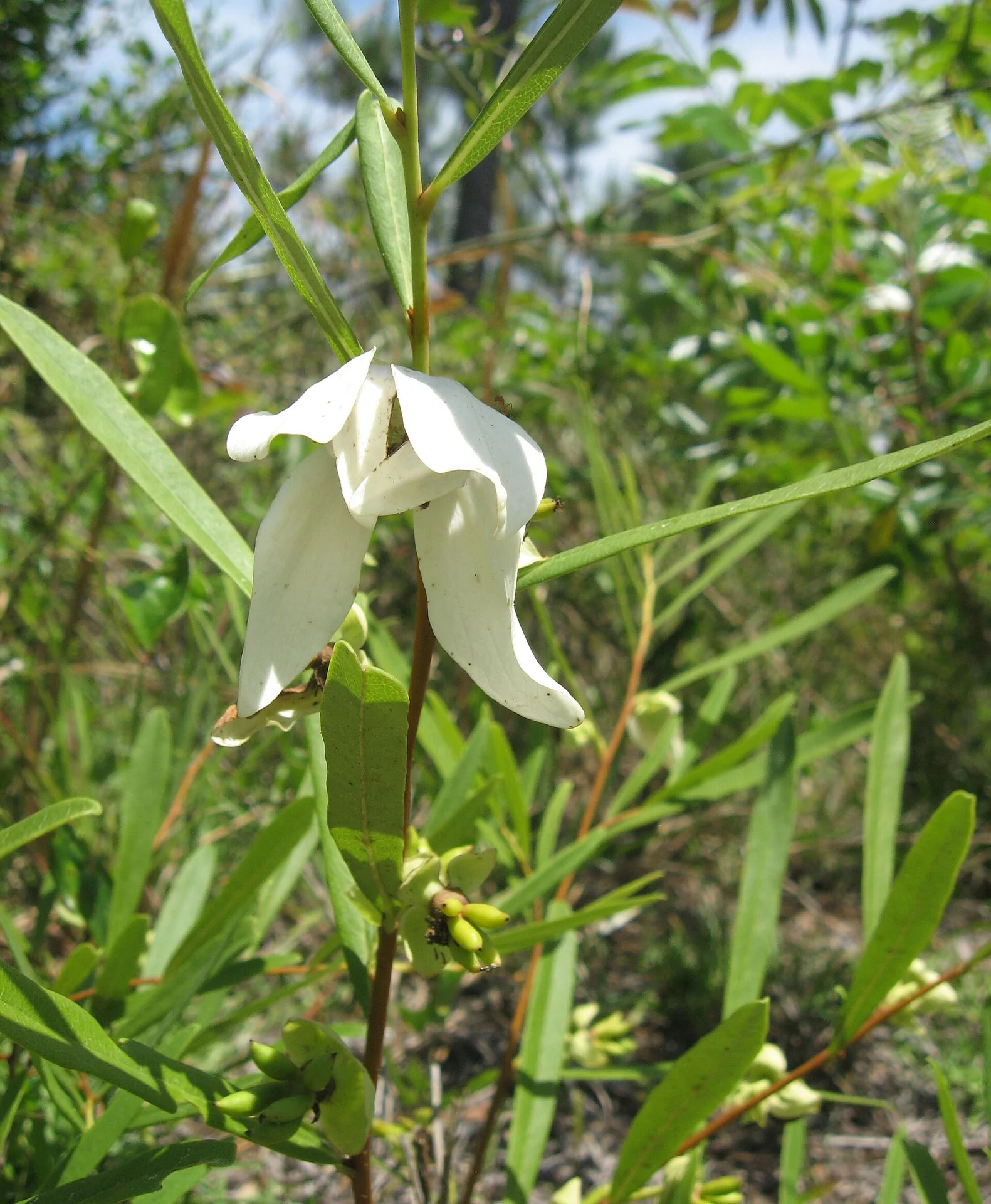
Asimina longifolia (Slimleaf Pawpaw): Morphology and Ecology
Native to the coastal plains of the Southeastern United States, Asimina longifolia thrives in dry pinelands and maritime forests. Commonly known as the slimleaf pawpaw or polecatbush, this deciduous shrub contributes significantly to its native ecosystems. It often grows in natural association with other characteristic regional flora, such as Florida phlox and laurel oak.
The species is broadly recognized by its exceptionally narrow foliage and striking white flowers. Botanists currently distinguish two main varieties across its range, var. longifolia and var. spatulata, though further taxonomic study is frequently recommended to fully understand their structural relationship.
Asimina longifolia is a relatively small bush, typically reaching 1 to 1.5 meters in height. The stems are stiffly upright to spreading, covered in a red-brown to yellow-brown bark. Its distinctively long, narrow leaves can measure up to 15 centimeters in length and feature margins that are slightly to strongly rolled upwards.
The plant produces fragrant, nodding flowers that are usually white or cream-colored, though occasionally pink. These blossoms feature spreading outer petals and shorter, upright inner petals. The resulting fruit is a yellow-green berry measuring 4 to 10 centimeters, containing dark brown, shiny seeds.
Flowering season
Spring to summer
Jan
Feb
Mar
Apr
May
Jun
Jul
Aug
Sep
Oct
Name
Dec
Interesting facts
The pollen of this species is uniquely shed in permanent tetrads, a notable characteristic within its genus.
It is remarkably well-adapted to its environment and has been observed thriving in both fire-excluded areas and regions that experience regular burns.
The flowers are highly fragrant, adding a distinctive olfactory dimension to the shrub's presence in the wild.