Bigflower pawpaw (Asimina obovata)

flag pawpaw
#61664A
#576A50
#5B606E
#25252C
#2B2A1F

Asimina obovata (Bigflower Pawpaw): Botanical Characteristics

Flourishing in the dry woods and open sandy hammocks of Florida, Asimina obovata stands out with its striking floral displays. This woody plant adapts well to the state's specialized coastal and inland scrub ecosystems.

The species provides crucial ecological support to local wildlife, offering both sustenance and habitat. Its impressive blooms and distinct growth pattern make it a notable component of the Southeastern United States flora.

Taxonomy

  • царство Plantae
  • division Tracheophytes (Vascular Plants)
  • subdivision Spermatophytes (Seed plants)
  • Angiosperms
  • magnoliids
  • order Magnoliales
  • family Annonaceae (Custard apple family)
  • subfamily Annonoideae
  • genus Asimina (Pawpaw)
  • species Asimina obovata (Bigflower pawpaw)

Living Pulse

Morphology

This species displays several remarkable morphological traits.

  • Habit: It grows as a heavily branched evergreen shrub or small tree, reaching heights of 2 to 5 meters.
  • Leaves: The leathery leaves are oblong to obovate, growing between 4 and 10 centimeters in length with pinnate venation.
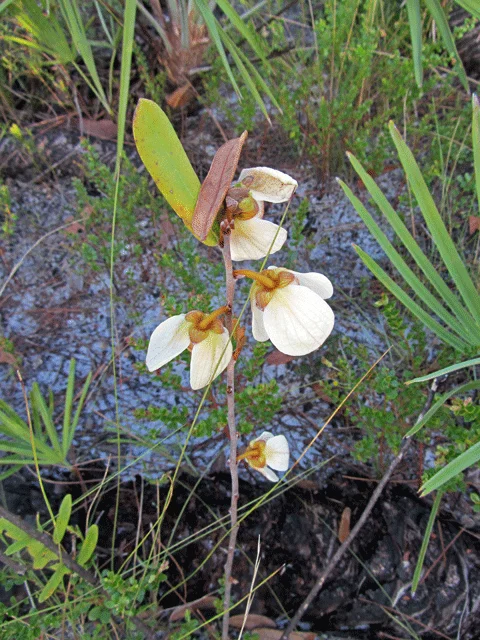
  • Flowers: Producing some of the largest flowers in its genus, the blooms can measure up to 10 centimeters across. They feature showy white to yellowish-white outer petals and smaller, curved inner petals.
  • Fruit: Following pollination, large green edible berries develop, reaching 5 to 9 centimeters in length.

Flowering season

Late winter to early summer

Jan
Feb
Mar
Apr
May
Jun
Jul
Aug
Sep
Oct
Name
Dec

Applications

The plant possesses both historical and ecological utility.

  • Foraging: The large green fruits are edible and serve as a reliable food source for local wildlife.
  • Habitat: It is occasionally utilized in native plant landscaping to support endemic insect populations and restore natural habitats.

Interesting facts

The bigflower pawpaw plays a vital role in its natural habitat.

  • It serves as a critical host plant for the zebra swallowtail butterfly and the pawpaw sphinx moth.
  • Similar to its botanical relatives, its pollen is uniquely shed as permanent tetrads.
  • The specific epithet obovata refers to the inverted egg-like shape of its leaves.

Geography of distribution

  • United States

Sources

  • Flora of North America
  • GBIF
  • Tropicos
  • World Flora Online (WFO)

Technical Information

Taxon Synonyms: Annona obovata

External Databases: GBIF, POWO, Tropicos

See also

Common Pawpaw

Common Pawpaw

Asimina triloba

Asimina triloba, commonly known as the pawpaw, is a small deciduous tree native to North …
Dwarf pawpaw

Dwarf pawpaw

Asimina pygmaea

A small, intriguing shrub native to Florida and Georgia, known for its deep crimson flowers …