Flame Tree
Flamboyant
Peacock Flower
Flame of the Forest
Phoenix Tree
IUCN: Уязвимый вид
#83563D
#ABE5FB
#B29E85
#3E2314
#812118
Plant palette
Delonix regia: The Majestic Royal Poinciana
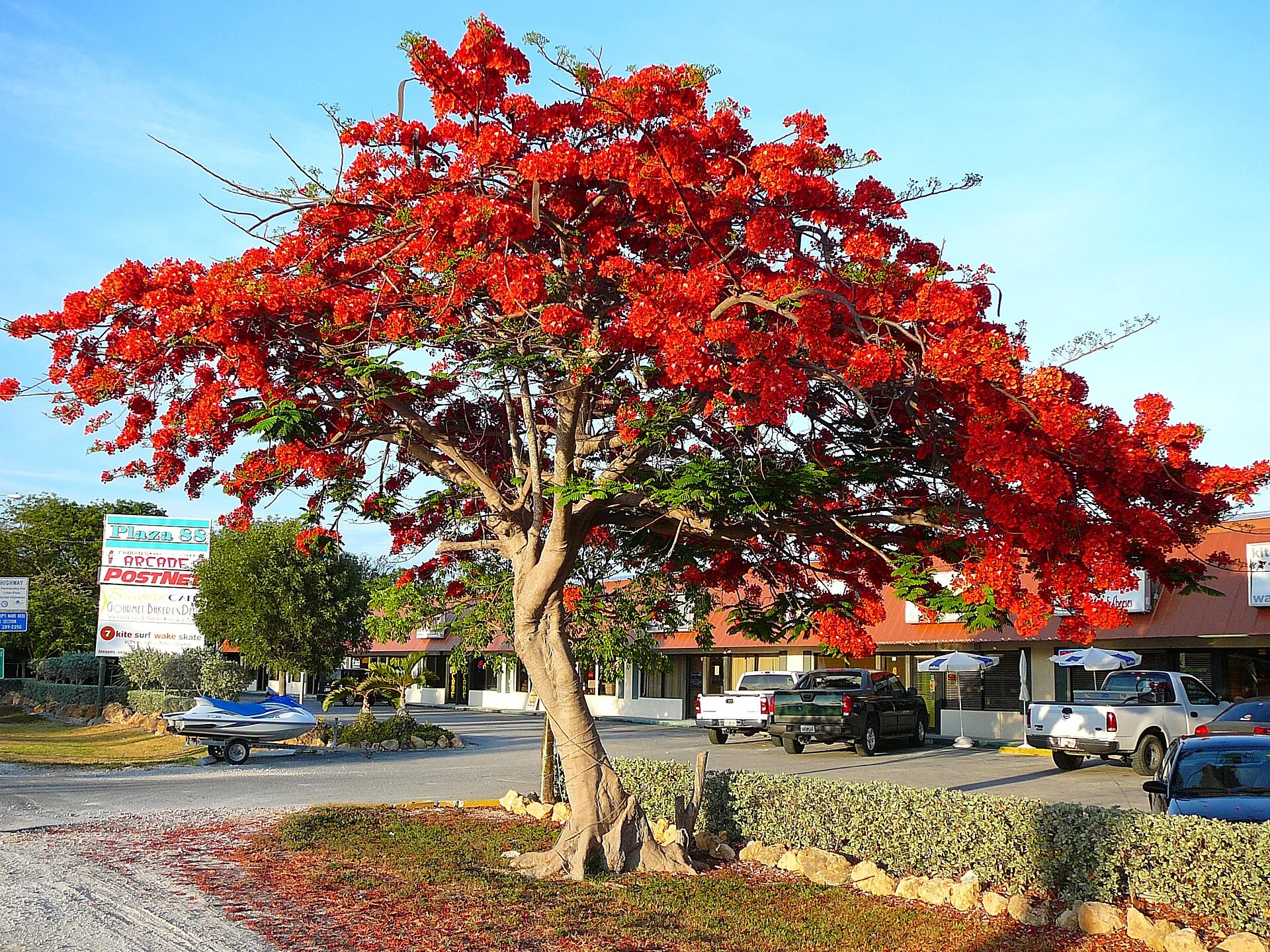
With its sweeping umbrella-like canopy erupting into a sea of scarlet blossoms, the royal poinciana paints tropical landscapes in shades of liquid fire during the height of summer. This spectacular display has earned Delonix regia a reputation as one of the most colorful trees in the world.
Native to the dry deciduous forests of Madagascar, this member of the legume family is now widely cultivated across tropical and subtropical zones. Beyond its striking visual appeal, the species is highly valued for providing dense, cool shade in hot climates.
Though endangered in its original wild habitat due to charcoal production, it continues to thrive globally in parks and along urban avenues. Its rapid growth and tolerance to diverse soil conditions make Delonix regia a favorite choice for landscape architects.
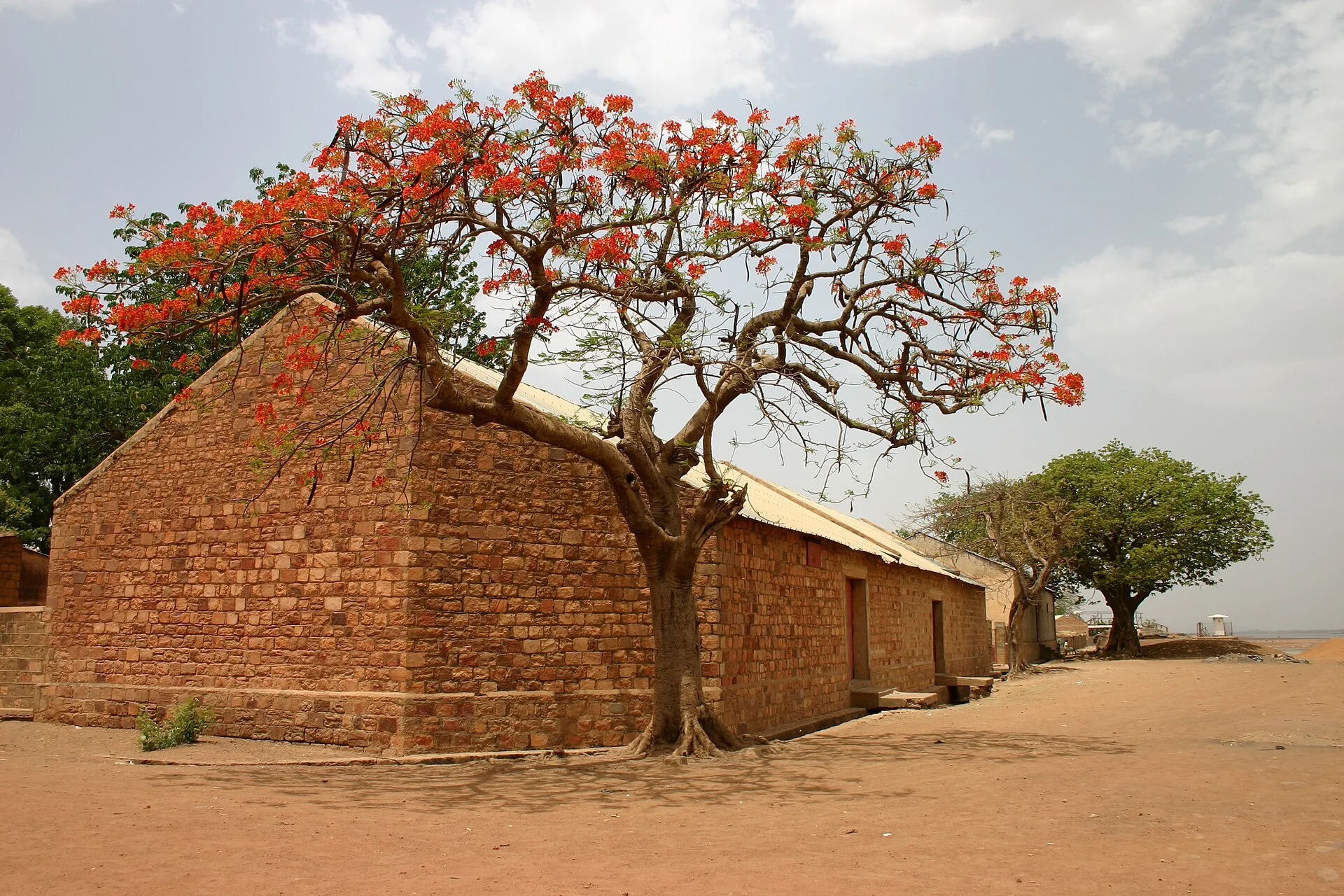
Delonix regia is a medium-sized deciduous tree reaching average heights of 10 to 12 meters, though it can grow up to 15 meters under optimal conditions. The tree forms a characteristic broad, umbrella-shaped canopy that is often wider than the tree is tall, supported by a smooth greyish-brown bark and buttressed roots at the base of mature specimens.
The foliage has a delicate, feathery appearance due to its bipinnate structure. The key features of its vegetative and reproductive organs include:
Leaves: Alternate, doubly pinnate compound leaves measuring 30 to 50 centimeters in length. Each leaf has 20 to 40 pairs of primary pinnae, subdivided into 10 to 20 pairs of small, oblong secondary leaflets that fold closed at nightfall.
Flowers: Large, showy blossoms up to 8 to 11 centimeters in diameter grouped in terminal corymbs. They consist of four clawed, spreading scarlet or orange-red petals, and a larger fifth upright petal called the standard, which is streaked with yellow and white.
Pods and Seeds: Flat, elongated, woody pods that can reach up to 60 centimeters in length. They transition from green to dark brown upon maturity, containing 20 to 40 hard, oblong, mottled seeds weighing approximately 0.4 grams each.
Flowering season
Blooms from April to July in the Northern Hemisphere, and from November to February in the Southern Hemisphere.
Jan
Feb
Mar
Apr
May
Jun
Jul
Aug
Sep
Oct
Name
Dec
Applications
Delonix regia serves multiple practical purposes across tropical and subtropical regions where it is cultivated. Its primary applications include:
Ornamental and Shade: With its wide, umbrella-like canopy, it is highly valued as a street and park tree to provide deep, cool shade in urban areas, plantations, and pastures.
Traditional Medicine: Various plant parts are utilized in folk remedies. A decoction of the flowers is ingested to treat respiratory ailments like bronchitis and coughs, while the macerated bark is applied topically to relieve rheumatic joints.
Wood and Crafts: The light, soft, and flexible wood is used for crafting small furniture, light structures like canoes, and domestic utensils, or consumed as firewood. The hard, mottled seeds are frequently strung into necklaces and bracelets.
Musical Instruments: In the Caribbean, the dry, mature woody pods containing loose seeds are used as traditional percussion instruments called 'shak-shaks' or maracas.
Industrial Uses: A thick gum extracted from the seeds is used in the textile and food industries, and the seeds yield an oil suitable for leather tanning. The flowers also serve as a rich source of nectar for honey bees.
Interesting facts
Delonix regia is steeped in cultural lore and regional traditions across the globe. Some of the most compelling stories and facts associated with the tree include:
The Flower of Calvary: In the Indian state of Kerala, Saint Thomas Christians refer to the blossoms as 'kaalvarippoo,' meaning the flower of Calvary. Local legend holds that a small poinciana tree stood near the Cross of Jesus, and his blood dipped onto the petals, staining them with their vivid crimson hue.
Symbol of School Days: Throughout Vietnam, the tree is known as the 'phoenix's tail' due to the shape of its delicate leaves. Because its vibrant red flowers bloom from May to July, coinciding with the end of the academic year, it is widely referred to as the 'pupil's flower' and serves as a poignant symbol of graduation and student life.
New Year Herald: In Myanmar, the fiery blossoms signal the arrival of the traditional Thingyan Water Festival in April. Similarly, in the island nations of Mauritius and La Réunion, the sudden burst of red flowers marks the beginning of the New Year.
Official Emblems: The species serves as the national flower of Saint Kitts and Nevis, the official tree of the Northern Mariana Islands, and the city tree of Key West, Florida. It is also the designated city tree of Tainan in Taiwan, and Xiamen and Shantou in mainland China.
Aggressive Roots: Despite its beauty, the tree possesses an extremely aggressive and shallow root system. These surface roots can easily uplift sidewalks, crack road pavements, and damage nearby drainage systems or building foundations.