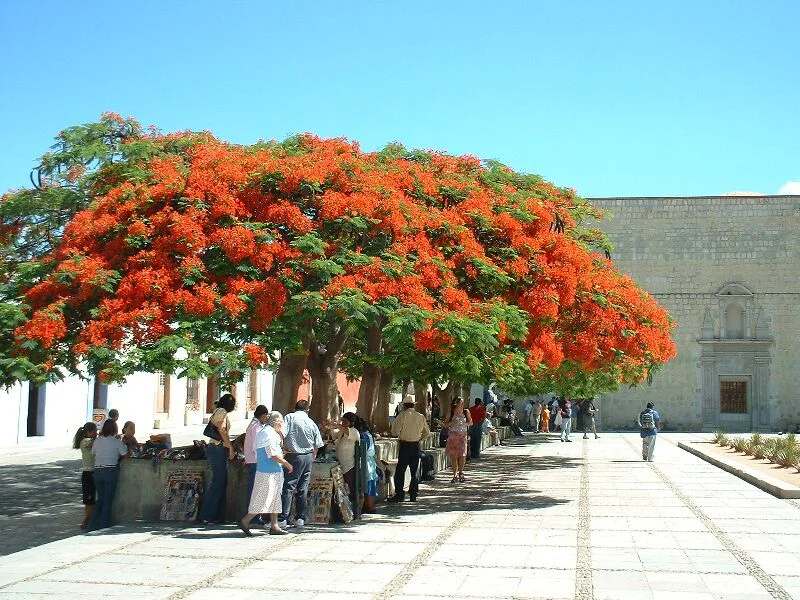
Amidst the arid, sun-drenched deciduous forests of Madagascar, a brilliant flash of scarlet and gold frequently disrupts the dusty landscape. These breathtaking displays belong to members of the genus Delonix, which are highly celebrated for their dramatic umbrella-shaped crowns.
Most species within this group are endemic to Madagascar, although a few extend their native range into East Africa and the Arabian Peninsula. Their stunning floral showcases have led to global cultivation, transforming streets and gardens in tropical regions worldwide.
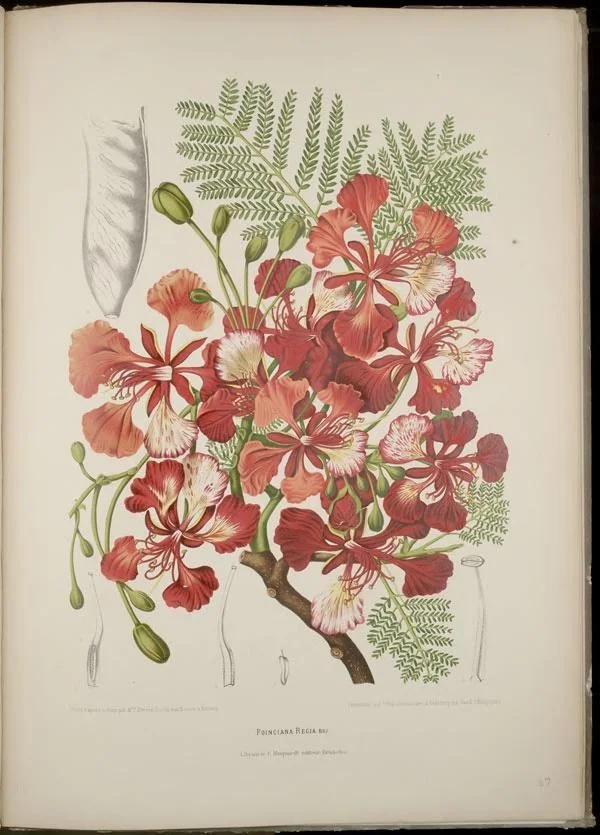
Botanical illustration
Фото: BioDivLibrary / Лицензия: Public Domain Mark
Morphology
Members of the genus Delonix are characterized by their unarmed, deciduous growth habit and spreading, umbrella-like crowns. Their bipinnate leaves are highly divided, reaching up to 50 centimeters in length and carrying hundreds of minute, oblong leaflets that give the foliage a soft, feathery texture.
Their reproductive structures display remarkable adaptations:
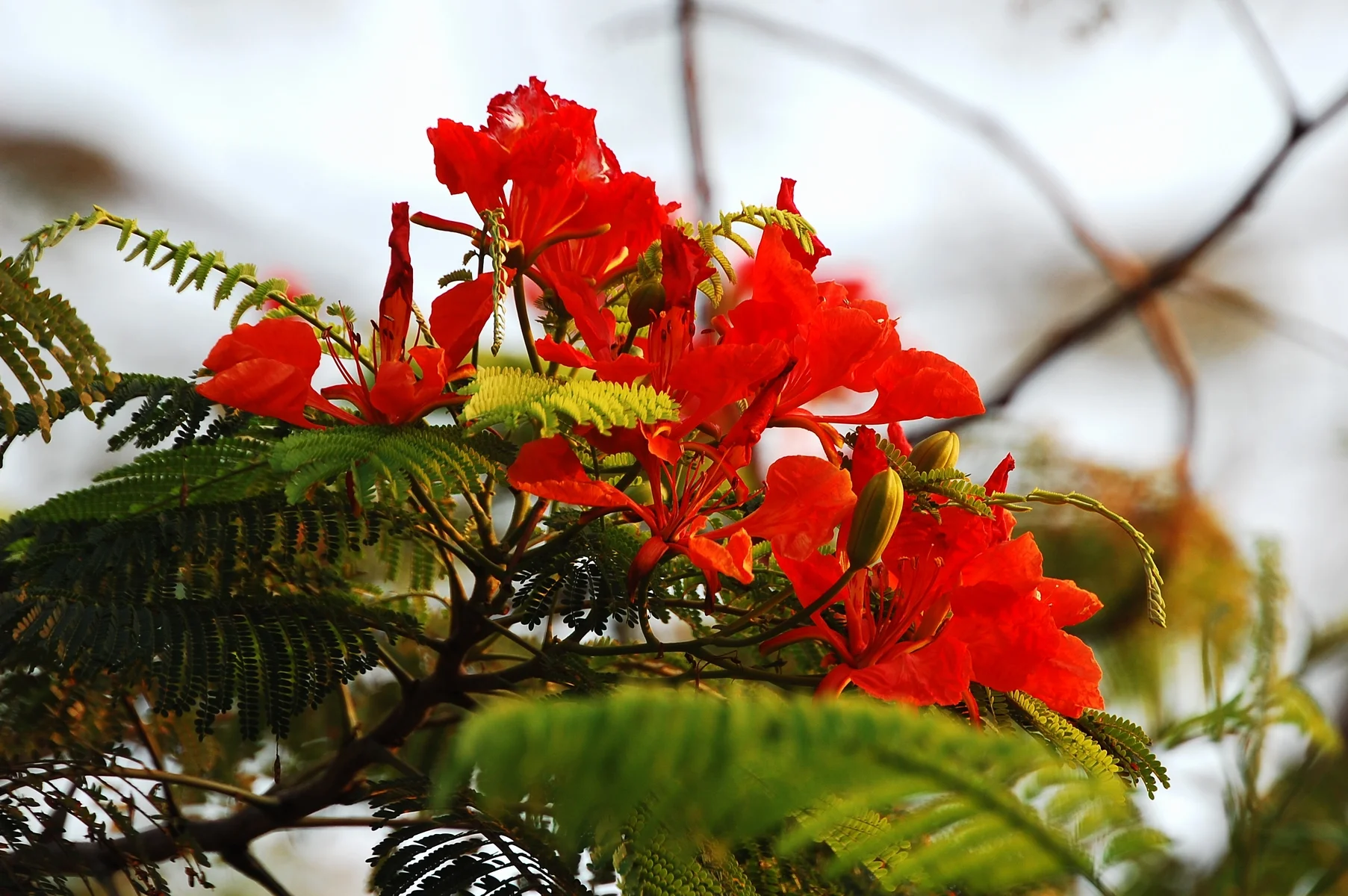
Flowers: The large, showy blossoms are arranged in terminal or axillary corymbose racemes, featuring five distinct, long-clawed petals with crinkled margins.
Stamens: Ten free, often hairy stamens protrude prominently from the center of the flower.
Fruit: The fruit is a flattened, woody, elongated pod that can reach up to 70 centimeters in length, splitting open at maturity to release multiple hard seeds.
Flowering season
Typically blooms during the warm dry season or early wet season, producing spectacular masses of flowers.
Jan
Feb
Mar
Apr
May
Jun
Jul
Aug
Sep
Oct
Name
Dec
Applications
The economic and cultural uses of Delonix species are diverse and deeply rooted in their native regions. In Madagascar, several species yield a thick, brown resin that locals dissolve to formulate traditional adhesives or consume as edible sweets.
Key applications include:
Ornamental Landscaping: Due to their spectacular flowering displays and broad shade-providing crowns, species like the Royal Poinciana are planted extensively in tropical urban areas.
Traditional Crafts: The hard, elongated seeds are frequently harvested to create decorative necklaces, beads, and musical instruments.
Local Resources: The soft, lightweight wood is sometimes used for light construction and boat-making, while the large woody pods are burned as fuel.
Interesting facts
The scientific name Delonix is a direct translation of its floral morphology, derived from the Greek words delos (evident) and onyx (claw), which references the distinctively shaped petals. While the fiery red flowers of the Royal Poinciana are pollinated by sunbirds and bees, other species in the genus produce pale or whitish flowers that are specialized for pollination by nocturnal moths.
Malagasy Endemism: Out of the twelve recognized species, nine are strictly endemic to the island of Madagascar.
Flame of the Forest: In many cultures, these trees are referred to as the 'flame tree' or 'peacock flower' due to the intense coloration of their massive blooms.