Humulus (Hops) - Genus Overview, Uses and Botanical Facts
Long before they defined the bitter, aromatic profile of modern beer, these vigorous vines wound their way through the damp river valleys of the Northern Hemisphere. The genus Humulus encompasses fast-growing herbaceous climbers that have shaped human agricultural history and brewing traditions for over a millennium.
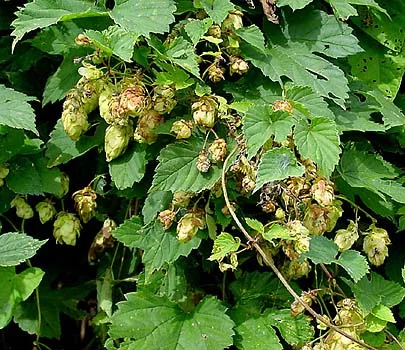
Equipped with hook-like climbing hairs, Humulus stems ascend surrounding vegetation in a clockwise spiral, reaching heights of up to fifteen meters. The economic and cultural importance of this genus centers around the resinous female inflorescences, which contain the essential bittering acids sought by brewers worldwide.
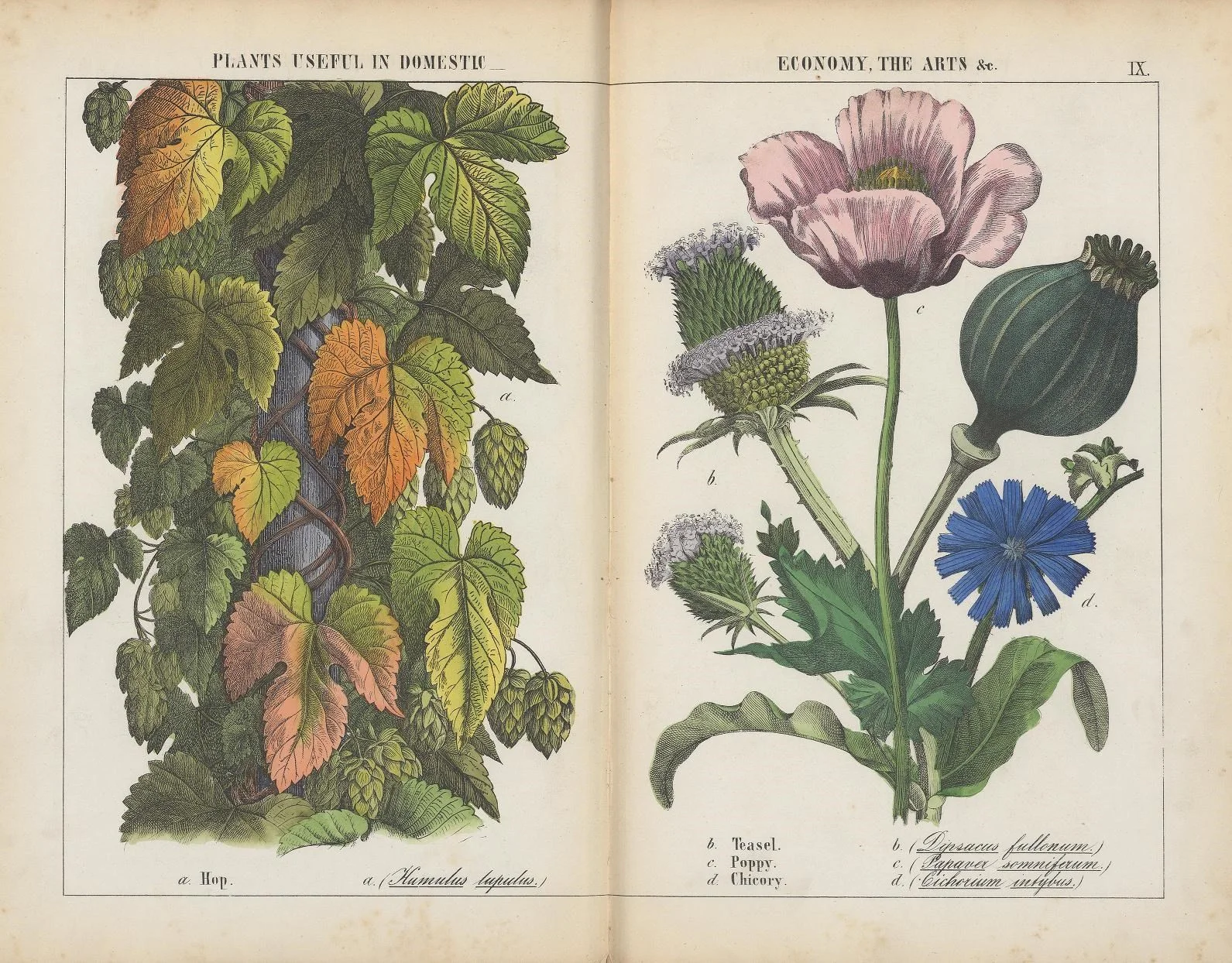
Botanical illustration
Фото: BioDivLibrary / Лицензия: Public Domain Mark
Morphology
Members of the genus Humulus are dioecious herbaceous plants, meaning male and female flowers develop on separate individuals. Their climbing stems are distinctly six-angled and utilize rigid, two-pronged hooked hairs to cling to support structures as they grow clockwise.
The morphological features of these plants include:
Leaves: Positioned oppositely on the stem, the leaves are petiolate and cordate at the base, typically featuring three to seven lobes with serrated margins.
Male Flowers: These are small and arranged in loose, highly branched paniculate inflorescences, containing five stamens with straight filaments.
Female Flowers: Grouped in dense, cone-like strobiles, these inflorescences feature overlapping bracts that enlarge significantly after flowering.
Lupulin Glands: The bracts of the female cones develop specialized glands that secrete lupulin, a yellow powder rich in bitter resins and essential oils.
Fruits: The resulting fruit is a slightly compressed, ovate nutlet enclosing a spirally coiled embryo.
Flowering season
Blooms from mid-summer to late summer, typically between July and August.
Jan
Feb
Mar
Apr
May
Jun
Jul
Aug
Sep
Oct
Name
Dec
Applications
The primary economic application of Humulus is in the brewing industry, where the female cones of Humulus lupulus are utilized as a bittering agent and stabilizer. The alpha-acids and essential oils in the cones impart the characteristic aroma, flavor, and bitterness to beer, while also acting as natural preservatives.
Beyond brewing, the genus finds significant use in other areas:
Pharmacology and Medicine: The active compounds, including lupulin, flavonoids, and xanthohumol, serve as mild sedatives in pharmaceutical preparations like Valocordin and Novo-Passit.
Culinary Uses: In European countries such as Belgium and Romania, young shoots are harvested in early spring and prepared similarly to asparagus or added to salads and soups.
Industrial Fibers: The strong fibrous stems are used to manufacture coarse textiles, ropes, and low-grade paper products.
Horticulture: Fast-growing species are employed for vertical greening of fences, trellises, and balconies in garden design.
Interesting facts
The evolutionary history of the genus reveals that Humulus split from its sister genus Cannabis approximately 28 million years ago. Its scientific name is believed to derive from the Latin word humus, referencing the plant's tendency to creep along the ground if it fails to find an upright support.
Here are several intriguing facts about this remarkable genus:
Royal Protection: During the 14th century, Emperor Charles IV prohibited the export of high-quality Bohemian hop cuttings under penalty of death to preserve the region's brewing monopoly.
Heavy Metal Biosorption: Scientific studies demonstrate that the biomass of Humulus leaves and stems is highly efficient at absorbing toxic heavy metals, capable of removing up to 74.2 milligrams of lead (Pb2+) per gram of dry leaves from aqueous solutions.
Sericulture Food Source: In China, the young foliage of certain species is historically utilized as a supplementary food source for silkworm caterpillars.
Potent Phytoestrogen: The compound 8-prenylnaringenin, discovered in the lupulin glands of the female cones, is recognized as one of the most potent plant-derived estrogens currently known to science.