
Drumstick Tree
Moringa oleifera
Moringa oleifera, commonly known as the drumstick tree, is a fast-growing, drought-resistant tree native to …
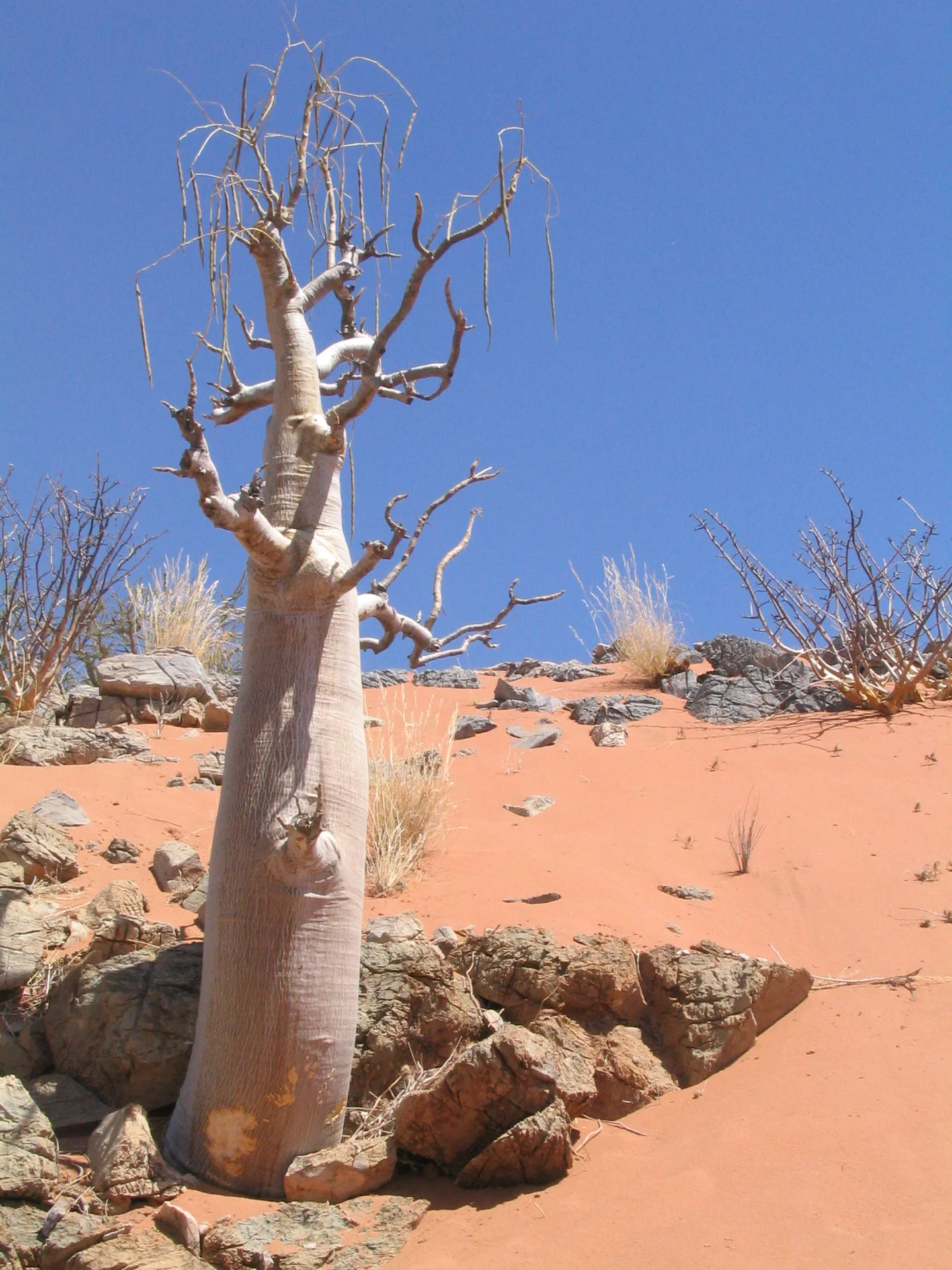
Standing like pale, eerie sentinels against the scorched, volcanic rocks of the Namib Desert, these bizarre trees evoke a sense of ancient mystery. Known commonly as the ghost tree, Moringa ovalifolia immediately catches the eye with its swollen, water-storing trunk and shimmering silvery bark.
In the famous Etosha National Park, a dense concentration of these plants forms the legendary Fairy Tale Forest, or Sprokieswoud, where they grow in unusual proximity on flat plains. Indigenous San folklore tells that the gods, in a fit of anger, threw Moringa ovalifolia out of heaven, causing them to land upside down with their roots reaching toward the sky.
During the dry winter months, Moringa ovalifolia sheds its leaves completely, entering a state of dormancy to conserve precious moisture. This survival mechanism, combined with its highly succulent stem, allows the species to endure the prolonged droughts of its desert habitat.
Moringa ovalifolia is a distinctive, deciduous pachycaul tree that typically grows to a height of 2 to 7 meters. Its most prominent feature is the massively swollen, succulent stem, which can reach up to 1 meter in diameter and tapers upward in a bottle-like shape. The branches are also thickened and succulent, rising from the main trunk to support a sparse canopy.
The bark and foliage exhibit several specialized adaptations:
The reproductive structures of Moringa ovalifolia are clustered in large, branched panicles:
Flowers typically bloom from November to May, followed by fruit ripening through the same period.
In extreme desert environments, Moringa ovalifolia serves as an important resource for both humans and wildlife. The San people historically utilized the tree during times of severe drought, tapping the soft, succulent wood of the trunk to extract a bitter but life-saving sap. Additionally, various parts of the tree, including the leaves and pods, are consumed as food by indigenous populations.
The ecological and ornamental value of this tree is also significant:
The bizarre growth habit of Moringa ovalifolia has earned it several evocative common names, including the Ghost Tree and Phantom Tree. This is because its pale, silvery-white trunk stands out dramatically against the dark volcanic hills, appearing almost luminous in the desert moonlight. In Namibia, the tree enjoys strict legal protection under nature conservation laws to prevent over-exploitation and habitat loss.
The most famous grouping of these trees is located within Etosha National Park:
Taxon Synonyms: Moringa ovalifoliolata
Moringa oleifera
Moringa oleifera, commonly known as the drumstick tree, is a fast-growing, drought-resistant tree native to …

Moringa hildebrandtii
An extraordinary water-storing tree endemic to Madagascar, extinct in the wild but preserved through traditional …

Moringa peregrina
Moringa peregrina is a resilient desert tree native to the Red Sea region and Arabian …

Moringa arborea
A rare, drought-resistant tree native to the arid regions of Kenya and Ethiopia, known for …