Paulownia tomentosa (Empress Tree): Care, Facts & Guide
In traditional Chinese households, planting a fast-growing tree upon the birth of a daughter was a cherished custom, ensuring that mature timber would be ready to craft her wedding chest years later. This legendary tree, deeply integrated into East Asian culture, captivates onlookers with its rapid growth and architectural presence.
Today, Paulownia tomentosa is celebrated globally as a striking ornamental specimen that easily adapts to urban environments. Its ability to colonize disturbed areas highlights its ecological role as a resilient pioneer plant.
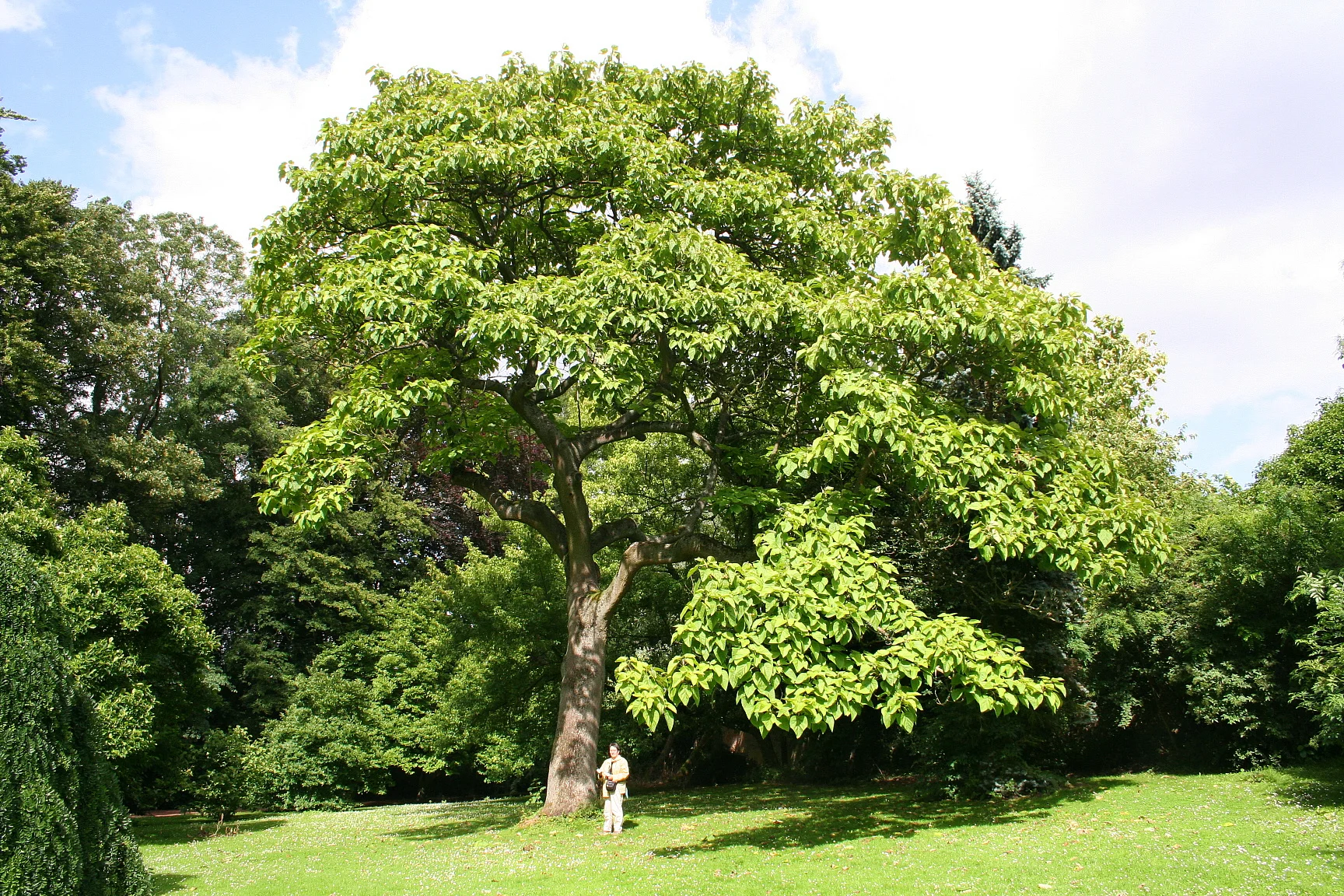
Paulownia tomentosa is a medium-sized deciduous hardwood tree that typically reaches heights of 10 to 25 meters. It develops a straight trunk with a broad, rounded, or umbrella-like crown supported by heavy, brittle branches.
The botanical structure of this species features several distinctive components:
Leaves: The large, heart-shaped or shallowly five-lobed leaves are arranged in opposite pairs on the stems, measuring 15 to 40 centimeters across. On young shoots or pollarded trees, they can reach up to 60 centimeters in width, with their undersides covered in soft, velvety hairs.
Flowers: Large, fragrant, violet-blue flowers bloom in early spring before the foliage appears. They are produced on upright panicles 10 to 30 centimeters long, featuring a tubular purple corolla resembling foxglove flowers.
Fruit and Seeds: The fruit is a dry, egg-shaped, woody capsule about 3 to 4.5 centimeters long. Each capsule contains between 1,200 and 2,300 tiny, winged seeds that are easily dispersed by wind and water.
Root System: The tree possesses a shallow, widely spreading, and highly regenerative root system that allows it to resprout rapidly after environmental damage.
Flowering season
Spring, typically from April to May, before the leaves unfold.
Jan
Feb
Mar
Apr
May
Jun
Jul
Aug
Sep
Oct
Name
Dec
Care parameters
Light
Requires full sun for optimal growth, though young saplings can tolerate partial shade.
Watering
Needs moderate watering; thrives in moist, well-drained soils but shows high drought resistance once established.
Temperature
Cold-hardy down to -25°C to -28°C when mature, though young shoots may freeze back to the root collar during harsh winters.
Humidity
Highly adaptable to various humidity levels; prefers warm, humid summers for rapid growth.
Toxicity
Non-toxic; the nitrogen-rich leaves are safe and often utilized as high-protein animal fodder.
Applications
The lightweight and durable timber of Paulownia tomentosa is highly valued in East Asia. It is traditionally used to manufacture musical instruments like the Japanese koto and Korean gayageum, as well as furniture, surfboards, and packing boxes.
Ecologically, the tree serves several purposes in modern land management:
Soil Erosion Control: The extensive root system helps stabilize slopes and prevent soil erosion.
Carbon Capture: Due to its large leaves and rapid growth rate, the species is frequently utilized in reforestation and carbon sequestration projects.
Agriculture: The nitrogen-rich leaves drop in autumn, naturally improving soil fertility and serving as nutritious fodder for livestock.
Interesting facts
In Japan, the tree is known as Kiri and is deeply woven into national symbols. The leaves and flowers of the tree serve as the official emblem of the Prime Minister and the Government of Japan.
Several other fascinating details surround this species:
Porcelain Packaging: In the 19th century, Chinese exporters used the soft, lightweight seeds as packaging material for porcelain. The accidental spilling of these seeds along railway lines contributed to the tree's naturalization in North America.
The Phoenix Legend: According to Asian mythology, the legendary Phoenix (Fenghuang) will only land on the branches of a healthy and strong Paulownia tree.
Wedding Tradition: A traditional Chinese and Japanese custom involves planting a Kiri seed when a daughter is born, later harvesting the mature tree to build a wedding chest as part of her dowry.
Fire Resistance: The wood is remarkably fire-resistant and has low thermal conductivity, which is why it was historically used to line safes and make kimono chests.