Princess tree
Phoenix tree
Kiri
Foxglove tree
Adam's tree
#536E49
#1E1E15
#1C2718
#5E6448
#8AA580
Plant palette
Paulownia Guide: Empress Tree Care, Uses & Botany
Legend has it that the mythical phoenix will only alight upon the branches of Paulownia, a tree of imperial beauty whose timber has protected precious wedding dowries for centuries. In many East Asian cultures, families traditionally plant this fast-growing tree upon the birth of a daughter, harvesting its wood to build a chest when she marries.
Renowned for its astonishing growth rate, Paulownia can reach up to six meters in height within its first year. This genus stands out not only for its ecological utility but also for its large, heart-shaped leaves and spectacular spring blossoms that resemble lavender foxgloves.
Beyond its ornamental appeal, the tree produces a lightweight yet incredibly durable timber that resists warp, moisture, and fire. Today, Paulownia is widely utilized in agroforestry, land rehabilitation, and the crafting of fine musical instruments.
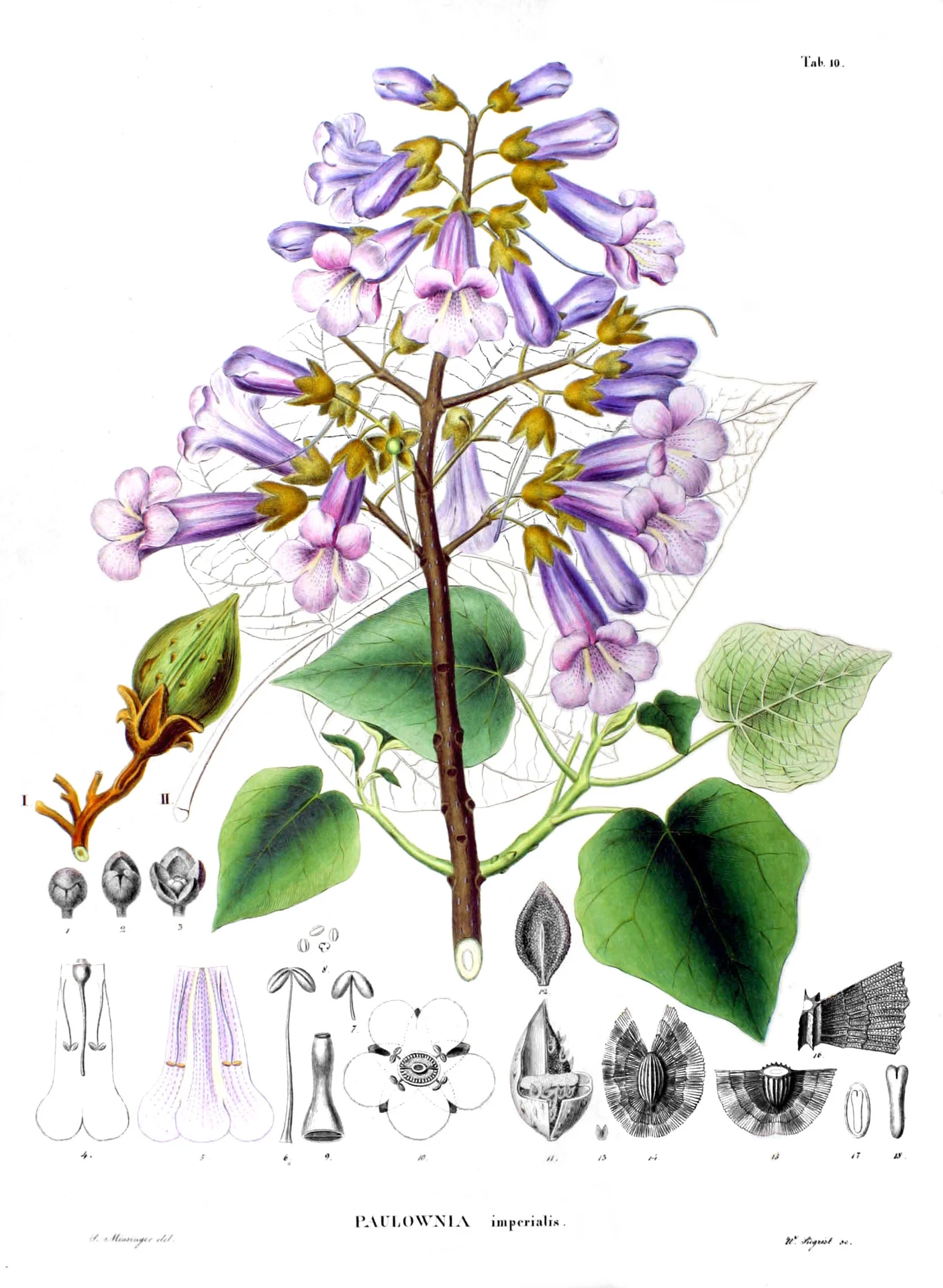
The species of Paulownia are rapid-growing deciduous trees, though they can remain evergreen in tropical climates, reaching heights between 5 and 30 meters. Their trunks feature a straight grain with bark that begins smooth and covered in prominent lenticels, gradually developing shallow fissures as the tree matures.
The foliage and branching characteristics of Paulownia include:
Leaves: Large, opposite, heart-shaped (cordate) leaves that measure 10–20 centimeters wide and 15–30 centimeters long, mounted on long petioles. The leaf surfaces are densely covered in soft, velvety hairs (tomentose), and the margins can be entire, toothed, or slightly lobed.
Twigs and Buds: Branching is typically pseudodichotomous, and the twigs lack terminal buds, with new buds developing in late summer and overwintering in a fuzzy brown calyx.
Flowers: Large, showy, zygomorphic blossoms arranged in terminal erect panicles. The tubular, foxglove-like corolla features five fused lobes in shades of pale violet, purple, or white, marked with internal yellow nectar guides.
Reproductive Organs: Inside the corolla are four stamens (two long and two short) and a superior bilocular ovary. The stigma tip contains a unique singular hole leading to a dilated chamber, which is a key distinguishing feature of this genus.
Fruits and Seeds: The ovary matures into a sticky, green oval capsule that turns woody and brown. Upon split-opening (loculicidal dehiscence), it releases up to 2,000 tiny, flat seeds equipped with paper-like lateral wings for wind dispersal.
Flowering season
Flowering occurs in mid to late spring, lasting for about 4 to 8 weeks, with blossoms appearing before or alongside the emerging leaves.
Jan
Feb
Mar
Apr
May
Jun
Jul
Aug
Sep
Oct
Name
Dec
Care parameters
Light
Requires full sun for optimal development; it cannot tolerate shade or competition from taller canopy trees.
Watering
Needs highly well-draining soils. Young trees require regular irrigation (around 40 liters weekly in summer), while established trees over three years old are drought-tolerant and rarely require watering.
Temperature
Highly adaptable but thrives in warm climates. Some cold-hardy species and hybrids can withstand severe winter frosts, though young shoots may freeze in extremely cold regions.
Humidity
Prefers moderate humidity and tolerates dry air, but it is highly sensitive to waterlogged or overly compacted soils.
Toxicity
Completely non-toxic to humans and animals. The leaves are high in protein and used as livestock feed, while the edible flowers are sometimes added to salads.
Applications
The versatile wood of Paulownia is prized for being lightweight, warp-resistant, and flame-retardant. It is traditionally used in Japan and China to make chest drawers (tansu), fragile item storage boxes (tomobako), geta clogs, and stringed musical instruments like the guqin and koto. Modern industries also utilize it for building boats, surfboards, touring skis, and electric guitar bodies.
Beyond timber production, the tree serves several agricultural and ecological purposes:
Agroforestry: Its deep root system and sparse canopy allow farmers to grow crops like wheat, soy, and cotton directly underneath it, providing wind protection and shade.
Fodder and Honey: The protein-rich leaves (containing 18% to 24% protein) serve as excellent livestock feed, while the nectar-abundant flowers support honeybee farming, yielding up to 800 kg of premium honey per hectare.
Ecological Restoration: Its rapid growth makes it a powerful carbon sink for climate mitigation, and its roots help control soil erosion, purify water, and extract toxins from industrially depleted soils.
Other Uses: The bark is processed into natural dyes, the leaves are utilized for organic pesticides, and the wood is burned to produce high-quality sketching charcoal and firework powder.
Interesting facts
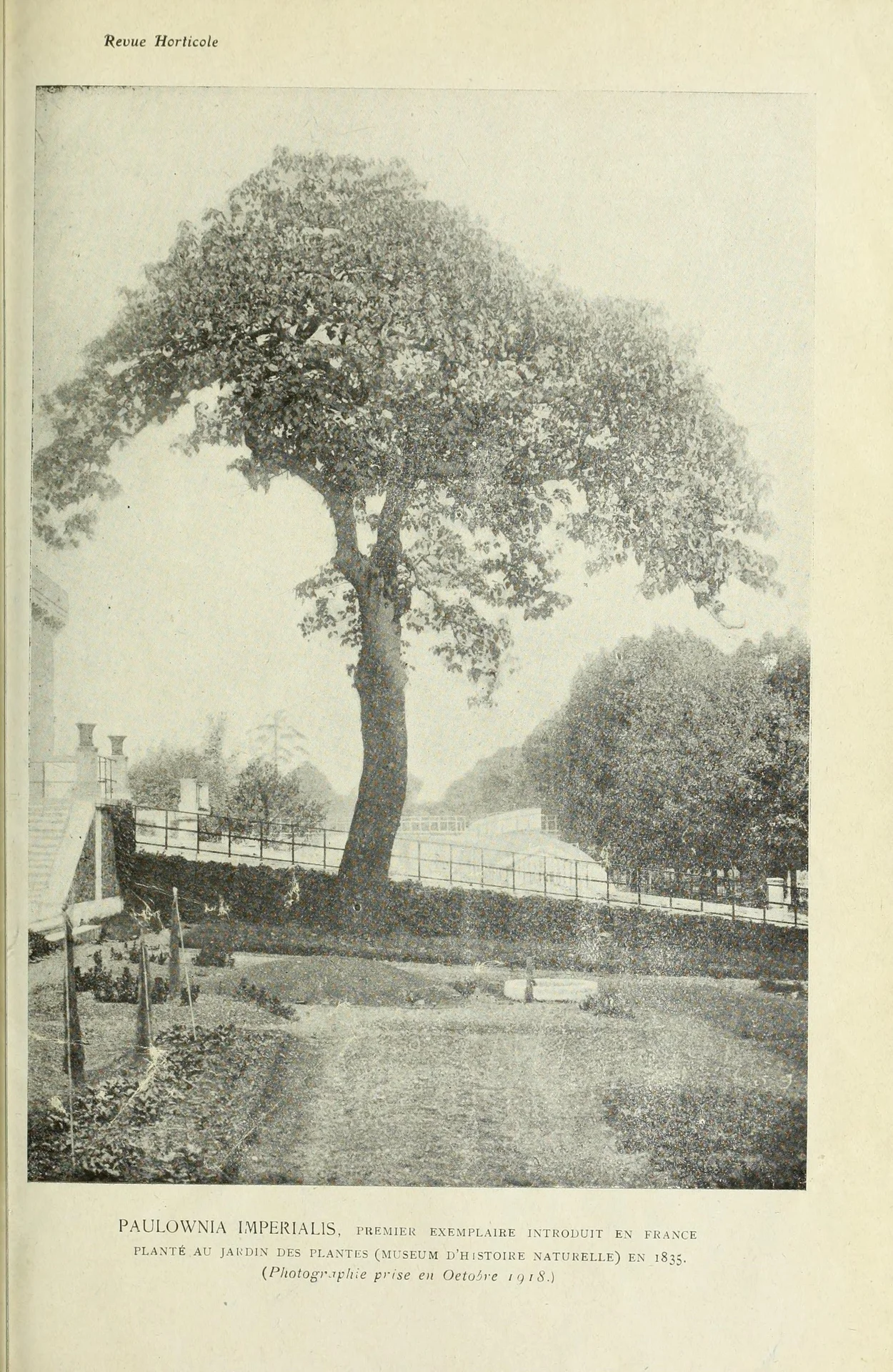
The cultural history of Paulownia is rich with legends and traditions spanning several centuries. Named by European botanists Siebold and Zuccarini to honor Grand Duchess Anna Pavlovna of Russia, the daughter of Tsar Paul I, the tree is widely known as the Princess or Empress tree. In China, ancient folklore associates the tree with the mythical phoenix, which was believed to roost only on its branches to bring good fortune.
Several fascinating regional customs and botanical facts highlight its uniqueness:
The Dowry Tree: A long-standing Chinese and Japanese tradition involves planting a tree at the birth of a daughter. When she reaches marriageable age, the tree is harvested to construct her wedding chest and furniture.
Government Symbolism: The flower crest of the tree, known as kiri in Japanese, serves as the official symbol of the Prime Minister and the Government of Japan, and its image is minted on the 500-yen coin.
The Phoenix Tree: Known for its resilience, the tree can regenerate directly from its cut stump using its existing root system, allowing multiple harvests without replanting.
Accidental Naturalization: In the 19th century, its lightweight seeds were used as packing material for porcelain shipped from China to North America, escaping into the wild when the packaging was discarded near ports.
Game and Play: The tree represents the suit of December in the Japanese card game Hanafuda (November in the Korean version), where Korean players sometimes humorously refer to it as the "sweet potato" due to the leaf shape.
Varieties and cultivars
Several selected cultivars and fast-growing hybrid clones have been bred for commercial timber production and climate resilience:
Shan Tong: A highly popular, cold-hardy hybrid between Paulownia fortunei and Paulownia tomentosa, valued for its straight trunk, wind resistance, and extreme growth speed.
9501: A hybrid variety bred specifically to tolerate severe winter temperatures while maintaining a high yield of quality timber.
Z07: An advanced commercial selection optimized for rapid biomass production and high resistance to drought and diseases.
Splendor: A cultivar selected for its exceptional growth rate and large, ornamental purple blooms.
Clon in Vitro 112: A laboratory-propagated, sterile clone designed for international forestry, ensuring non-invasive cultivation with uniform wood density.
A remarkably fast-growing deciduous tree native to East Asia, cultivated for its lightweight timber, biomass production, and ornamental purple flowers.
Paulownia catalpifolia is an exceptionally fast-growing deciduous tree native to Shandong, China, recognized for its large catalpa-like leaves and highly …