
Cacao Tree
Theobroma cacao
Theobroma cacao, commonly known as the cacao or cocoa tree, is a tropical evergreen species …
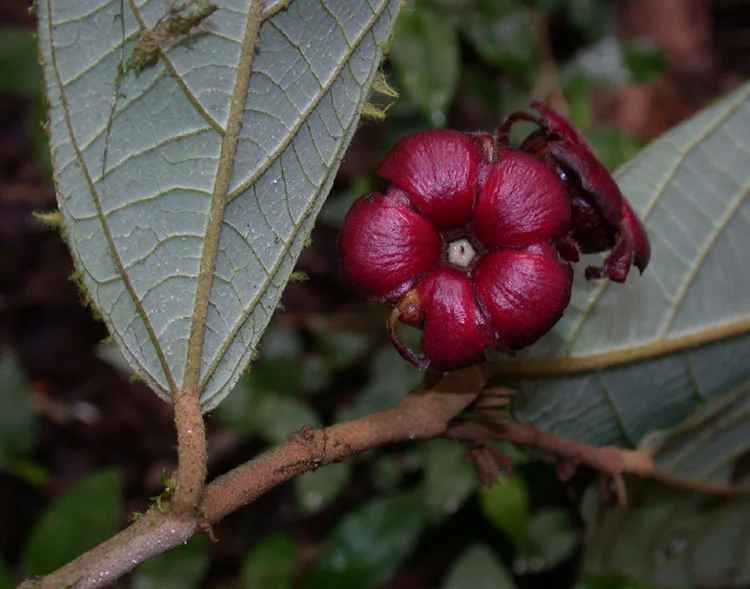
Hailing from the dense tropical wet forests of Central America, Theobroma mammosum stands as a fascinating wild relative of the commercial cacao tree. It grows as a tall canopy or subcanopy species under humid conditions.
This species is of notable scientific interest due to its biochemical properties. Researchers study its natural resistance mechanisms against common agricultural pathogens affecting cultivated cacao.
This tall tree can reach heights ranging from 7 to 35 meters in its native forest habitat. It utilizes the C3 photosynthetic pathway to capture energy in the shaded understory.
The simple, alternate leaves measure 7 to 25 centimeters in length and 3 to 10 centimeters in width. They are oblong-elliptic, narrowly elliptic, or oblanceolate, featuring entire or slightly sinuate margins.
Red flowers with petals measuring 1.5 to 1.8 centimeters emerge on short pedicels. The resulting cylindrical-oblong fruits grow up to 18 to 20 centimeters long, characterized by a unique nipple-like apex.
Flowering in September, fruiting in June
The epicarp of young fruits contains high concentrations of total phenolic compounds and ortho-dihydroxyphenols. These chemical constituents play a major role in defense mechanisms against fungal pathogens.
Agricultural scientists utilize this species as a model organism in plant pathology studies. Specifically, it helps researchers understand how members of the genus resist infections by the destructive fungus Ceratocystis fimbriata.
The specific epithet mammosum derives from the Latin word for breast. This naming directly references the distinctive, rounded protrusion found at the apex of its mature fruits.
Although it belongs to the same genus as commercial chocolate, its fruit lacks the same culinary popularity. It remains primarily a subject of ecological and pharmacological exploration.
Theobroma cacao
Theobroma cacao, commonly known as the cacao or cocoa tree, is a tropical evergreen species …

Theobroma grandiflorum
A tropical rainforest tree related to cacao, native to the Amazon basin. It is widely …

Theobroma bicolor
Theobroma bicolor, commonly known as the mocambo or jaguar tree, is a wild and cultivated …

Theobroma speciosum
An abundant Amazonian tree famous for its beautiful red flowers blooming on the trunk and …