Indian Ginseng
Winter Cherry
Poison Gooseberry
Rennet
#889F41
#090C02
#607732
#040B01
#A4B85B
Plant palette
Withania somnifera: Botanical Profile and Uses of Ashwagandha
Deep within the arid, sun-baked regions of India and the Middle East, a resilient green shrub emits a unique, earthy scent reminiscent of a damp horse. This sensory signature belongs to Withania somnifera, a botanically fascinating plant that has woven itself into the fabric of traditional medicine for millennia.
Commonly referred to as ashwagandha or Indian ginseng, this evergreen member of the nightshade family thrives in stony, dry soils. Its reputation as a potent adaptogen has sparked significant scientific interest in its bioactive compounds, particularly in western herbalism.
Withania somnifera displays a highly specialized architecture adapted to survive in dry climates. Below are the key morphological features of this evergreen shrub:
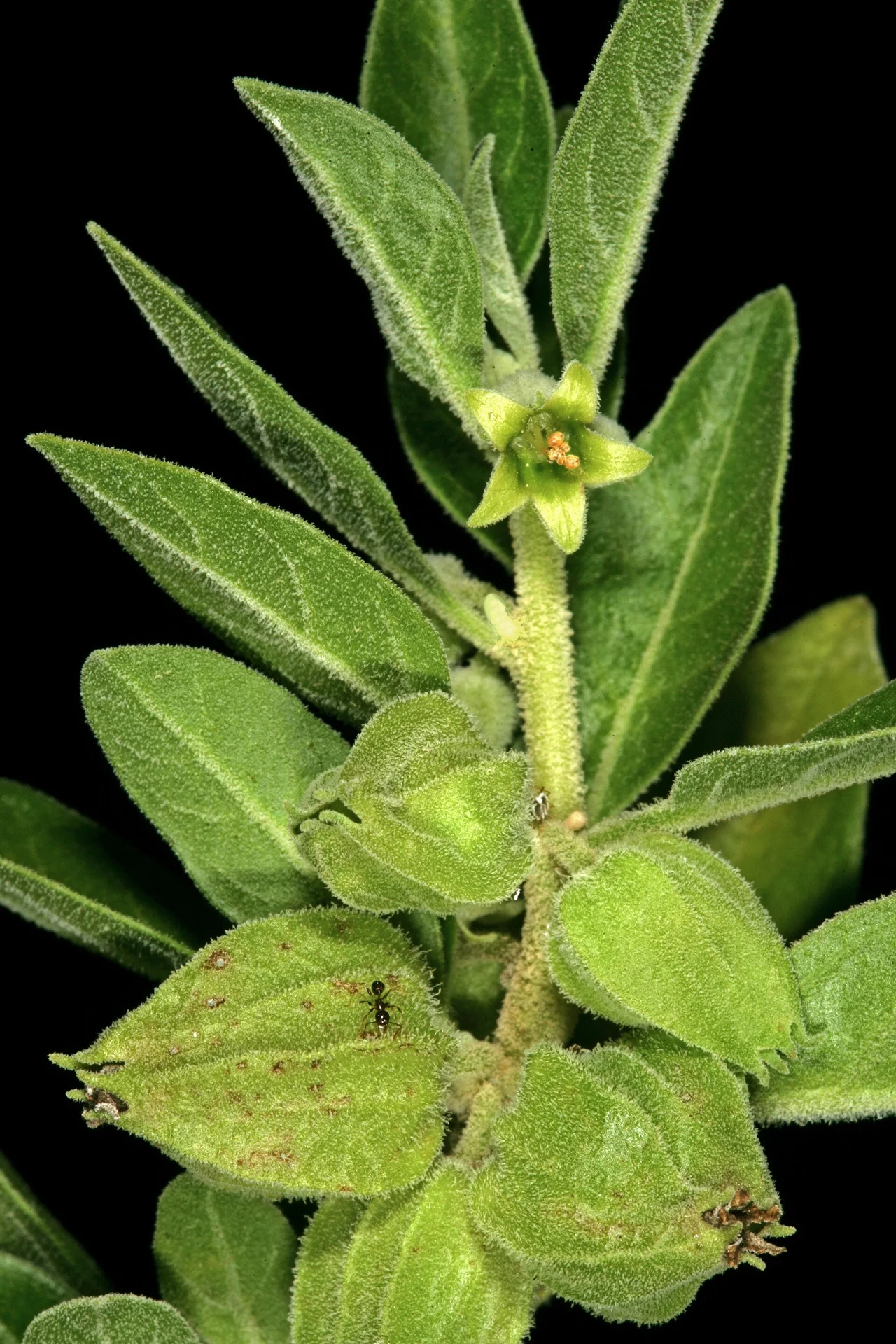
Stems and Branches: The plant grows as a compact shrub, typically reaching 35 to 75 centimeters in height, though some specimens can grow up to 150 centimeters. Its branches are heavily covered with star-shaped, velvety hairs (tomentum) that radiate from a central woody stem, giving it a dusty, grayish-green appearance.
Leaves: The leaves are simple, dull green, and elliptic in shape, measuring up to 10–12 centimeters in length. They are arranged alternately or almost oppositely along the stems, featuring a cuneate base and a hairy underside, especially along the veins.
Flowers: Small, inconspicuous green or yellowish-green flowers are bell-shaped and grow in axillary clusters of four to six. They feature a five-lobed calyx and a bell-shaped corolla, which is hairy on the outer surface.
Fruit and Seeds: The fruit is a smooth, glossy, globose berry, 5 to 8 millimeters in diameter, which turns bright orange-red when ripe. This berry is entirely enclosed by an inflated, paper-like calyx, which dries to a light brown color. The seeds inside are small, flattened, slightly kidney-shaped, and pale brown.
Roots: The plant develops a stout, fleshy, tuberous taproot that is light brown on the outside and white on the inside. These roots can grow 30 to 45 centimeters deep and are the primary source of the plant's aromatic compounds.
Flowering season
Depending on the region and local climate, flowering typically occurs from late autumn through early spring, often peaking between November and March.
Jan
Feb
Mar
Apr
May
Jun
Jul
Aug
Sep
Oct
Name
Dec
Applications
The historical and modern applications of Withania somnifera are vast, stretching from ancient medical systems to modern dietary wellness and food chemistry:
Traditional Medicine: For thousands of years, the root powder of this species has been a cornerstone of Ayurvedic medicine in India, classified as a rasayana to promote longevity, vitality, and physical strength. In Yemeni folk medicine, known locally as ubab, the dried leaves are ground into a healing paste applied to wounds and burns.
Modern Dietary Supplements: Today, extracts from the root and leaves are widely marketed as adaptogens to help the body manage physical and mental stress. Modern research focuses on its ability to lower cortisol levels, alleviate generalized anxiety, and improve sleep parameters, particularly for individuals struggling with insomnia.
Cheese Production: In food technology, the berries of the plant serve as a natural vegetable rennet substitute. The enzymes present in the fruit pulp can curdle milk, making it a valuable tool in vegetarian cheese-making processes.
Interesting facts
The cultural footprint of Withania somnifera is filled with rich lore, historical associations, and botanical quirks:
The Scent of a Horse: The common name Ashwagandha translates literally from Sanskrit as "smell of a horse." This refers both to the strong, characteristic odor of the fresh root and the traditional belief that consuming it imparts the strength and stamina of a stallion.
Apollo's Gift: In ancient European lore and old English herbals, the plant was known as apolinar or glofwyrt. A popular myth suggests that the god Apollo himself discovered the plant and gifted it to Asclepius, the Greek god of medicine.
Sleep Inducer: The botanical species name somnifera is Latin for "sleep-bringing." This directly references the plant's long-recognized sedative properties and its historical use in helping with sleep disturbances.
Ayurvedic Constitution: Within the traditional Indian system of Ayurveda, the plant is believed to balance the Vata and Kapha constitutional doshas, while potentially aggravating the hot and fiery Pitta dosha.
Phytochemical Safeguards: Under threat in the wild, the plant's concentrations of valuable secondary metabolites, such as withanolides, can be severely depleted when it is attacked by leaf-spot diseases like Alternaria alternata or pests like the carmine red spider mite.