Abroma augustum (devil's cotton): morphology, uses, and facts
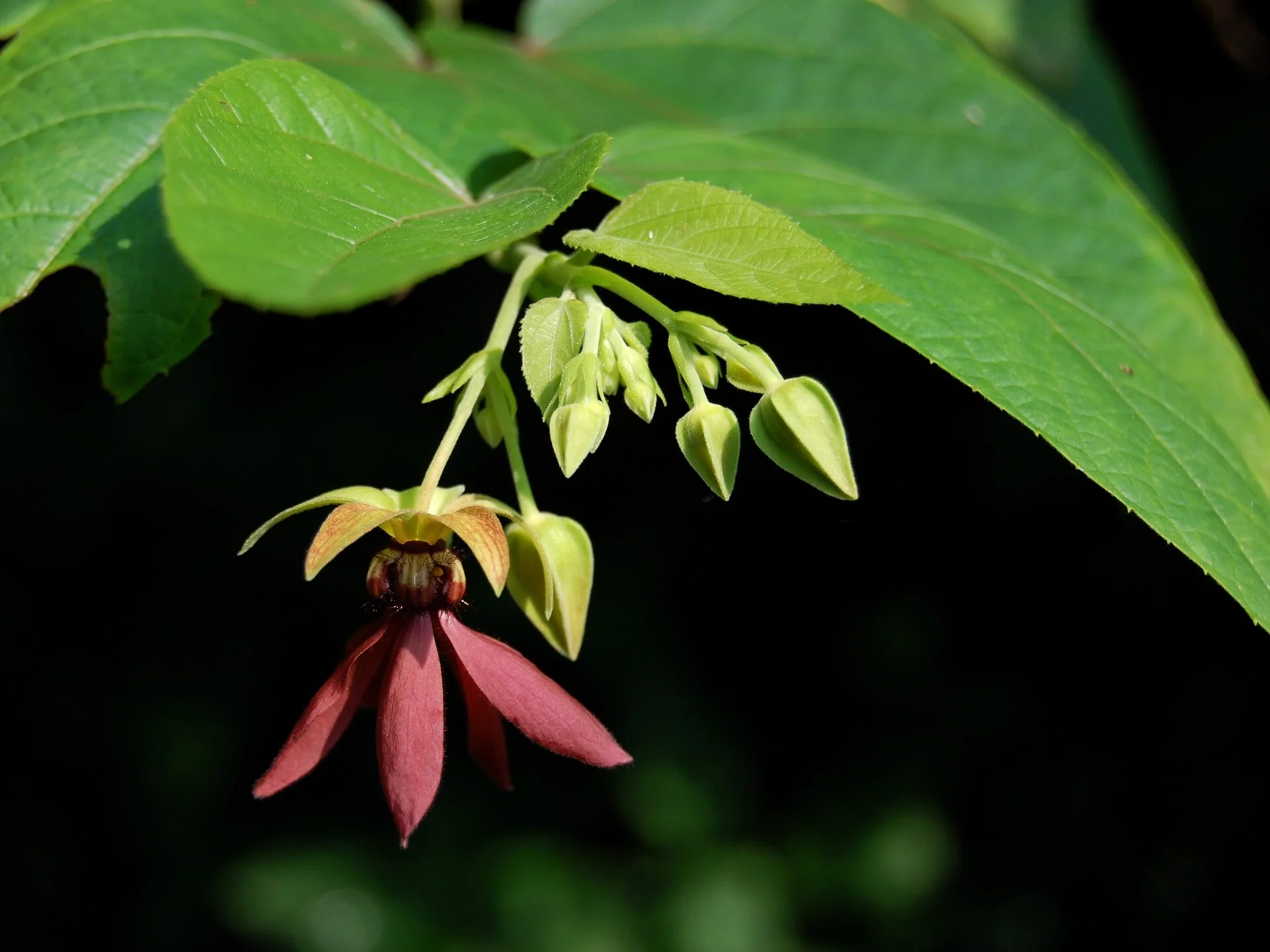
Abroma augustum, widely known as devil's cotton, is an erect evergreen shrub or small tree native to tropical Asia and the western Pacific, where it thrives along stream banks, forest edges, and secondary clearings. It catches the eye with its pendulous, lantern-like dark maroon flowers and five-winged seed capsules, while its Latin specific epithet augustum means "majestic" or "noble," referring to the stately appearance of its foliage and blooms.
This species is the sole member of the genus Abroma within the mallow family (Malvaceae), though older classifications placed it in Sterculiaceae. It was first scientifically described by Carl Linnaeus in 1767–1768 as Theobroma augustum, and later transferred to its current genus by Carl Linnaeus the Younger in 1782.
In its natural habitat, Abroma augustum typically grows as a multi-stemmed shrub reaching 2 to 4 meters in height, though it can occasionally develop into a small tree up to 10 meters tall. Its branches and twigs are covered with a dense coat of sharp, brittle stellate hairs—star-shaped microscopic bristles that easily break off upon contact and cause intense skin irritation.
Dimorphic foliage
The plant displays two distinct leaf shapes on the same branches, a botanical trait known as heterophylly (having differently shaped leaves on different parts of the stem). All leaves are arranged alternately and held on long petioles.
Lower and older leaves near the base of the branches are large, Measuring 20 to 37 centimeters across, with a heart-shaped (cordate) base and 3 to 5 prominent palmate lobes.
Upper leaves near the branch tips are smaller, unlobed, and ovate-oblong with finely toothed margins and a pointed apex.
Pendulous flowers
The bisexual flowers hang downward in small clusters (cymes—flat-topped or convex flower clusters in which the central flower opens first) containing 1 to 4 blossoms, measuring 3 to 7.5 centimeters in diameter. Each flower features five greenish, triangular sepals and five spoon-shaped petals in shades of deep maroon, dark purple, or occasionally yellow with a pale concave base.
Inside the flower, the stamens are fused into a cup-shaped staminal tube bearing 15 anthers. These fertile anthers alternate regularly in groups of three with five sterile, petal-like structures called staminodes.
Winged capsules and seeds
After pollination, the flower develops into an upright, papery capsule shaped like an inverted cone or bell, measuring 4 to 5 centimeters long. The fruit features five prominent longitudinal wings and splits open at the top and along the partitions when ripe, exposing a dense lining of irritating hairs and numerous small, cylindrical black seeds lacking wings or arils.
Flowering season
Blooms primarily from late spring through early autumn (May to September), with fruits ripening from October to January.
Jan
Feb
Mar
Apr
May
Jun
Jul
Aug
Sep
Oct
Name
Dec
Applications
For centuries, communities across South and Southeast Asia have harvested the inner bark (bast—strong fibrous tissue from the phloem layer of the stem) of Abroma augustum as a durable textile material. After cutting the thick stems and soaking them in mud or water for two to three days to soften the outer tissues—a microbial process called retting—artisans scrape away the rough bark to extract silky white fibers comparable in strength to jute.
Cordage and textiles: The extracted bast fibers are spun into strong fishing lines, fishing nets, hammocks, ropes, and coarse woven fabrics, and in parts of Indonesia they are dyed to craft traditional hairpieces.
Traditional medicine: In Indian and Bangladeshi folk medicine as well as homeopathy, extracts from the mucilaginous root bark, stems, and leaves are used to address gynecological conditions such as dysmenorrhea and irregular menstruation, alongside skin ailments and diabetes.
Botanical collections: Despite its irritating hairs, the shrub is occasionally cultivated in tropical botanical gardens and warm conservatory collections as an ornamental curiosity for its striking, pendulous maroon blossoms.
Interesting facts
Why Linnaeus contrasted it with cacao
When Carl Linnaeus first examined this plant, he placed it in the cacao genus Theobroma (meaning "food of the gods") because the cupped bases of its petals and its staminal tube closely mirrored the floral architecture of the chocolate tree. When Nikolaus Joseph von Jacquin established the separate genus Abroma in 1776, he coined the name by adding the Greek privative prefix a- ("not"), literally translating to "not food" to warn that unlike cacao, this thorny-haired relative is unsuitable for culinary consumption.
Coordinated mechanics of floral deception and seed dispersal
The reproductive cycle of Abroma augustum relies on a finely tuned sequence of structural shifts between flowering and fruiting. During bloom, the flower stalk bends downward so the blossom hangs like a sheltered bell, protecting the pollen from heavy monsoon rains while the soft, spoon-like maroon petals sway in the slightest breeze to attract small, dark-loving flies and beetles.
Pollinator trapdoor: The concave white bases of the petals form five tiny windows around the cup-like staminal tube, guiding insects directly past the anthers and stigmas as they crawl toward the light.
Post-pollination inversion: Once fertilized, the stalk stiffens and turns the developing five-winged capsule upright, transforming it from a hanging shelter into an open-topped cup that catches the wind to shake out ripe seeds while lining the interior with stiff, irritating hairs that deter seed-eating rodents.