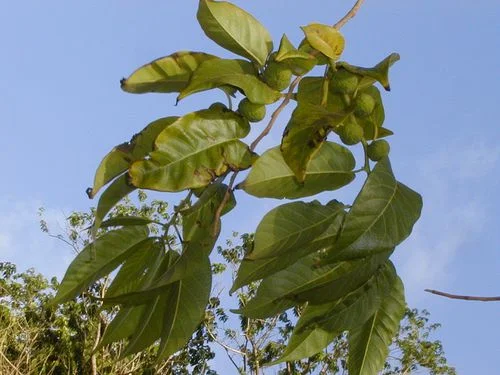
Allaeanthus greveanus: Endemic Malagasy Forest Tree Profile
Allaeanthus greveanus is a deciduous small to medium-sized tree endemic to the seasonally dry forests and rocky savannas of western, southwestern, and northern Madagascar. Its specific epithet greveanus honors French naturalist Guillaume-Grandidier Grevé, a nineteenth-century collector who documented the flora and fauna of Madagascar's western coast near Morondava.
Originally described in 1895 by French botanist Henri Ernest Baillon as Ampalis greveana, the species was transferred by Cornelis Christiaan Berg in 1977 to the genus Broussonetia as Broussonetia greveana (its currently accepted name in several taxonomic databases), before Léandri and subsequent treatments placed it within the Afro-Asian genus Allaeanthus.
In its native dry deciduous woodlands, the tree grows from 5 to 20 meters tall with a cylindrical trunk up to 50 centimeters in diameter and smooth, gray to yellowish-brown bark. When cut, the inner fibrous bark exudes a milky white or yellowish latex—a pressurized fluid stored in specialized tubular cells called laticifers.
Foliage
The leaves are arranged alternately along the branches and drop completely during Madagascar's prolonged dry season to conserve water. Leaf blades are ovate to cordate or elliptic, measuring 5 to 12 centimeters long and 3 to 8 centimeters wide, with finely crenate to serrate margins, acuminate tips, and three prominent basal veins arising from the top of a slender petiole.
Flowers and fruiting heads
Strictly dioecious inflorescences: Male and female flowers are borne on separate trees; staminate (male) blooms form slender, pendulous cylindrical catkins up to 5 centimeters long, whereas pistillate (female) blooms are packed into dense, spherical heads (capitula).
Syncarpous fruits: After wind pollination, the female flower head develops into a fleshy, globose compound fruit (syncarp) about 1.5 to 2 centimeters in diameter, with small drupaceous fruitlets embedded in sweet, orange-red pulp.
Flowering season
Late dry season to early rainy season (September to December)
Jan
Feb
Mar
Apr
May
Jun
Jul
Aug
Sep
Oct
Name
Dec
Applications
Across rural communities in western and southern Madagascar, where the tree is known locally as vory, Allaeanthus greveanus serves as a multi-purpose resource harvested from woodland margins. Its straight-grained, lightweight timber and fibrous inner bark have long been utilized by local craftspeople.
Woodworking and construction: The pale, moderately soft wood is easy to carve and is used regionally for light carpentry, household utensils, canoe outriggers, and interior framing.
Bast fiber and forage: The tough phloem fibers of the inner bark are stripped to twist durable cordage and ropes, while the nutrient-rich fallen leaves and sweet mature syncarps provide seasonal fodder for livestock and edible wild fruit for local inhabitants.
Interesting facts
Ballistic pollen release timed to the dry-season winds
Living in the deciduous dry forests and tsingy limestone landscapes of western Madagascar requires synchronizing reproduction with sharp seasonal shifts between parched winters and sudden summer rains. Towards the end of the dry season, before the dense canopy of new leaves fully expands to block air currents, male trees of Allaeanthus greveanus unfurl their catkins while the four stamens inside each tiny flower remain bent inward under elastic tension like cocked springs.
As morning warmth lowers the relative humidity of the air, the anther walls dry out and suddenly snap upright, catapulting a puff of dry, microscopic pollen grains directly into the unobstructed breeze. Female trees coordinate their receptive, feathery stigmas to emerge at the exact same window, allowing fertilized syncarps to mature rapidly with the onset of the first seasonal rains so that native lemurs and fruit bats can disperse the seeds onto moist soil.
Inflexed stamen catapults: Prior to flower opening, the filaments are held folded inward by turgor pressure and structural tissue restraints, releasing their stored mechanical energy in milliseconds to overcome the boundary layer of still air around the catkin.
Coevolution with Malagasy frugivores: Unlike wind-dispersed seeds that struggle to establish on rocky substrates, the fleshy, aromatic syncarps attract lemurs that swallow the small endocarps whole and deposit them with natural fertilizer in shaded forest crevices.