Catkin Yew
Chinese Flowering Catkin Yew
Cathay Catkin-Yew
Northern Catkin-Yew
Eastern Catkin-Yew
Chinese Flowering Catkin-Yew
IUCN: Vulnerable
#4D6E4B
#87AE85
#213622
#66955F
#61634A
Plant palette
Amentotaxus argotaenia Guide: The Rare Catkin Yew
Shrouded in the damp, mist-laden gorges and steep limestone cliffs of Southern China and Northern Vietnam, a rare conifer guards the ancient secrets of the subtropical mountain forests. This evergreen shrub or small tree, distinguished by its unique pendulous male catkins, has survived for millennia in secluded valleys, adapting to both acidic soils and rugged karstic terrains.
Often known as the Chinese flowering catkin-yew, Amentotaxus argotaenia stands as a striking representative of the Taxaceae family. Its slow-growing nature and highly specialized seed reproduction make it a subject of conservation concern, as well as a plant of significant botanical interest.
Amentotaxus argotaenia typically grows as an evergreen, dioecious shrub or small tree reaching up to 7 meters in height, with a trunk diameter generally up to 20 centimeters, rarely reaching 50 centimeters. The bark is smooth and reddish-brown during its early years, transitioning to a light or dark gray hue and exfoliating in thin flakes as it matures.
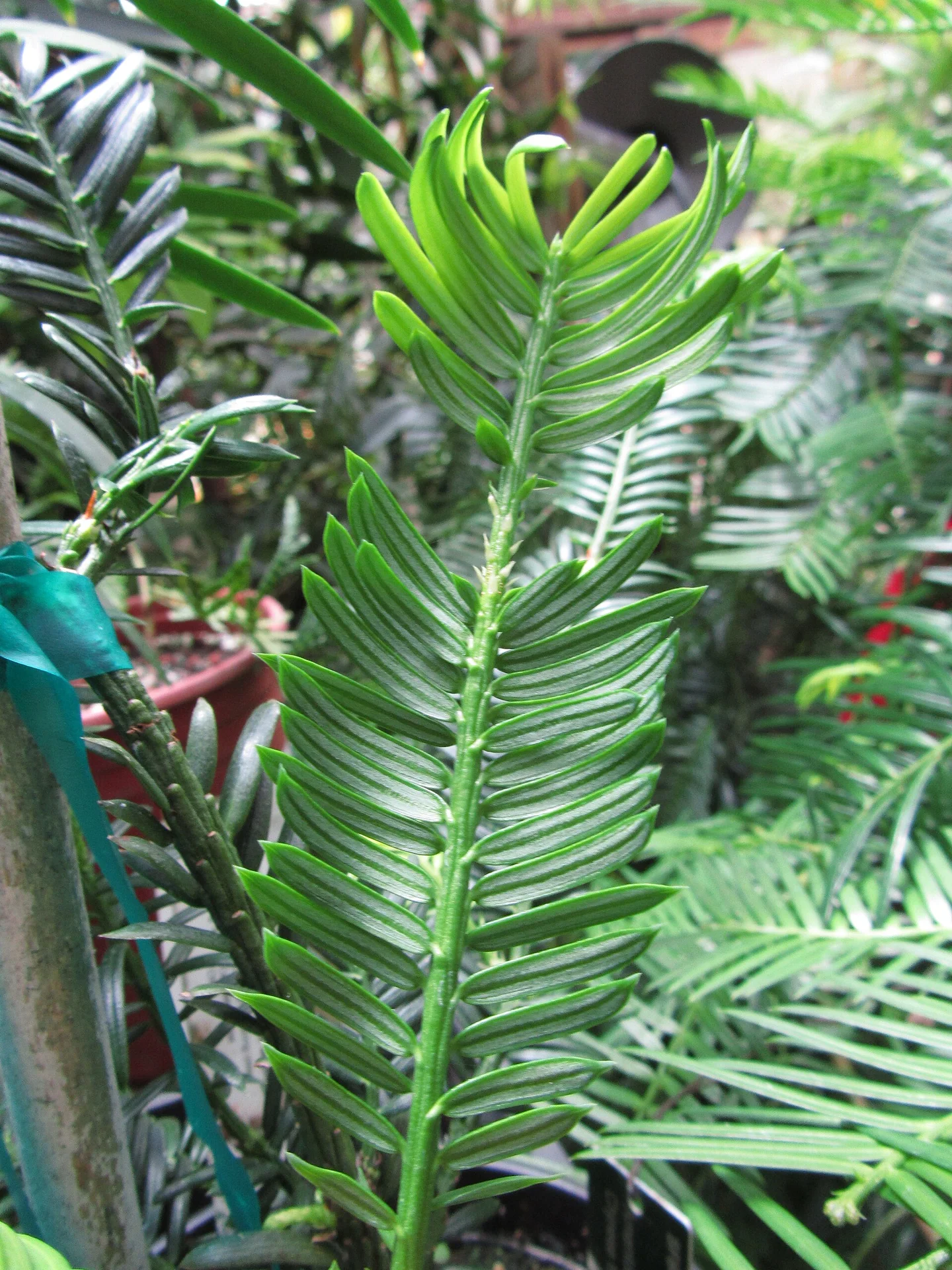
The leathery leaves are arranged in two ranks and project from the branches at angles of 45 to 90 degrees. Each needle is linear or linear-lanceolate, measuring 3 to 11 centimeters in length and 6 to 11 millimeters in width, and can be straight or slightly falcate. While the upper surface is a lustrous dark green, the underside is marked by two bright, white stomatal bands that run parallel to the prominent green midrib.
The reproductive structures are highly specialized and separate by sex. Male pollen cones are organized in catkin-like spikes measuring 1.5 to 6.5 centimeters in length, arranged in groups of two to four at the branch tips. Female cones develop singly on curved, slender stalks, producing an oblong seed enveloped by a smooth, fleshy arillus that turns a brilliant, glossy red upon reaching maturity in autumn.
Flowering season
Pollen is released in April, and the seeds reach maturity in October.
Jan
Feb
Mar
Apr
May
Jun
Jul
Aug
Sep
Oct
Name
Dec
Applications
In local craft and industry, the dense and fine-grained wood of Amentotaxus argotaenia is highly valued for manufacturing tools, household furniture, and various agricultural implements. Its ornamental appeal makes it a desirable landscape shrub and a subject for bonsai cultivation, particularly in the warmer provinces of southern China.
Furthermore, chemical investigations of its oil-rich seeds indicate potential medicinal applications. Researchers are actively studying the species for bioactive compounds that could be utilized in developing new anticancer therapies, similar to those derived from other members of the yew family.
Interesting facts
The botanical name of the genus, Amentotaxus, directly references its unique flower-like structures, merging the Latin word for catkin with the name of the yew tree. Similarly, the specific epithet argotaenia derives from Greek terms for silver and band, highlighting the prominent stomatal stripes on the underside of its foliage.
A rare evolutionary trait among conifers is this species' capacity to resprout directly from cut stumps, which has saved localized populations from complete extirpation in heavily harvested areas. In Hong Kong, this resilience has allowed historic specimens to regenerate after historical deforestation.
On the high karstic cliffs of Libo County in Guizhou, a specialized variety known as Amentotaxus argotaenia var. brevifolia survives in an extremely restricted range of under five square kilometers. With fewer than 50 mature individuals left in the wild, this variety is officially categorized as critically endangered.