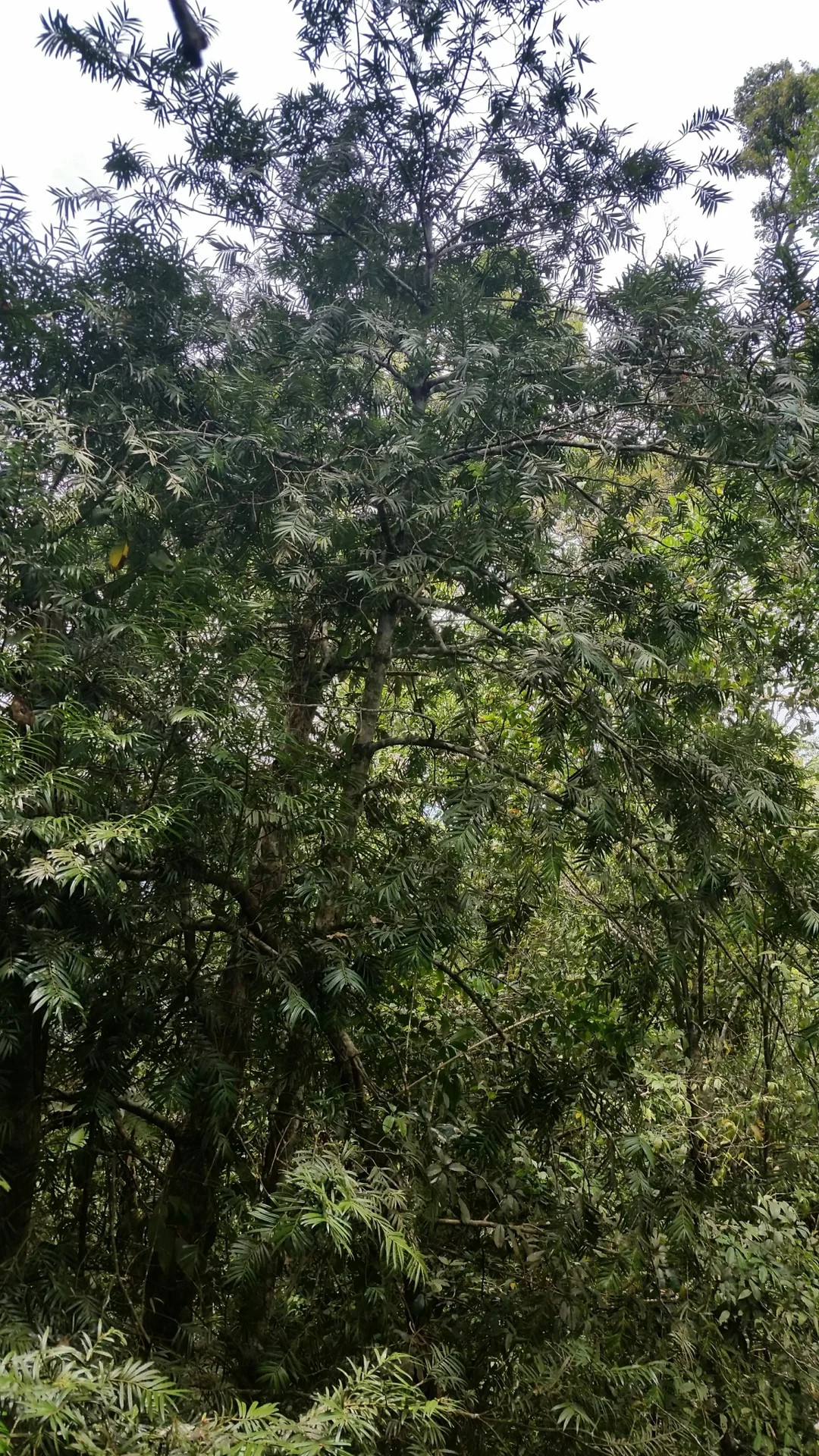
Amentotaxus poilanei: Poilane's Catkin Yew Ecology
Restricted to the high-altitude cloud forests of central Vietnam, Amentotaxus poilanei is a rare and vulnerable conifer. Commonly known as Poilane's Catkin Yew, it is named in honor of the French botanist Eugène Poilane, who first collected it in the early 20th century.
The tree grows scattered but locally common in cool, damp mountain habitats. It is primarily protected within the boundaries of the Ngoc Linh Nature Reserve, where constant cloud cover and high rainfall support its growth.
This species forms a large tree reaching heights of up to 20 meters, with a trunk diameter that can reach 1 meter. Its brown bark is smooth at first, becoming scaly and exfoliating in thin layers as the tree matures.
The leaves and reproductive structures display the following features:
Needles: Linear or oblanceolate needles grow in two rows at angles of 50° to 70° from the twig. They are 5 to 8 centimeters long and have a wrinkled, spotted dark green upper surface due to sclereid cells.
Stomatal Bands: The underside of the needle features two prominent white or cream-grey bands covered with a thick layer of white wax.
Male Cones: Organized in terminal clusters of 3 to 4 catkin-like racemes, each 2.5 to 4.5 centimeters long, containing 8 to 12 pairs of pollen cones.
Female Structures: The seed-bearing structures develop on a thin, recurved stalk measuring 1 to 2 centimeters in length.
Applications
Although the size of the tree makes its timber technically suitable for construction and joinery, there is no recorded economic utilization of this species. Its remote mountain habitat and high conservation status prevent commercial harvesting.
Interesting facts
The specific epithet honors Eugène Poilane, an active French plant collector who discovered the type specimen of this conifer in Vietnam.
The species is extremely similar in appearance to its relatives, particularly Amentotaxus formosana, and some taxonomists debate whether it should be classified as a distinct species or a regional variety of Amentotaxus yunnanensis.