Amentotaxus Guide: Ancient Catkin-Yews of Southeast Asia
Thriving in the shaded, moist understories of subtropical Southeast Asian forests, these ancient conifers populate steep mountain slopes and deep ravines. Their lineage dates back to the Middle-Late Jurassic era, making them living links to the prehistoric flora of the Daohugou Bed in China.
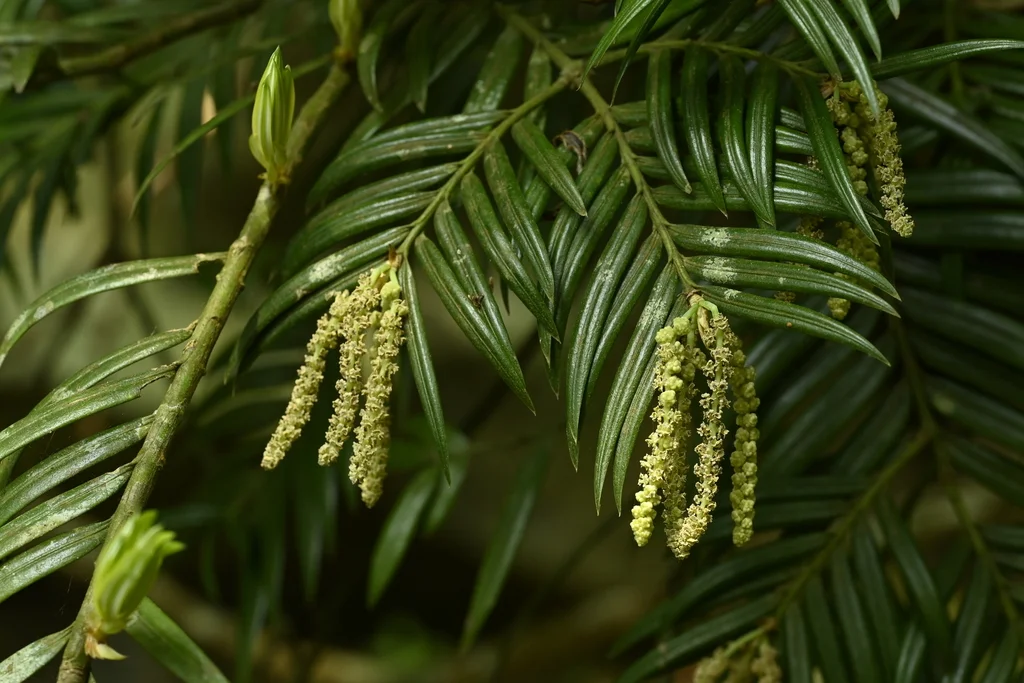
Often referred to as catkin-yews, they stand out in the conifer world due to their unique pollen-bearing structures that resemble hanging catkins. Their soft, flattened leaves feature two striking white stomatal bands on the underside, contrasting with the dark green upper surface.
Growing as evergreen shrubs or small trees, these plants reach heights between 2 and 15 meters with spreading branches. The linear-lanceolate leaves are spirally arranged on the shoots but twist at the base to form two distinct flat ranks.
Each soft leaf measures 4 to 12 centimeters in length and features a blunt apex, distinguishing them from the spine-tipped leaves of the related genus Torreya. The undersides of the needles are marked by two broad, white stomatal bands, while the upper surface remains a deep green.
These plants produce catkin-like male pollen cones that hang in clusters of two to six, measuring 3 to 15 centimeters long. The female seed cones mature over 18 months into a drupe-like structure, featuring a single nut-like seed surrounded by a fleshy orange-to-red aril.
Applications
Cultivation of certain species, particularly Amentotaxus argotaenia, occurs occasionally for ornamental purposes in botanical collections and specialized gardens. However, because they are not fully cold-hardy in temperate climates, their use is largely restricted to greenhouse collections or mild subtropical regions.
Interesting facts
The unique features of this genus have led to several fascinating scientific discoveries and historical debates:
Etymological Origins: The botanical name is a hybrid term combining the Latin word amentum (meaning catkin) with Taxus (yew), directly referencing the distinctive catkin-like appearance of its male cones.
Jurassic Lineage: Fossil evidence indicates that these plants are extremely ancient, with recognizable fossils found in the Middle-Late Jurassic Daohugou Bed in China, showing they have survived for millions of years.
Taxonomic Classification: For a long time, the genus was grouped with plum-yews in the Cephalotaxaceae family or even proposed for its own family, Amentotaxaceae, but modern DNA analysis has firmly placed it within the yew family, Taxaceae.