Amphipetalum paraguayense - Rare Talinaceae Succulent of South America
Native to the dry, chacoan regions of South America, Amphipetalum paraguayense stands out as a unique succulent herb. This plant represents the sole species within the monotypic genus Amphipetalum, which belongs to the family Talinaceae.
It thrives in the wild landscapes of eastern Bolivia and western Paraguay, particularly in the department of Boquerón. Since its description in 1988, it has captured the interest of botanists due to its rarity and specific adaptational traits.
Amphipetalum paraguayense develops as a perennial, herbaceous plant characterized by loosely branched, velvety-hairy stems reaching up to 40 centimeters in length. These shoots arise from an elongated, thickened taproot. The flat, slightly succulent leaves are obovate to wedge-shaped, measuring 3 to 11 centimeters in length and 1.5 to 6.5 centimeters in width, with a truncate or emarginate apex and a very short or absent petiole.
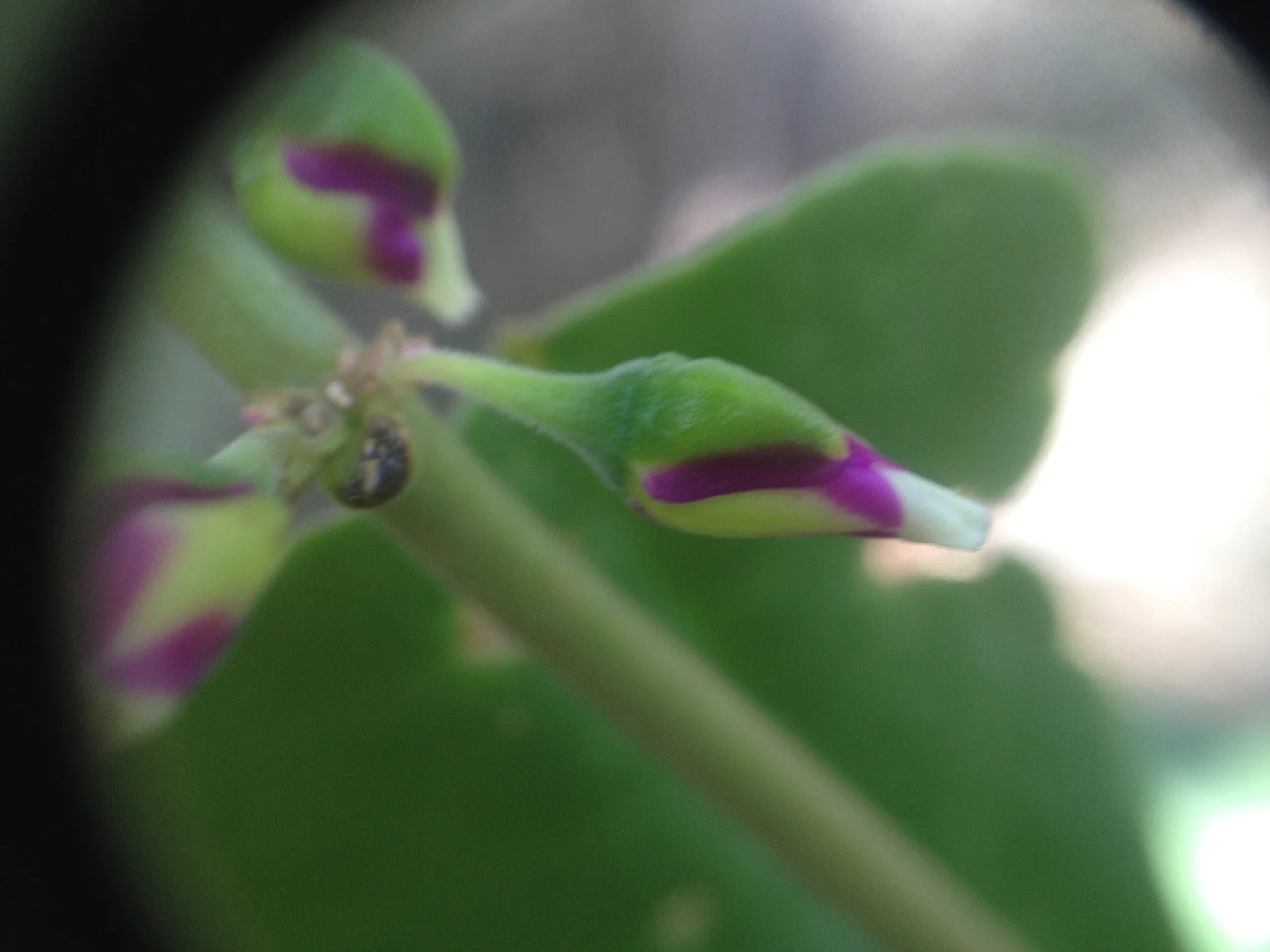
The terminal inflorescence reaches a length of up to 17 centimeters, displaying flowers arranged in whorled-clustered, cymose configurations on pedicels that thicken towards the tip. The two green sepals are broadly ovate and feature distinct purple margins with hairy outer surfaces. The outer sepal measures 3 by 4 millimeters, while the inner sepal is 5 by 3.5 millimeters.
Its five white petals exhibit a unique dimorphism. The two outer petals are ovate, hairy on the outside, and marked with a purple spot on one half. In contrast, the three inner petals are larger, obovate, completely glabrous, and measure up to 9 millimeters in length.
The flower also contains 12 to 19 stamens with filaments that are hairy near their base. The spherical ovary develops into a dry capsule splitting into three valves.
Interesting facts
The genus name Amphipetalum is derived from the Greek words amphi, meaning 'double' or 'different', and petalon, meaning 'petal'. This directly references the plant's unusual flower structure, which contains two distinct types of petals. The outer two petals are smaller and pubescent, whereas the inner three petals are larger and smooth.
Geography of distribution
Paraguay
Bolivia
Sources
Plants of the World Online (POWO)
World Flora Online (WFO)
Candollea (original description by Nélida María Bacigalupo, 1988)