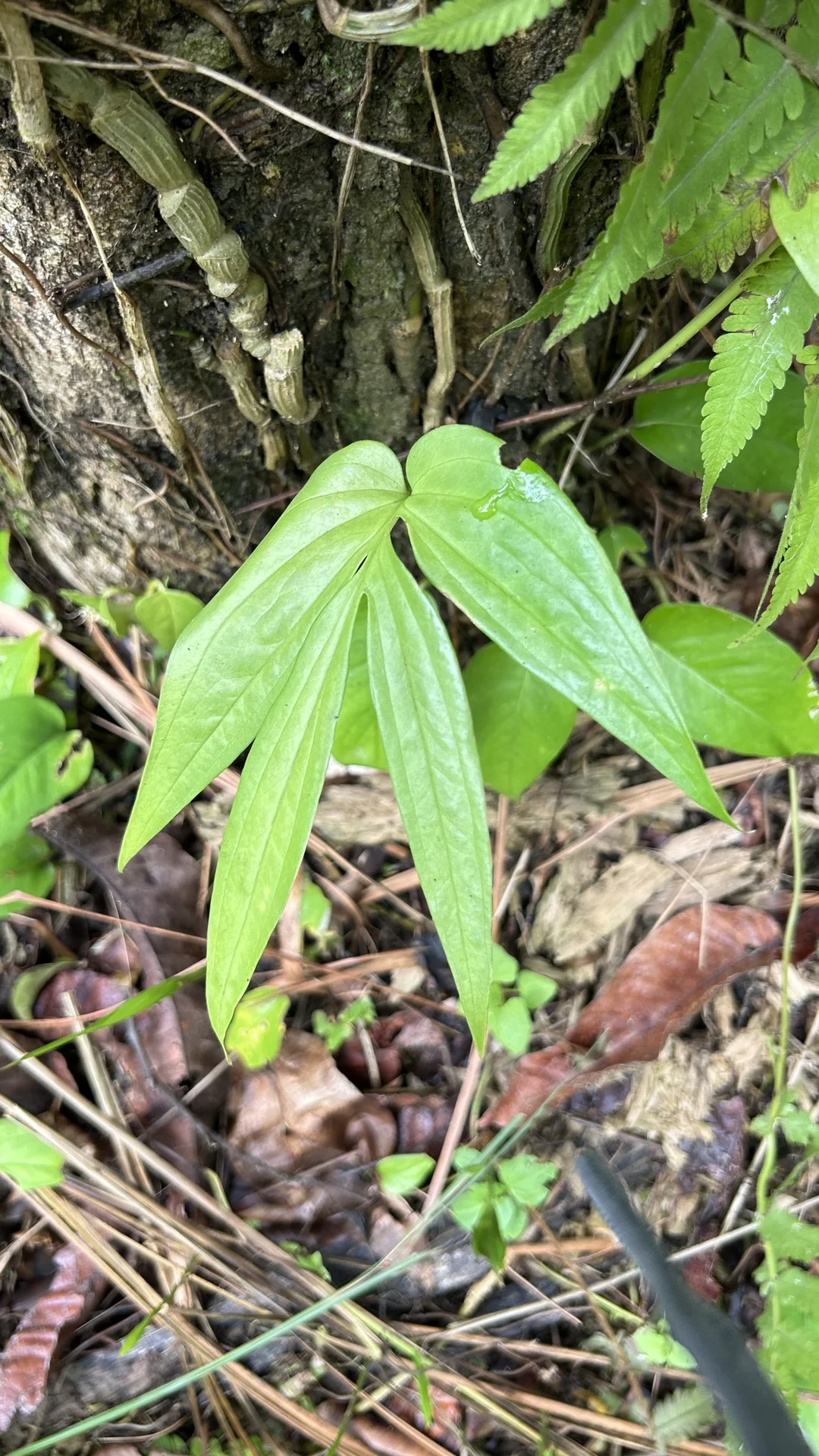
Amydrium zippelianum — fenestrated climbing aroid from Malesia
Amydrium zippelianum is a vigorous, high-climbing epiphytic vine native to the humid lowland and lower montane rainforests of Central Malesia, stretching from the Philippines and Sulawesi to New Guinea. Its specific epithet, zippelianum, honors Alexander Zippelius, a 19th-century German-born horticulturist and botanical collector who explored the islands of the Dutch East Indies and gathered the original specimens in New Guinea.
Belonging to the arum family (Araceae), this dramatic plant was first described in 1863 by Heinrich Wilhelm Schott under the name Rhaphidophora zippeliana. Over a century later, in 1968, the American botanist Dan Henry Nicolson transferred it to the genus Amydrium after studying its distinctive floral anatomy, mesh-like stem fibers, and seed structure.
Amydrium zippelianum is a large-scale climber capable of ascending several meters up tree trunks, undergoing a striking transformation in leaf shape (heteroblasty) as it matures.
Stems and fibrous sheaths
The robust, climbing stems measure 1 to 2.5 cm in diameter and are clothed in a persistent, coarse network of brown fibers formed by the breakdown of old leaf bases. Between leaf-bearing nodes, the vine occasionally sends out long, whip-like, leafless runner shoots (flagella) that rapidly search for neighboring supports.
Juvenile and adult foliage
While young plants creeping in the shade produce smaller, nearly solid heart-shaped leaves, mature climbing stems develop expansive, leathery blades up to 60–80 cm long with a deeply sculpted silhouette.
Lobes and fenestrations: Adult blades are deeply pinnatifid (cut into broad lateral lobes along the midrib) and pierced by irregular oval perforations (fenestrations) clustered near the central costae.
Venation network: Unlike related monsteroid genera with strictly parallel lateral veins, the secondary and tertiary veins of Amydrium weave into a distinct, visible mesh (reticulate venation) between the main ribs.
Inflorescence and berries
Mature vines produce solitary or paired inflorescences from the upper leaf axils, held on sturdy erect stalks.
Spathe and spadix: A thick, reflexed yellowish-white spathe opens to expose a cylindrical, pale yellow to cream-colored spadix covered in bisexual flowers.
Fruit: After pollination, the spadix swells into a heavy cluster of rounded berries that turn glossy red to orange-red at maturity, contrasting sharply with the green canopy.
Care parameters
Light
Bright, filtered indirect light mimicking dappled rainforest canopy; avoid harsh midday sun which scorches the thin interveinal tissue.
Watering
Keep the airy substrate evenly moist with lukewarm water, allowing only the top few centimeters of the mix to dry slightly between waterings.
Temperature
Thrives in warm, stable tropical temperatures between 20°C and 29°C (68°F–84°F); protect from cold drafts and temperatures below 15°C.
Humidity
Requires high ambient humidity of 65% to 85% for clean unfurling of the large perforated leaves.
Toxicity
Contains insoluble calcium oxalate crystals (raphides) in all tissues; toxic if ingested by pets or humans and irritating to skin and mucous membranes.
Applications
Amydrium zippelianum is valued both in traditional ethnobotany within its native range and in modern ornamental horticulture around the world.
In traditional folk medicine across parts of its native Malesian range, the large leaves are prepared and applied topically to soothe sore ribs and localized chest discomfort. In indoor gardening and botanical conservatories, it has become a sought-after collector's plant, grown on moss poles or bark totems to showcase its architectural, deeply cut foliage.
Interesting facts
Fiber-reinforced armour and foraging runners
Climbing up a tall tree trunk in the storm-swept rainforests of New Guinea and the Philippines requires more than just sticky roots; it demands both structural protection for the stem's water-carrying vessels and a way to relocate if a host branch breaks. Amydrium zippelianum addresses both challenges through two specialized anatomical systems that set it apart from ordinary houseplants.
First, as each leaf petiole ages, its basal sheath does not simply rot away or peel off cleanly. Instead, the soft parenchyma cells dissolve while the tough vascular bundles remain behind, wrapping the stem and emerging buds in a dense, woven mat of rot-resistant fibers.
Protective fibrous corset: This breathable mesh acts like natural chainmail, shielding the tender apical meristem from bark-grazing insects while trapping sponge-like pockets of rainwater and humus around the clasping roots.
Leafless scouting flagella: When a vine outgrows its perch or loses light, it switches from making heavy, energy-expensive leaves to shooting out fast-growing, slender stolons with long internodes that sweep across the forest floor or bridge gaps between trunks until they detect the vertical shadow of a new host tree.
Combined with its perforated leaf blades that vent tropical updrafts without tearing, these coordinated mechanisms allow a single plant to anchor, armor, and navigate its way through a constantly shifting three-dimensional jungle.
Varieties and cultivars
While wild-type green forms remain the standard in botanical collections, selective propagation has introduced several rare variegated sports prized by aroid enthusiasts.
'Variegata' (White/Albo Variegated): Features striking sectors, marbling, and splashes of creamy white to pale mint across the deeply lobed green blades.
'Aurea Variegated': Displays bold patches of chartreuse and golden-yellow variegation that intensify as the newly unfurled leaf hardens off under bright filtered light.