Wrinkled Cape Woody Carrot (Anginon rugosum)

Groovy Finkel

Anginon rugosum (Groovy Finkel) — Botanical Profile and Habitat

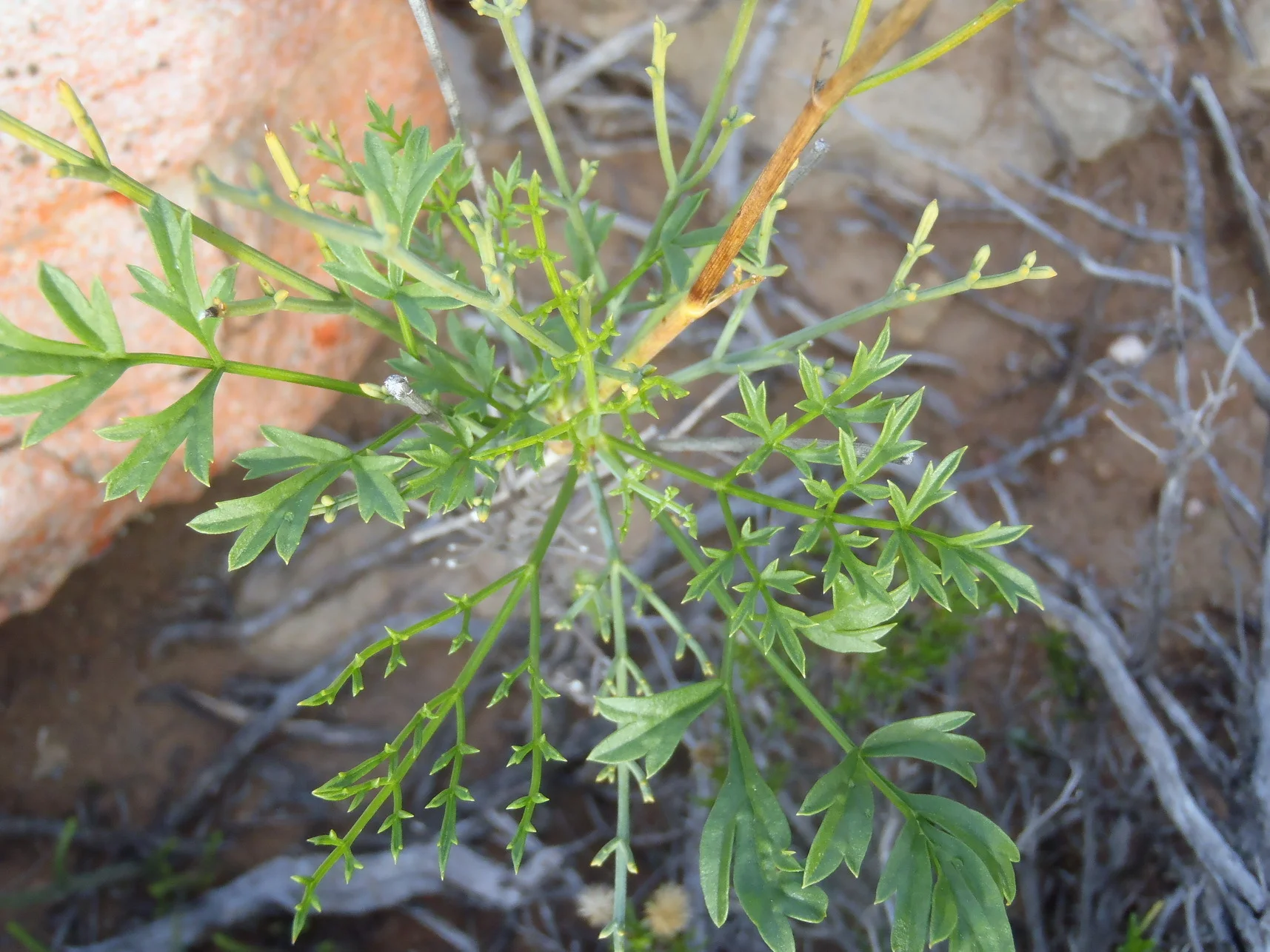
Anginon rugosum, known locally as the groovy finkel, is a hardy woody shrub native to the rocky coastal slopes and limestone hills of South Africa. Instead of the soft, feathery foliage typical of its herbaceous relatives, it carries stiff, needle-like leaves and flat-topped clusters of bright yellow flowers, while its specific epithet rugosum means 'wrinkled' and points directly to the textured surface of its mature fruits.

Belonging to the carrot and parsley family, Apiaceae, this species was first described by the Swedish naturalist Carl Peter Thunberg as Conium rugosum before Constantine Samuel Rafinesque transferred it to the genus Anginon in 1838.

Taxonomy

  • ∟ царство Plantae
  • ∟ division Tracheophytes (Vascular Plants)
  • ∟ subdivision Spermatophytes (Seed plants)
  • ∟ Angiosperms
  • ∟ mesangiosperms (Core angiosperms)
  • ∟ eudicots
  • ∟ core eudicots
  • ∟ asterids
  • ∟ order Apiales
  • ∟ family Apiaceae
  • ∟ genus Anginon
  • ∟ species Anginon rugosum (Wrinkled Cape Woody Carrot)

Living Pulse

Morphology

Unusual among members of the Apiaceae family, Anginon rugosum grows as a rigid, upright woody shrub reaching up to two meters in height, supported by tough, branching stems with smooth, grayish bark.

Foliage and stems

  • Leaf structure: The plant produces stiff, leathery leaves that are either simple and needle-like (acicular) or divided into a few narrow, cylindrical segments that minimize exposed surface area.
  • Sheathing bases: Each leaf attaches to the stem via a firm, clasping basal sheath that protects the developing axillary buds from drying winds.

Flowers and fruits

  • Compound umbels: Robust stalks lift dense, umbrella-shaped clusters (umbels) of small, five-petaled yellow flowers high above the foliage during the warm season.
  • Wrinkled schizocarps: After pollination, each flower develops into a dry, two-parted fruit (schizocarp) that splits into twin seed-like mericarps covered in a coarsely wrinkled, tuberculate outer wall.

Flowering season

Late summer to autumn in the Southern Hemisphere (February to April)

Jan
Feb
Mar
Apr
May
Jun
Jul
Aug
Sep
Oct
Name
Dec

Interesting facts

While most members of the carrot family are soft annuals or herbaceous perennials that die back to the ground, Anginon rugosum has engineered a woody, drought-resistant architecture tailored to the harsh summer heat of the South African Cape.

Engineering against desiccation

  • Cylindrical leaf geometry: By rolling its photosynthetic tissue into tough, needle-shaped cylinders with a thick waxy cuticle, the shrub drastically reduces water loss while still capturing sunlight from every angle.
  • Aromatic oil canals: Embedded within the stems and the wrinkled walls of the fruits are microscopic resin ducts called vittae, which store volatile essential oils that deter browsing herbivores when fresh green forage is scarce in late summer.
  • Synchronized late-season blooming: The shrub flowers and sets fruit at the height of the dry season, using deep woody roots to tap underground moisture when competing herbaceous plants are dormant, ensuring that its winged, textured mericarps are ready for dispersal just as autumn winds arrive.

Geography of distribution

  • South Africa

Sources

  • Plants of the World Online (POWO) — Royal Botanic Gardens, Kew: Anginon rugosum (Thunb.) Raf.
  • World Flora Online (WFO): Anginon rugosum taxonomic record
  • Global Biodiversity Information Facility (GBIF): Anginon rugosum occurrence and backbone taxonomy

Technical Information

Taxon Synonyms: Anginon uitenhagense, Conium rugosum, Trinia uitenhagensis, Trinia uitenhagense, Rhyticarpus rugosus

External Databases: GBIF, POWO, Tropicos
See also

True Araucarias

True Araucarias

Araucaria sect. Araucaria

Araucaria sect. Araucaria is a botanical section of evergreen conifers native to South America. It …