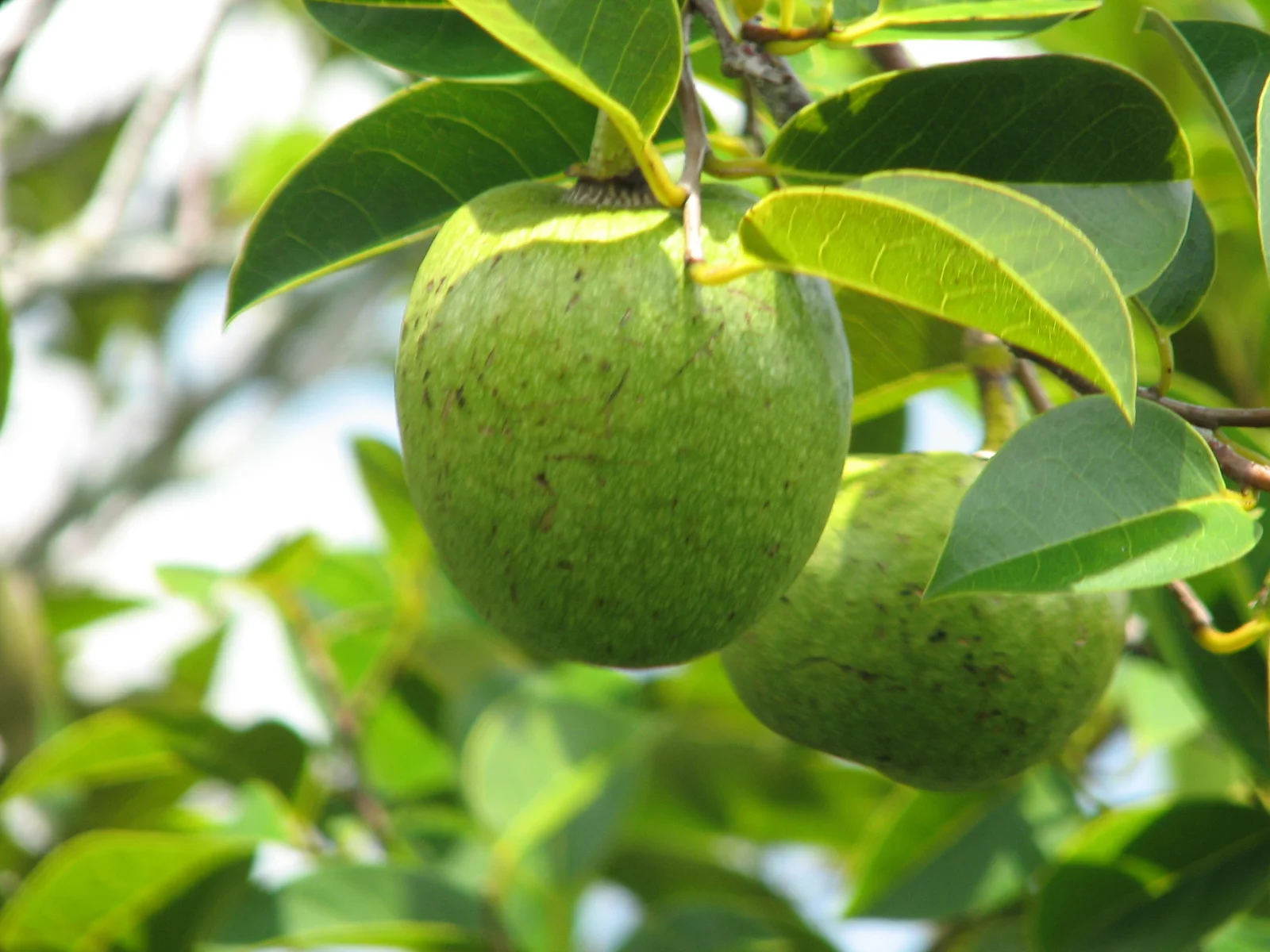
Alligator apple
Swamp apple
Corkwood
Bobwood
Monkey apple
IUCN: Least Concern
#5E7A21
#86A52B
#425E0E
#A1B867
#EBF1D9
Plant palette
Annona glabra (pond apple): botany, habitat, fruit and uses
Annona glabra, widely known as the pond apple or alligator apple, is a resilient tropical and subtropical tree that thrives in flooded swamps, estuaries, and brackish coastal wetlands across the Americas and West Africa. Its Latin specific epithet glabra means "smooth" or "hairless", referring to its glossy, completely glabrous leaves and smooth-skinned fruits that distinguish it from many velvety relatives.
The species belongs to the custard apple family (Annonaceae), placing it in the same genus as the famous soursop and cherimoya. It was formally described by Carl Linnaeus in 1753 in his foundational work Species Plantarum.
Annona glabra is a semi-deciduous or evergreen tree that typically reaches 3 to 8 meters in height, though under ideal conditions in the Florida Everglades it can grow up to 12–15 meters tall. Its narrow gray trunk features prominent lenticels—specialized breathing pores in the bark—and frequently develops swollen, buttressed bases that anchor the tree in unstable, waterlogged mud.
Leaves
The alternate, two-ranked leaves are ovate to oblong-elliptic with an acute tip, measuring 8 to 15 cm long and 4 to 6 cm wide. When crushed, the leathery, hairless blades release a crisp scent reminiscent of green apples, which helps botanists quickly distinguish the tree from surrounding mangroves.
Flowers
Solitary flowers emerge on stout, curved pedicels and reach 2 to 3 cm in diameter, opening for only a brief period:
Outer petals: three thick, leathery, heart-shaped petals of pale cream or yellow-green, marked with a deep crimson spot near the base.
Inner petals: three slightly smaller petals that are whitish on the outside and vividly blood-red on the inside, forming a sheltered pollination chamber.
Fruits and seeds
The fruit is a smooth, spherical to oblong syncarp—a compound structure formed by the fusion of many individual carpels—measuring 7 to 15 cm long and up to 9 cm wide. As it ripens, the skin turns from dark green to golden yellow, enclosing a fragrant, yellow-to-orange pulp and more than 100 convex, light-brown seeds about 1 cm long.
Flowering season
In tropical and subtropical regions, flowering occurs primarily from late spring through winter, with peak blooming observed between May and January depending on local wet seasons.
Jan
Feb
Mar
Apr
May
Jun
Jul
Aug
Sep
Oct
Name
Dec
Applications
Unlike commercial relatives such as cherimoya or soursop, the ripe yellow-orange pulp of Annona glabra has a mild flavor reminiscent of ripe honeydew melon, sometimes accompanied by a slight resinous aftertaste. In the Maldives and parts of the Caribbean, the aromatic flesh is blended with milk or sugar into refreshing cold beverages, or cooked down into sweet household jams and jellies.
Beyond the kitchen, humans have found several practical uses for the tree's specialized tissues:
Agricultural rootstock: horticulturists in South Florida and tropical Asia have used Annona glabra as a flood-tolerant rootstock for grafting sugar apple (Annona squamosa) and soursop (Annona muricata), often inducing a compact, dwarfing effect on the scion.
Lightwood and fishing gear: because the wood—traditionally called corkwood or bobwood—is remarkably light and spongy, coastal communities have carved it into fishing net floats, bottle stoppers, and buoyant rafts, while using the fragrant orange pulp as crab bait.
Folk medicine and pharmacology: in traditional remedies, leaf decoctions have been used to soothe digestive upsets, and crushed seeds cooked in coconut oil were historically applied externally against head lice; modern laboratory research also investigates its alcoholic seed extracts for acetogenins with potential antitumor activity.
Interesting facts
Built-in life jackets for transoceanic voyages
Most fruit trees would suffocate if their roots were submerged in brackish water or their seeds dropped into the ocean, yet Annona glabra is engineered as an amphibious pioneer. Its seeds are encased in a tough, corky coat with internal air spaces that act like microscopic flotation vests, allowing them to drift in both fresh and salt water for up to 12 months while retaining high germination viability.
This exact coordination between buoyant fruit pulp, salt-impervious seed coats, and flood-tolerant seedling physiology explains why the species naturally spans both sides of the Atlantic Ocean. Long before human navigation, ocean currents carried floating fruits between the coasts of tropical America and West Africa, establishing thriving populations along distant estuarine riverbanks.
Breathing in oxygen-starved mud
Surviving in stagnant swamp soil requires a finely tuned internal ventilation system, because waterlogged mud quickly runs out of free oxygen. To keep its submerged tissues alive, Annona glabra develops a spongy, low-density wood structure and prominent bark lenticels—tiny gas-exchange valves on the lower trunk and buttresses—that channel atmospheric air down toward the roots.
Ecological webs from Florida to Queensland
In its native range, the tree is a cornerstone of wetland food webs, whereas in introduced habitats its resilience can overwhelm local ecosystems:
Alligators and ghost orchids: in the Florida Everglades, American alligators and wetland mammals eagerly consume the fallen yellow fruits, while the rough, humid bark of older pond apple trunks serves as the primary host surface for the rare, leafless ghost orchid (Dendrophylax lindenii).
Cassowaries and mangroves: introduced to northern Queensland, Australia, around 1912 as a hardy rootstock, the tree escaped into coastal estuaries where its shade-tolerant seedlings form dense carpets, and its seeds are now dispersed over five kilometers at a time by the endangered southern cassowary.