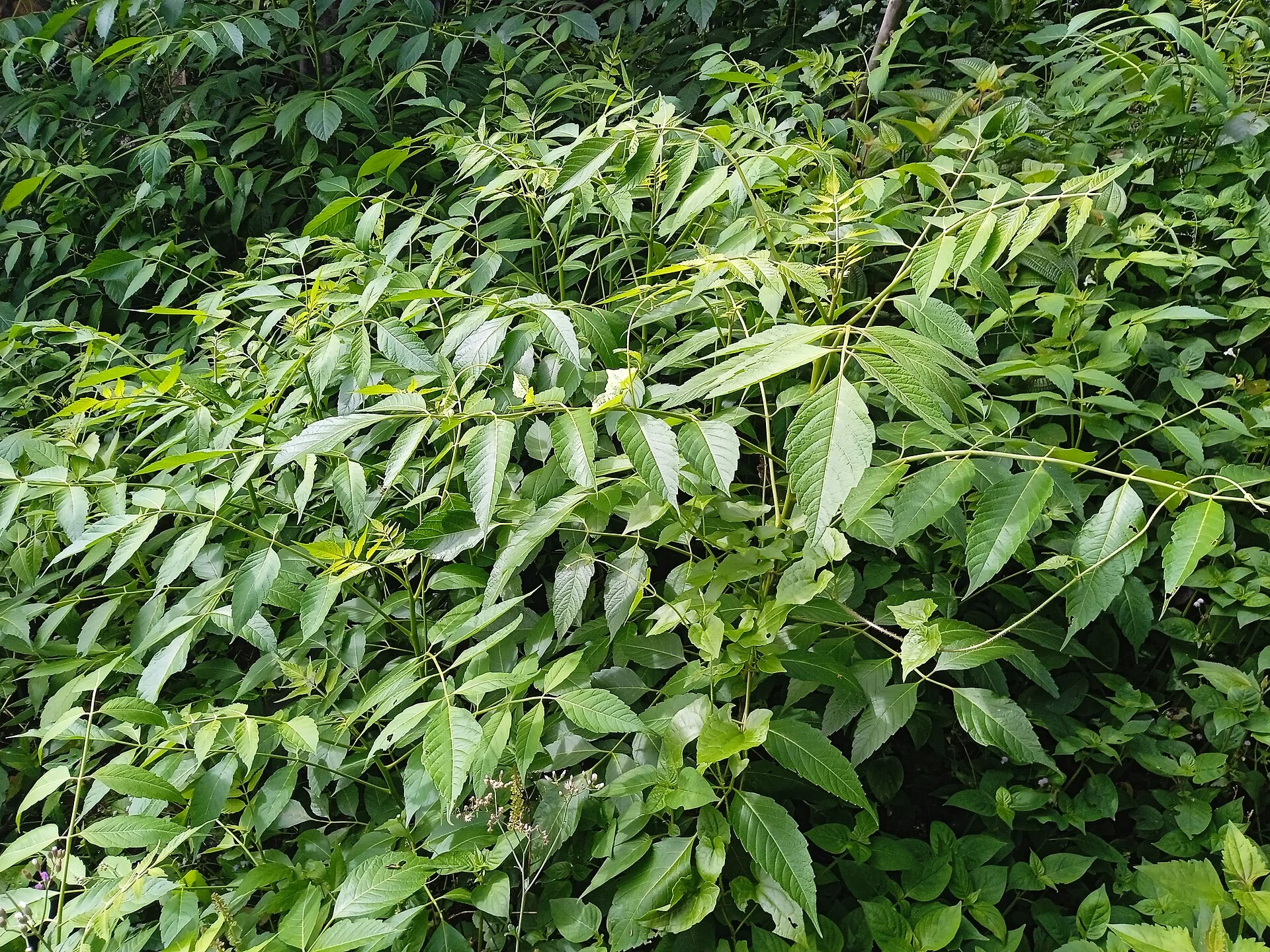
Native to wide swathes of Asia and northern Australia, Brucea javanica thrives in open habitats, secondary forests, and coastal sand dunes. This plant has long been integrated into traditional medicine systems across its range, particularly for its intense bitterness and therapeutic potential.
Local populations historically utilized various parts of the plant to manage gastrointestinal disorders and fevers. Modern pharmacological interest focus on its unique chemical constituents, which are being investigated for potential oncology and antiparasitic applications.
This species grows as an evergreen shrub or small understory tree, typically reaching heights between 1.5 to 5 meters, though exceptional specimens can grow up to 10 meters. The branches and compound leaves are covered with fine, soft yellowish hairs that are especially prominent on the veins and undersides of the foliage.
The leaves are pinnately compound, containing 3 to 15 (usually 7 to 9) ovate-lanceolate leaflets with coarsely serrate margins. Each mature leaflet spans 20 to 40 centimeters in length and tapers to a sharp point at the apex.
The tiny flowers, measuring a mere 1.5 to 2 millimeters in diameter, range in color from greenish-white to greenish-red or deep purple. They are arranged in compact panicles. The resulting fruits are small, oval, fleshy drupes up to 8 millimeters long that turn dark gray or black when fully ripe, becoming distinctly wrinkled upon drying.
Flowering season
Flowers in June and July in the Northern Hemisphere, and from October to February in Australia.
Jan
Feb
Mar
Apr
May
Jun
Jul
Aug
Sep
Oct
Name
Dec
Applications
The primary value of this species lies in its medicinal properties. The seeds, known commercially as Macassar kernels, contain quassinoid compounds called bruceolides, which have demonstrated significant antimalarial and amoebicidal activities in laboratory studies.
In traditional Chinese medicine, the fruit has been documented since the 18th century for treating dysentery and malaria. Ongoing clinical research in China explores injectable oil emulsions derived from the seeds as an adjuvant therapy in lung cancer chemotherapy, showing promising results that warrant further rigorous clinical trials.
Interesting facts
All parts of the plant, including the roots, bark, and seeds, contain extremely bitter compounds that serve as a natural defense mechanism against herbivores.
The specific epithet javanica translates from Latin to mean "of Java," referencing one of its native Indonesian islands.
A single mature tree is highly productive, capable of yielding over 2,000 small black drupes per season.
Research indicates the presence of moronic acid within the plant, a triterpenoid showing potential anti-HIV activity in preliminary laboratory screenings.