Fringed redmaids
Menzies' calandrinia
Desert rock purslane
Calandrinia menziesii (Red maids): Habitat, Traits and Uses
Calandrinia menziesii, widely known as red maids, is a low-growing, semi-succulent annual herb that carpets open meadows and sunny hillsides across western North America from British Columbia down to Baja California. It catches the eye in early spring with its satiny, jewel-toned magenta to crimson blossoms, while its specific epithet honors the Scottish surgeon and naturalist Archibald Menzies, who explored the Pacific coast in the late eighteenth century.
First described in 1833 by the British botanist William Jackson Hooker as Talinum menziesii and transferred to the genus Calandrinia by Thomas Torrey and Asa Gray in 1838, this species is also frequently treated in botanical literature in relation to Calandrinia ciliata.
The plant grows from a slender annual taproot that anchors it firmly in sandy or rocky soils. Its fleshy, branching stems spread outward along the ground or curve gently upward, forming loose rosettes and low mats ranging from 5 to 40 centimeters across.
Foliage and protective hairs
The leaves are narrow, spoon-shaped to linear-oblanceolate, and noticeably succulent—meaning they contain specialized water-storing tissues that help the plant endure dry spring spells. Along the leaf margins and the two-lobed calyx (the outer protective cup of the flower), fine, stiff bristles known as cilia form a delicate fringe that breaks up drying winds at the surface.
Flowers and seed capsules
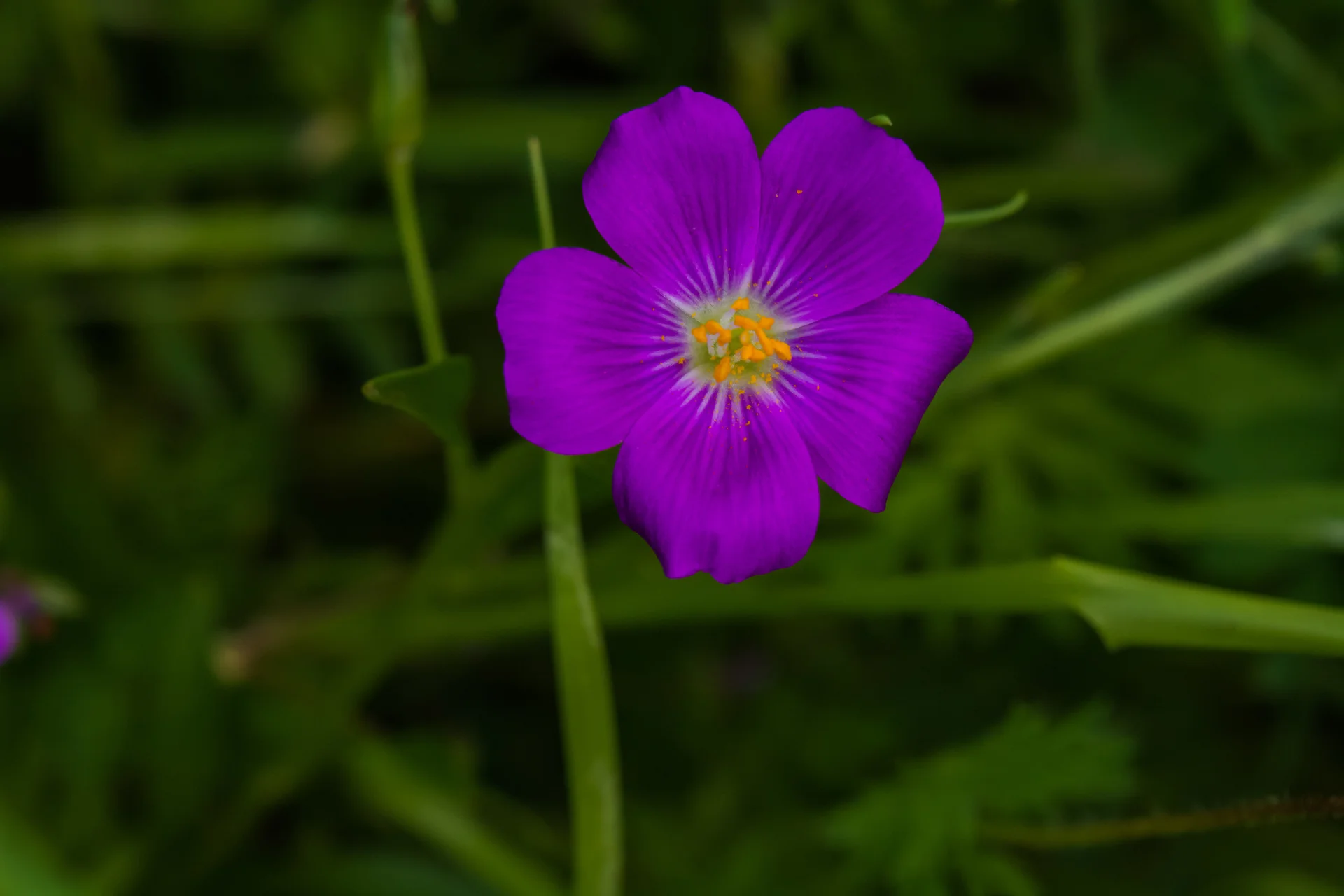
Corolla: Each solitary flower features five satiny petals in vivid shades of magenta, rose-red, or crimson, occasionally showing a softer pink or white center.
Reproductive organs: The center of the bloom holds between 3 and 15 pollen-bearing stamens and a three-parted stigma ready to receive visiting pollinators.
Fruit and seeds: After pollination, the flower develops into an oval, three-valved capsule (a dry fruit that splits open at maturity) packed with dozens of tiny, lens-shaped, glossy black seeds.
Flowering season
Blooms from late winter through spring, typically peaking between February and May depending on elevation and rainfall.
Jan
Feb
Mar
Apr
May
Jun
Jul
Aug
Sep
Oct
Name
Dec
Care parameters
Light
Requires full sun; the flowers remain tightly closed in shade or on overcast days and only unfurl under direct sunlight.
Watering
Prefers moderate moisture during winter and early spring growth, but needs sharp drainage and very little water once established to prevent root rot.
Temperature
Thrives in cool to mild spring temperatures between 10°C and 22°C (50°F–72°F) and naturally completes its life cycle before intense summer heat arrives.
Humidity
Adapts well to low to moderate outdoor humidity and dislikes damp, stagnant air.
Toxicity
Non-toxic to humans and animals; both the succulent leaves and seeds are edible.
Applications
Ethnobotany and culinary traditions
Indigenous peoples of California—including the Chumash, Miwok, and Ohlone—harvested the abundant, glossy black seeds in vast quantities to toast and grind into pinole, a nutrient-dense flour rich in natural oils. These seeds were also pressed into savory cakes and offered as highly valued ceremonial gifts and trade goods.
The tender young succulent leaves and stems have a mild, slightly tangy flavor and can be eaten raw in spring salads or lightly steamed as a potherb, much like common purslane.
Ornamental gardening and restoration
Wildflower meadows and rock gardens: Gardeners sow Calandrinia menziesii in sunny borders, gravel beds, and xeriscapes (low-water landscapes), where its low stature and brilliant magenta blooms create a vivid seasonal groundcover.
Pollinator support and agricultural cover: In California vineyards and orchards, it is encouraged as a native winter-spring cover crop that attracts native solitary bees and syrphid flies without competing with deep-rooted trees or vines for summer water.
Interesting facts
Solar-powered petals and thermal protection
Every flower on Calandrinia menziesii operates on a strict schedule governed by light and temperature, opening only for a few hours from mid-morning to early afternoon when the sun shines directly overhead. This precision movement, known as photonasty (plant movement triggered by changes in light intensity), is driven by rapid shifts in water pressure within the cells at the base of the petals.
Pollen preservation: By folding its petals shut during damp mornings, cloudy afternoons, and chilly nights, the plant shields its delicate pollen grains from dew and rain that would otherwise wash them away or cause them to burst.
Synchronized pollinator window: The brief midday opening matches the exact flight window of small native bees and hoverflies, which require solar warmth to power their wing muscles, ensuring that the flower displays its nectar and pollen only when its specific couriers are active.
Drought-escaping life cycle and seed banking
Rather than fighting the scorching, rainless summers of western North America, this species practices drought escape by compressing its entire active life into the cool, moist window between late winter and spring. Its succulent leaves store just enough water to buffer sudden dry weeks while the plant channels all its energy into rapid seed production.
Armored seed coats: Each tiny black seed is encased in a smooth, hard outer coat—the testa—which resists crushing, fungal decay, and premature sprouting during brief summer thunderstorms.
Staggered germination: The seeds remain dormant in the soil bank for years until the exact combination of cool autumn temperatures and steady winter rains signals that the soil is deeply moistened, guaranteeing the next generation a safe start.