
Brazilian hackberry
Celtis brasiliensis
A deciduous tree or scrambling shrub in the Cannabaceae family, native to various countries in …
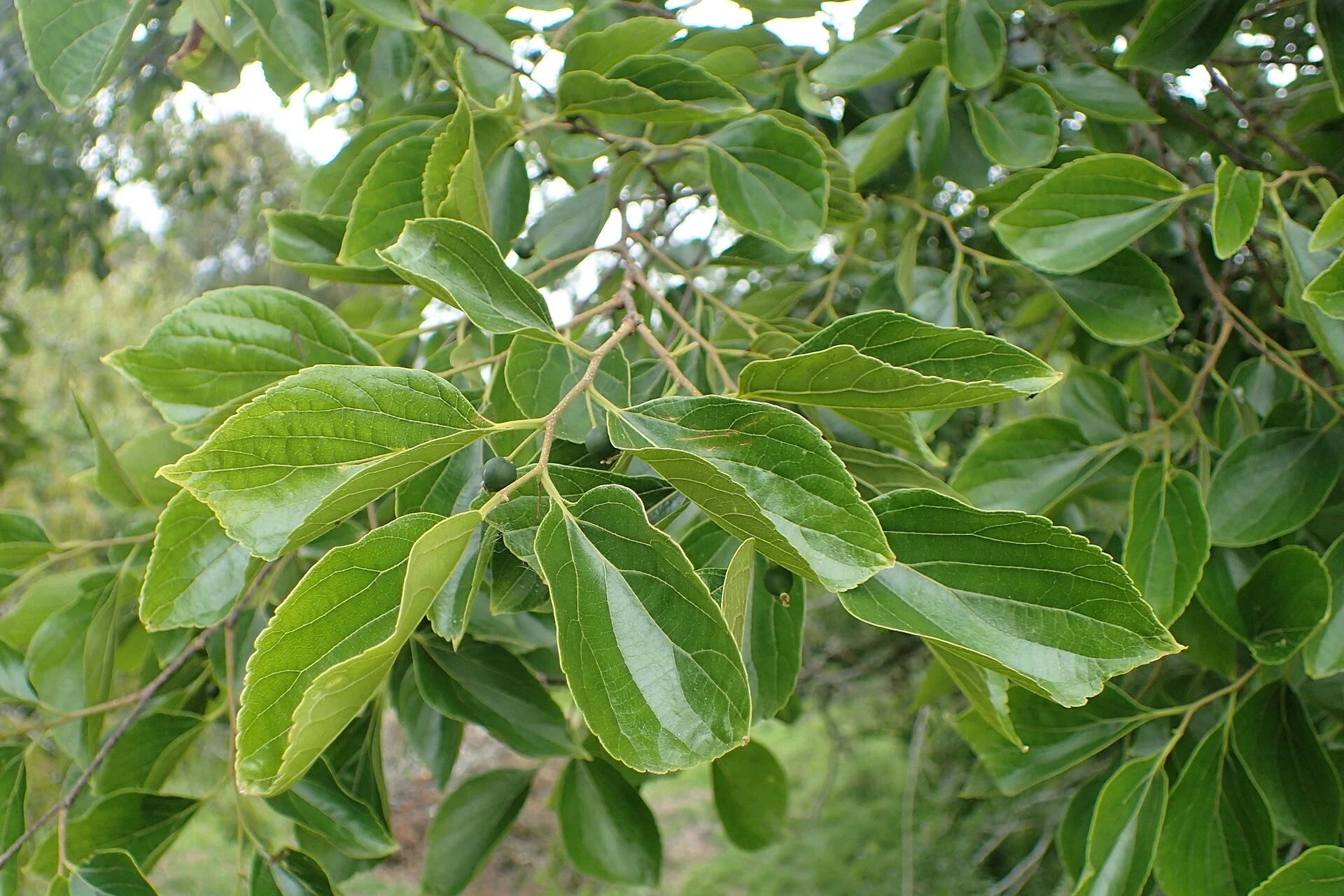
Native to various regions across East Asia, Celtis biondii thrives predominantly in limestone-rich environments as a member of the Cannabaceae family. Botanists frequently observe this deciduous tree sharing habitats with ancient flora such as wild Ginkgo biloba. Reaching mature heights of up to 18 meters, it forms a significant component of regional forest ecosystems across China, Japan, Korea, and Taiwan.
The physical structure of Celtis biondii exhibits significant variability depending on its specific environment, with mature deciduous trees typically reaching 18 to 25 meters in height, and occasionally up to 40 meters. The tree possesses gray bark accompanied by yellowish-brown branches. Its alternate leaves range from 3 to 15 centimeters in length, presenting an ovate to broadly obovate or elliptic shape with distinctively serrated margins and an acuminate, elongated tip.
Foliage texture is generally characterized as slightly thick and leathery, featuring a prominent three-veined pattern at the leaf base. Following the spring flowering period, the plant produces spherical drupes measuring between 6 and 10 millimeters in diameter. As these fruits mature toward the autumn months, they transition through striking shades of yellow and orange-red, eventually ripening to a dark brown or black coloration.
Spring
Urban planners and landscaping professionals occasionally utilize Celtis biondii for urban greening and park plantings due to its inherent environmental resilience. Its robust root system and adaptability make it a suitable candidate for stabilizing soils and enhancing biodiversity in appropriate climatic zones.
Local dialects and regional botanical literature often refer to this tree as the "purple bullet tree" due to the unique shape and coloration of its drupes. The species exhibits several notable ecological characteristics that interest conservationists:
Taxon Synonyms: Celtis cavaleriei, Celtis leveillei, Celtis chuanchowensis, Celtis biondii var. heterophylla, Celtis biondii var. insularis, Celtis rockii, Celtis emuyaca, Celtis biondii var. holophylla
Celtis brasiliensis
A deciduous tree or scrambling shrub in the Cannabaceae family, native to various countries in …

Celtis gomphophylla
A tall tree species in the Cannabaceae family, widespread across sub-Saharan Africa, Madagascar, and the …

