
Brazilian hackberry
Celtis brasiliensis
A deciduous tree or scrambling shrub in the Cannabaceae family, native to various countries in …
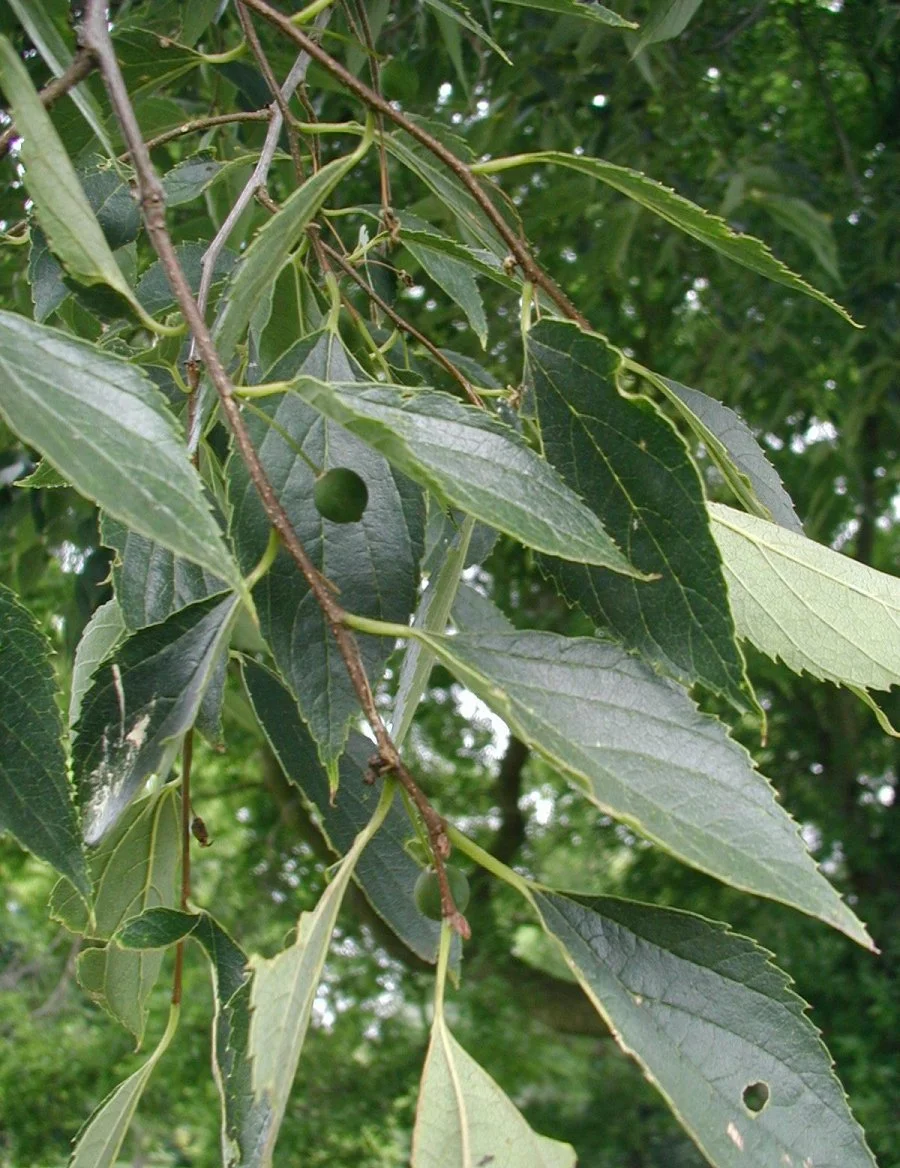
Clinging to sun-baked limestone cliffs and rugged mountain gorges, the Caucasian hackberry thrives where few other botanical species can survive. This robust tree firmly anchors fragile slopes across the Caucasus and Central Asia with its extensive root network.
Known scientifically as Celtis caucasica, it is deeply intertwined with the local ecology and history of its native mountainous range. Beyond its ability to endure severe droughts, this species has provided local populations with remarkably dense wood, earning it the moniker of the iron tree.
Celtis caucasica typically grows as a deciduous tree or large shrub reaching 4 to 7 meters in height. Exceptional specimens, however, can soar up to 15 meters under optimal conditions. The crown is characteristically broad and irregular, supported by thin, zig-zagging branches.
Young twigs display a brownish hue, eventually maturing into trunks with smooth, light grey bark. The leathery, ovate to lanceolate foliage is arranged alternately along the stems, measuring roughly 4 to 10 centimeters long. These leaves feature sharp-toothed margins, an asymmetrical base, and prominent veining.
Their upper surface is a dark, somewhat rough bluish-green, while the underside is paler and softly pubescent. Flowering occurs before or as the leaves unfurl, presenting inconspicuous pale green blooms. These give way to small, nearly spherical drupes measuring up to 1 centimeter in diameter.
As they ripen, the fruits transition from reddish-yellow to a dark, slightly glaucous brown or bluish shade. Each drupe harbors a wrinkled seed enveloped in a layer of sweet, edible flesh.
The tree typically blooms in spring, from March through May, often just before or as the new leaves begin to emerge.
The fruits of Celtis caucasica are notable for their sweet, agreeable flavor and can be consumed fresh or dried. Historically, they were ground into a nutritious flour used to bake flatbreads or prepare a traditional thick porridge known as prishmi. The seeds themselves yield a fatty oil that resembles almond oil.
Due to its extreme density and elasticity, the timber is highly valued in regional carpentry and woodworking crafts. In traditional practices, the tannin-rich bark was employed for tanning leather and yielding a yellowish-brown dye for wool and silk.
Ecologically and in landscape design, this species serves as a champion of natural erosion control. Its exceptional drought tolerance makes it invaluable for stabilizing steep mountainous screes. Furthermore, its ability to withstand poor soils and pollution has led to its successful use as a resilient street tree in urban environments.
The resilient nature of Celtis caucasica has generated numerous fascinating cultural and ecological associations across its native range.
Taxon Synonyms: Celtis tupalangi, Celtis australis subsp. caucasica, Celtis caucasica subsp. caudata, Celtis arcata, Celtis inglisii
Celtis brasiliensis
A deciduous tree or scrambling shrub in the Cannabaceae family, native to various countries in …

Celtis gomphophylla
A tall tree species in the Cannabaceae family, widespread across sub-Saharan Africa, Madagascar, and the …

