
Brazilian hackberry
Celtis brasiliensis
A deciduous tree or scrambling shrub in the Cannabaceae family, native to various countries in …
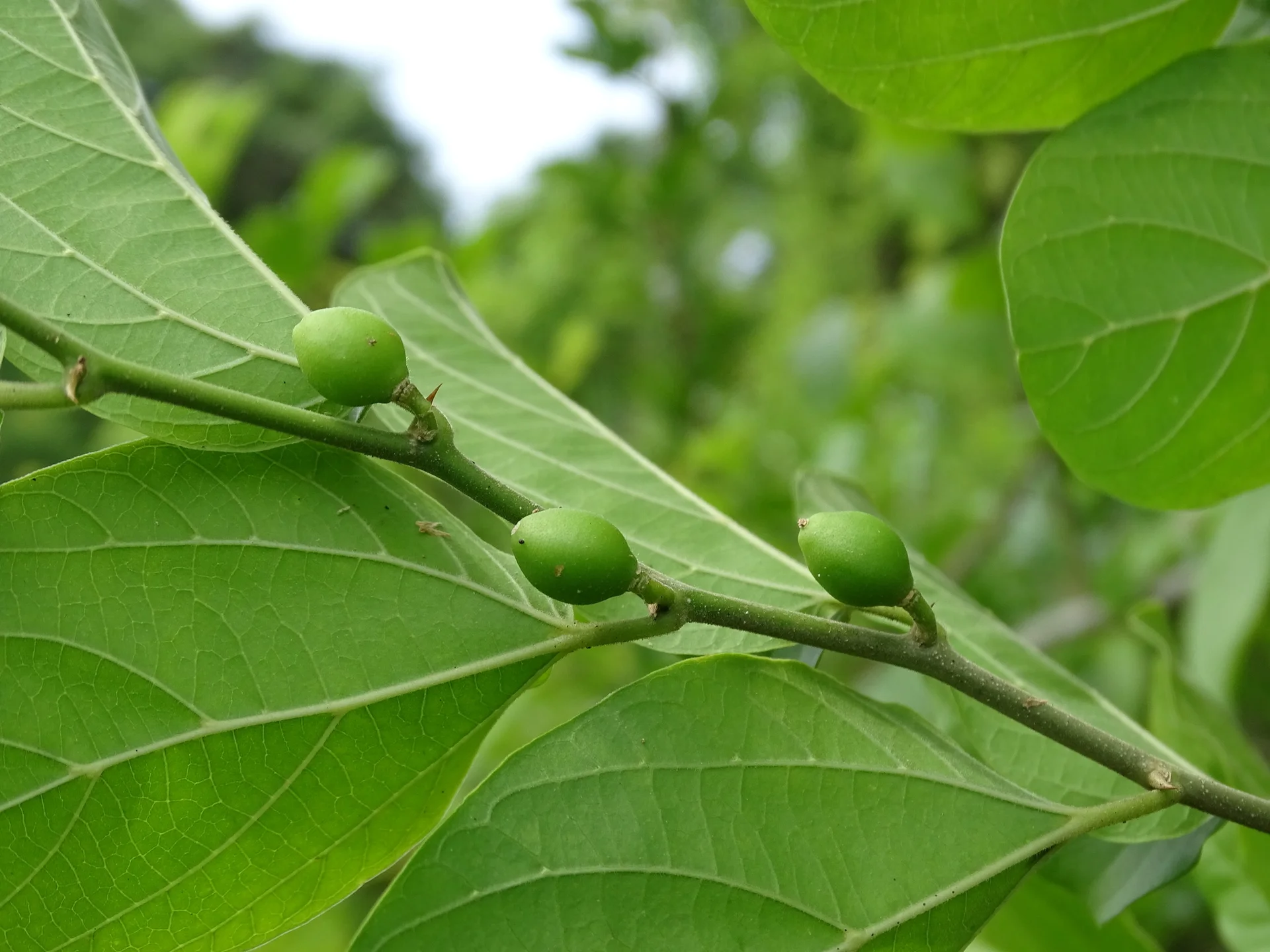
Armed with distinctive curved thorns, Celtis iguanaea adapts to its environment as a vigorous, woody climber or scrambling shrub. Widely distributed across a vast geographical range from the southern United States through Central America and down into South America, this deciduous species thrives in various tropical and subtropical habitats. The plant, often colloquially known as the iguana hackberry, demonstrates remarkable botanical resilience and morphological plasticity across its extensive natural domain.
The vegetative anatomy features oblong-oval leaves that span between 5 and 10 centimeters in length and 2 to 5 centimeters in width. Unlike some related species, the leaf base is typically rounded or somewhat heart-shaped rather than strictly oblique.
The leaf margins present variability, ranging from entire to distinctly crenate or serrated, while the apex tapers to an acute or briefly acuminate point. The stems are notably armed with sharp, curved thorns that aid in the plant's climbing habit.
Floral structures emerge as paniculate axillary cymes, giving rise to distinctive fruit development. The resulting drupes measure 10 to 14 millimeters in length, distinctly longer than their supporting pedicels. As these small, fleshy fruits mature, they typically develop an orange-yellow coloration, providing a stark visual contrast against the foliage.
Taxonomic classification of this species has undergone significant revision. For many years, Celtis ehrenbergiana was treated as a completely separate species within botanical literature.
However, a comprehensive systematic review in 2014 determined that it was morphologically synonymous with this climber. This consensus ultimately led to its reclassification as a synonym of Celtis iguanaea.
Taxon Synonyms: Celtis biflora, Celtis platycaulis, Celtis zizyphoides, Celtis aculeata, Celtis velutina, Rhamnus iguanaea, Celtis goudotii, Mertensia iguanea, Mertensia citrifolia, Mertensia zizyphoides, Mertensia goudotii, Momisia aculeata, Momisia anfractuosa, Momisia laevigata, Momisia pubescens, Celtis aculeata var. serrata, Ziziphus iguanea, Momisia zizyphoides, Celtis ehrenbergiana, Momisia platycaulis, Momisia brevifolia, Celtis aculeata var. laevigata, Rhamnus grangenos, Celtis aculeata var. pubescens, Ziziphus commutata, Momisia tala, Mertensia rhamnoides, Momisia spinifera, Momisia ehrenbergiana, Momisia tarijensis, Plagioceltis dichotoma, Momisia iguanaea
Celtis brasiliensis
A deciduous tree or scrambling shrub in the Cannabaceae family, native to various countries in …

Celtis gomphophylla
A tall tree species in the Cannabaceae family, widespread across sub-Saharan Africa, Madagascar, and the …

