
Brazilian hackberry
Celtis brasiliensis
A deciduous tree or scrambling shrub in the Cannabaceae family, native to various countries in …
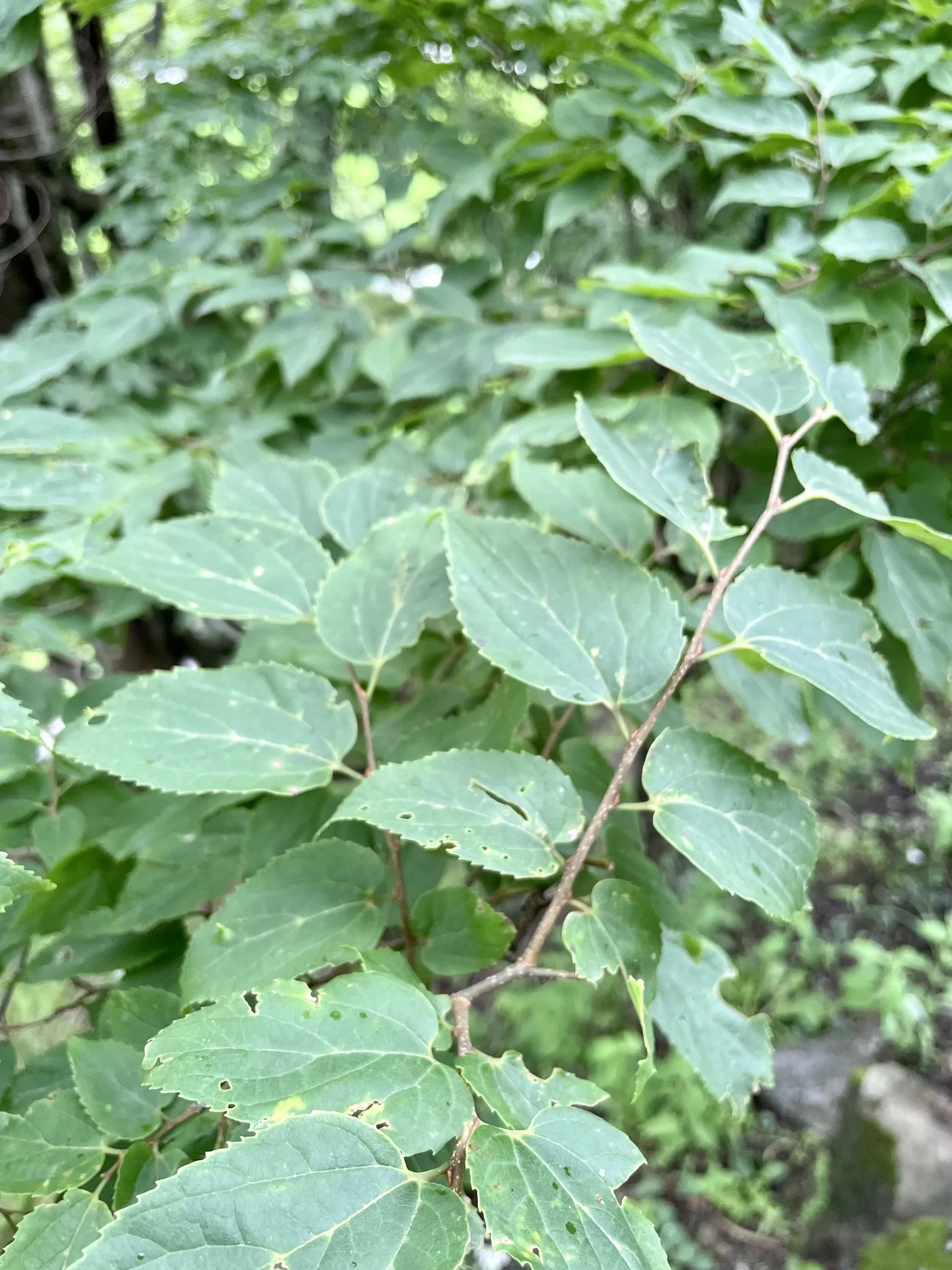
Gracing the mountain slopes and deep valleys of East Asia, Celtis jessoensis stands as a resilient deciduous canopy tree. Commonly known as the Japanese hackberry, it derives its specific epithet from an archaic reading of Hokkaido, reflecting its rugged northern range and historical significance.
This species acts as an integral component of the temperate broadleaf forests across the Japanese archipelago and the Korean peninsula. Reaching heights of up to 25 meters, Celtis jessoensis provides essential habitat and seasonal forage for diverse local wildlife.
Celtis jessoensis develops into a substantial deciduous tree, typically growing between 10 to 25 meters in height. The foliage is arranged alternately along the stems, featuring elliptic to long-elliptic leaves that measure 5 to 10 centimeters in length and 3 to 5 centimeters in width.
The leaves are characterized by a sharply serrated margin extending along the entire edge, a long-pointed apex, and a dark green upper surface. The undersides are notably glaucous with fine, downy pubescence running along the prominent leaf veins.
This species is polygamous and monoecious. Male flowers emerge with four tepals and four stamens, while female flowers develop from the leaf axils on long pedicels, featuring a distinctively two-lobed stigma. Following pollination, the tree produces spherical drupes that ripen to a dark black color.
The tree produces inconspicuous flowers in late spring, primarily blooming throughout May.
Historically, the dense and robust wood of Celtis jessoensis has been utilized in regional craftsmanship and light industry. It provides excellent raw material for producing high-quality charcoal and crafting durable wooden tools and agricultural implements.
Beyond its timber value, the tree is frequently employed in organized afforestation projects to stabilize mountain soils and restore native woodland habitats. The small, black drupes produced in the autumn are also noted to be edible, serving both human foragers and local avian populations.
The botanical epithet jessoensis honors the northernmost main island of Japan, Hokkaido, historically referred to by European botanists as Ezo or Jesso, where the tree forms an important part of the regional ecosystem.
In Korea, botanists easily distinguish it from the closely related Chinese hackberry (Celtis sinensis) by examining the leaf margins, which are serrated along their entirety rather than just the upper half, and by its fruits, which turn black upon maturity instead of orange-red.
A unique morphological variation, Celtis jessoensis var. angustifolia, is recognized for its noticeably narrower leaves and grows natively in the isolated habitats of Jeju Island.
Taxon Synonyms: Celtis aphanonthoides, Celtis hashimotoi, Celtis edulis, Celtis jessoensis f. angustibolia, Celtis choseniana, Celtis cordifolia
Celtis brasiliensis
A deciduous tree or scrambling shrub in the Cannabaceae family, native to various countries in …

Celtis gomphophylla
A tall tree species in the Cannabaceae family, widespread across sub-Saharan Africa, Madagascar, and the …

