
Brazilian hackberry
Celtis brasiliensis
A deciduous tree or scrambling shrub in the Cannabaceae family, native to various countries in …
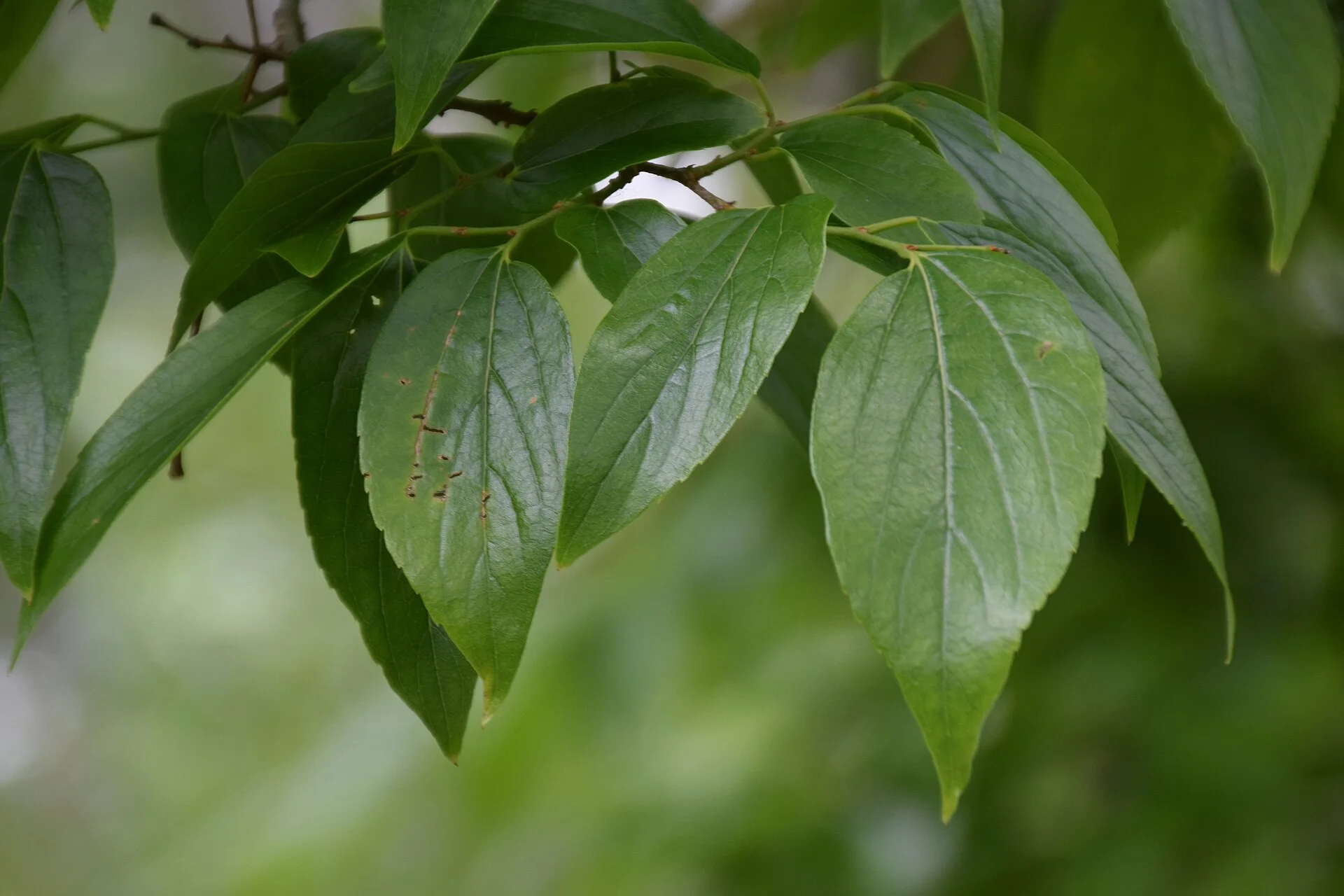
The large deciduous tree Nilgiri elm (Celtis tetrandra) shapes the landscape of mesophytic mixed forests across Asia. The species possesses an extensive natural range, growing in valleys and on slopes at elevations between 700 and 1,500 meters above sea level. The plant is widely distributed throughout the Indian Subcontinent, southern China, Southeast Asia, and the western parts of Indonesia.
The tree reaches up to 30 meters in height and forms a broad, spreading canopy. The trunk bark is grayish-white, generally smooth, and occasionally features transverse folds. Young branches are thin, yellowish-brown, and slightly pubescent.
The leaves are simple and alternate, ranging from ovate-lanceolate to rhombic in shape, with a length of 5 to 13 centimeters. The base of the leaf blade is cuneate and asymmetrical, while the margin is serrated in the upper part. The purple flowers are small: male flowers are clustered and have 4 stamens, whereas bisexual flowers are located at the upper parts of the shoots.
The fruits are spherical drupes of a yellow or orange-brown color. The diameter of each fruit is 7 to 8 millimeters. Inside, there is an edible, sweetish, mealy pulp enclosing a large ribbed stone.
In its native regions, the tree is utilized in a variety of ways. The sweet, mealy pulp of the fruit is edible, and the hard stones can be used in local crafts.
The tree also has practical economic value for local communities:
The plant does not belong to the elm family (Ulmaceae), despite its popular English common name «Nilgiri elm». Historically, the entire hackberry genus was classified under the elm family for a long time. However, based on modern molecular genetic studies, the taxon was reclassified into the Cannabaceae family.
Taxon Synonyms: Celtis hamiltonii, Celtis alpina, Celtis xizangensis, Celtis sinensis var. tetrandra, Celtis tetrandra f. pendula, Sponia tetrandra, Celtis acata, Celtis salvatiana, Celtis kunmingensis, Celtis yunnanensis, Celtis formosana, Celtis serotina, Celtis napalensis
Celtis brasiliensis
A deciduous tree or scrambling shrub in the Cannabaceae family, native to various countries in …

Celtis gomphophylla
A tall tree species in the Cannabaceae family, widespread across sub-Saharan Africa, Madagascar, and the …

