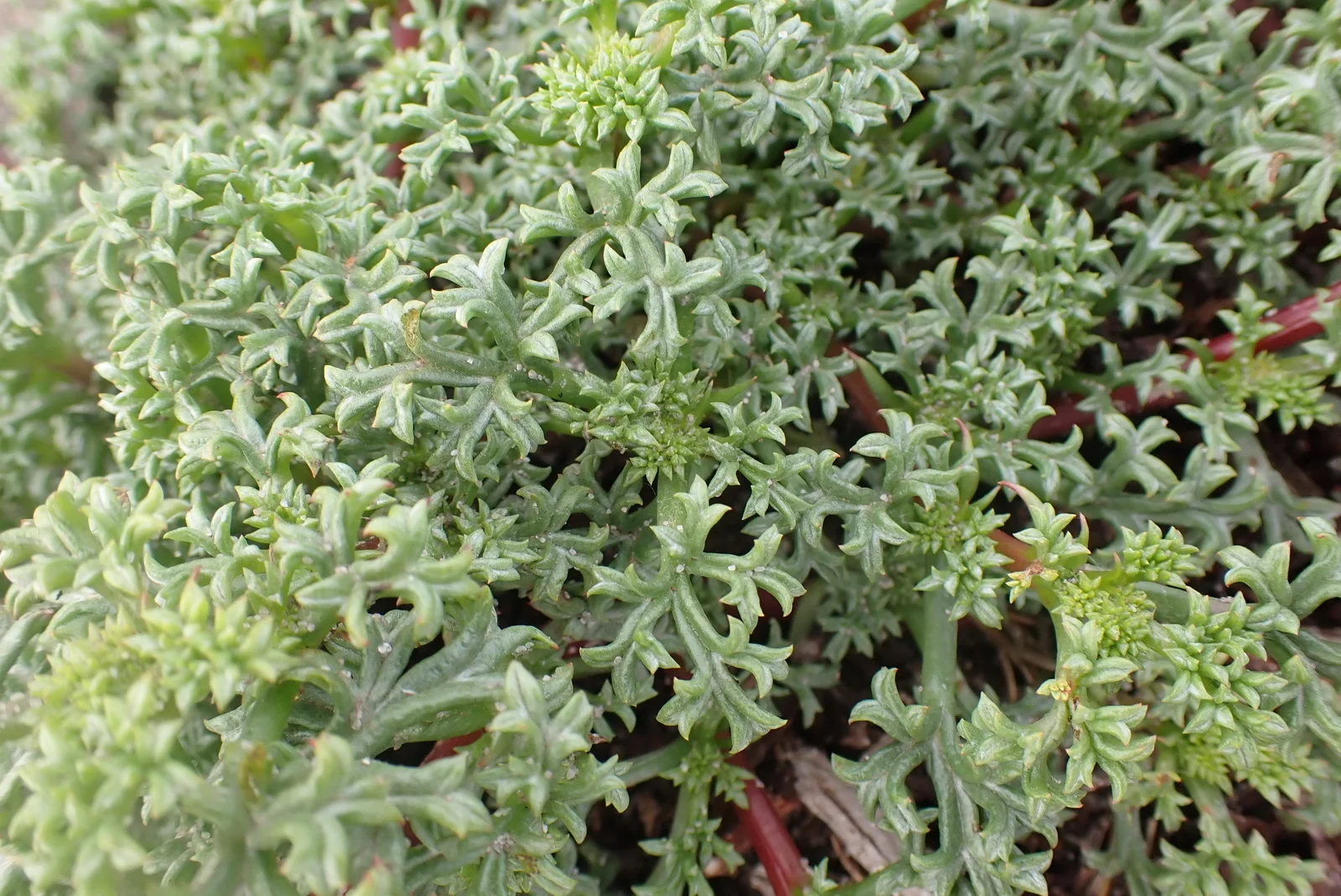
Dasispermum suffruticosum (dune celery): coastal botany and traits
Dasispermum suffruticosum, commonly called dune celery, is a tough, sprawling perennial native to the wind-swept beaches and coastal sand hills of South Africa. Its specific epithet suffruticosum means 'subshrubby', describing how the plant builds a woody, persistent base anchored deep in shifting sand while sending out fresh, succulent green shoots above.
It is the most widespread member of the Southern African genus Dasispermum in the carrot and parsley family, Apiaceae. Originally described by the Swedish botanist Peter Jonas Bergius in 1767 under the name Conium suffruticosum, it was transferred to its current accepted genus by Brian Laurence Burtt in 1988.
The plant grows as a smooth, hairless (glabrous) subshrub with prostrate to ascending stems that are finely grooved and heavily branched. Over time, the lower stems become tough and woody, acting as a tether against moving sand drifts.
Succulent foliage
Its leaves are carried on long petioles nearly equal in length to the blade and show a finely divided, bipinnatisect (twice-feathered) structure. To cope with maritime exposure, the leaf segments have specialized traits:
The oblong leaflets are thick and noticeably fleshy, storing fresh water inside their tissues to buffer against salt spray and drying winds.
When bruised, the foliage releases a sharp, celery-like aroma coming from internal oil ducts known as vittae—tiny resin canals running through the stems and leaves.
Umbels and polymorphic fruits
Flowering occurs on terminal and lateral compound umbels—flat-topped, umbrella-like flower clusters built from 9 to 16 main spokes (rays). The small flowers have five pale yellow to cream-white petals that attract coastal insects.
Each pollinated flower matures into a schizocarp—a dry fruit that splits into two single-seeded halves called mericarps—bearing prominent longitudinal ribs that often expand into corky, papery wings.
Interesting facts
Two-speed seed dispersal on shifting coastal dunes
Surviving on the narrow strip of mobile sand between the high-tide mark and coastal scrub requires a delicate balance between holding conquered ground and finding new dunes before waves wash a colony away. Dasispermum suffruticosum solves this challenge through heterocarpy—the production of fruits with markedly different wing shapes on the very same plant, and sometimes even within a single two-parted fruit.
This structural variety directly governs how each seed travels across the beach:
Mericarps equipped with broad, light, spongy wings catch the strong onshore winds and tumble rapidly across open sand, Or float effortlessly on seawater currents to colonize distant beaches.
By contrast, heavier, narrower-winged mericarps drop close to the parent subshrub and quickly become buried in the accumulating sand mound, ensuring the local population renews itself right where moisture and shelter are already proven.
Combined with thick, waxy cuticles and succulent leaf blades that dilute absorbed sea salt, this dual-mode fruit engineering turns constant coastal disturbance from a hazard into a reliable mechanism for survival.