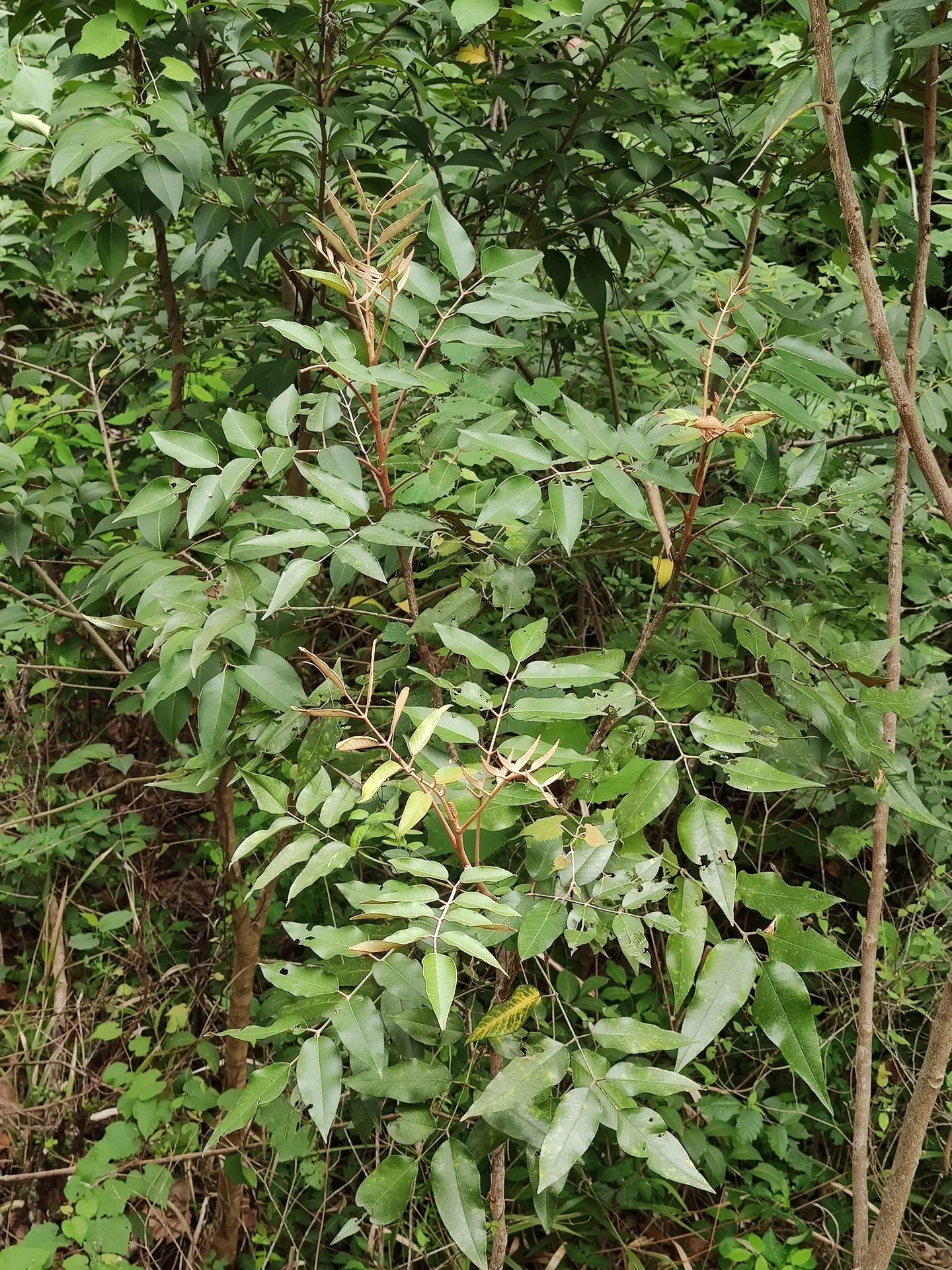
Decatropis bicolor is an evergreen shrub or small tree native to the mountain slopes, limestone canyons, and oak-pine forests of Mexico and northern Central America. Its specific epithet, bicolor, highlights the dramatic visual contrast of its pinnate leaves: deep, glossy green on the upper surface and densely felted with bright whitish or pale-rusty wool underneath.
A member of the citrus and rue family, Rutaceae, this plant was first described in 1837 by the German botanist Joseph Gerhard Zuccarini under the name Simaba bicolor. In 1886, the Munich taxonomist Ludwig Adolph Timotheus Radlkofer transferred it to the genus Decatropis (meaning "ten keels," in reference to its ridged ovary carpels), establishing its modern accepted name, Decatropis bicolor.
Growing between 2 and 8 meters tall, Decatropis bicolor features stout branches coated in velvety, star-shaped hairs (stellate trichomes) when young. Its large, odd-pinnate leaves (imparipinnate) are crowded near the branch tips and carry several pairs of lance-shaped to oblong leaflets with rolled-under margins (revolute).
When held up to the light or gently rubbed, the leaflets reveal tiny translucent dots—pellucid glands—which are microscopic spherical pockets packed with fragrant essential oils typical of the family Rutaceae.
Ten-keeled carpels and terminal panicles
Creamy-white panicles: The plant produces dense, upright, branched clusters (terminal panicles) of small, five-petaled white to cream flowers that stand out brightly against the foliage.
Ten dorsal ridges: At the center of each flower sits a five-lobed ovary (gynoecium) where each lobe bears two pronounced longitudinal ribs on its back, creating the ten distinct keels that give the genus Decatropis its name.
Follicular fruits: Following pollination, the flower matures into a cluster of up to five small, keeled, dry fruitlets (follicles) that split open at maturity to release smooth, dark seeds.
Flowering season
Typically flowers during the spring dry-to-wet transition (March to June), depending on elevation and local rainfall.
Jan
Feb
Mar
Apr
May
Jun
Jul
Aug
Sep
Oct
Name
Dec
Applications
Phytochemical research and traditional remedies
In rural Mexican communities across states such as Hidalgo, San Luis Potosí, and Veracruz, Decatropis bicolor is occasionally harvested from the wild for traditional herbal preparations. Infusions of the aromatic leaves and bark have been investigated by Mexican ethnobotanists and pharmacologists for their antimicrobial and anti-inflammatory properties.
Bioactive coumarins and alkaloids: Laboratory analyses of its leaf extracts have isolated specialized furocoumarins (such as heraclenin and imperatorin) and quinoline alkaloids, which researchers study for their ability to inhibit fungal growth and modulate cellular inflammation.
Essential oil profiling: The volatile oils distilled from its pellucid leaf glands are rich in sesquiterpenes and monoterpenes, making the species a subject of academic interest in natural product chemistry.
Interesting facts
Dual-sided leaf architecture for mountain sunshine and drought
In the seasonally dry limestone mountains of the Sierra Madre Oriental (from Coahuila and Nuevo León south to Chiapas), plants must endure intense high-altitude ultraviolet radiation alongside months of parched winds. The striking two-toned leaf of Decatropis bicolor is not merely decorative; it functions as a two-sided climate-control panel.
Reflecting heat above, trapping moisture below
The upper solar shield: The top side of each leaflet is smooth, thick-walled, and coated in a waxy cuticle that handles direct mountain sunlight while housing tightly packed palisade cells for photosynthesis.
The lower boundary layer: The underside, where the breathing pores (stomata) are located, is blanketed in a thick, tangled mat of pale stellate trichomes (star-shaped hairs) that reflect radiant heat bouncing off dry limestone rock and trap a still layer of humid air right against the leaf surface.
Chemical defense in the middle: Sandwiched between these two layers are internal pellucid oil cavities filled with bitter furocoumarins and volatile terpenoids, which deter leaf-chewing insects that would otherwise breach the protective wool and cause the leaf to desiccate.